
Embed academic English
At a glance
Explore what academic English is, recommendations for embedding, Academic English into your teaching. Explore different approaches for addressing common questions about embedding academic English in your unit.
Jump to these sections:
Embedding academic English in unit content requires considering what "communication skills" students require. The term “communication skills” is used to refer to the full spectrum of English language and academic communication abilities.
While the terms overlap to some extent and may mean different things to different people, they can generally be defined as:
Academic English
The type of language used in academic contexts, including:
- Discipline-specific terminology and ways of speaking and writing
- The vocabulary of study, assignments and assessment
- The level of formal, impersonal and objective style appropriate to the discipline.
Academic literacy
The skills needed to be successful in academic study including the ability to:
- Read and interpret academic texts
- Follow the conventions of academic writing
- Find, use and acknowledge scholarly information
- Work in accordance with the principles of academic integrity.
Communication skills
The ability to convey a message clearly in written or oral form, in a style appropriate to the audience and context.
Professional language
The type of language used in the workplace, including:
- Discipline-specific terminologies
- The degree of formality, objectivity and impersonality used in the contexts relating to the profession
- The conventions of written and oral communication in the contexts relating to the profession.
Benefits for embedding academic language
English language proficiency and communication skills are essential for all Monash students for multiple reasons. They:
- Allow students to engage with the university environment and create a healthy social network.
- Support students’ mental wellbeing; by maintaining self-confidence and a healthy view of the world around themselves.
- Facilitate the creation and maintenance of students’ sense of belonging to the university.
- Support academic success, retention, progression and intellectual growth.
- Support success and positive experience during placements, work integrated learning and internships.
- Improve successful post-graduation employment or access to further study.
Recommendations for embedding academic English
As Monash academics, our job is not to teach English language - other resources are available for students to develop this. However, it is our responsibility to provide opportunities in which students can grow and develop their communication skills.
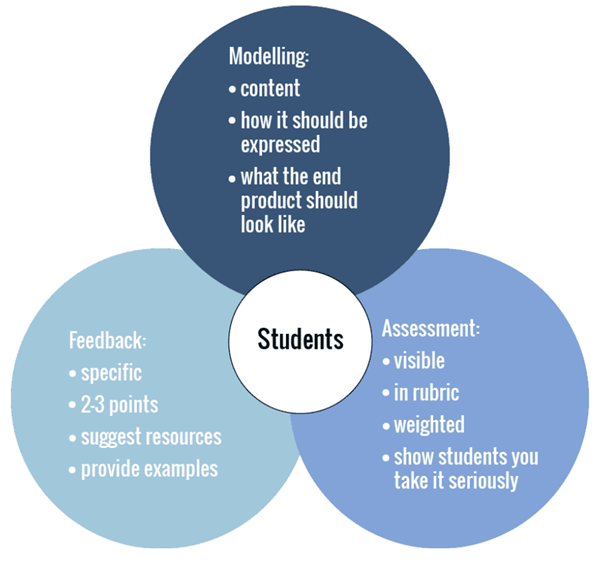
There are three essential ingredients for successfully embedding English language communication skills in units. We need to show:
- what is expected of them
- provide them with feedback on early attempts
- motivate them to succeed through visible, weighted assessment.
The diagram below sums up the essentials of successful embedding English language.
There are many simple actions you can take every day to support students’ communication skills development through your teaching. Here are some recommended techniques drawn from the field of English language teaching.