Manage classroom tension and conflict
These pages provide an overview and practical strategies for all Monash staff and educators to prevent, manage and recover from escalation of classroom tensions and conflict by adopting trauma-informed approaches. They are intended for anyone involved in teaching and learning at Monash University, including lecturers, tutors and teaching associates.
In these pages, we have linked to resources to help educators nurture safer and more inclusive environments, and to predict and handle situations of classroom tension and conflict that might emerge in response to sensitive issues. These might include:
- Geopolitical tensions
- Sexual harm
- Racism
- Trauma backgrounds
A note on "safe spaces": Although safety is one of the principles of trauma-informed practice, we acknowledge that as educators and peers we cannot always guarantee a “safe space”, as we cannot guarantee that individuals will not be offended or hurt by what another says. However, we can be thoughtful and respectful in our interactions, and aim to uphold the principles of trauma-informed practice presented below.
The strategies in these pages are underpinned by trauma-informed pedagogies. Trauma-informed pedagogies are educational approaches that help people to understand and respond to the various ways in which trauma can impact students' behaviour and learning. No prior knowledge of trauma-informed approaches is required to make use of these pages.
Watch the following videos for an introductory overview to trauma-informed practice and how these can be applied in education settings.
We hope that these pages will create a platform for conversations around the challenges and sensitivities of trauma-informed approaches.
Please be aware that this guidance includes reference to trauma and examples of traumatic incidents, circumstances and events however, these sources of trauma are not discussed in detail.
Trauma-informed approaches
View
Trauma-informed practice acknowledges that traumatic experiences are highly prevalent. It is designed to support organisations to reduce risk of trauma and retraumatisation of people exposed to trauma. While trauma-informed approaches apply to a wide range of activities, the focus of these pages is on trauma-informed pedagogies in tertiary classrooms, and supporting tertiary educators to negotiate tensions in their units.
Prevalence: Davies et al. (2021) surveyed > 800 first year undergraduate students in an ethnically diverse part of England with a very high poverty rate. Four in five students reported at least one adverse event or circumstance before age 18, half reported three or more, and 20% reported at least six. Research from the US has similarly found that traumatic experiences are pervasive among college populations. According to one US study, 16.3% of 2,637 undergraduates surveyed reported multiple experiences of maltreatment (Berzenski & Yates, 2011). In Australia, it is estimated that between 50% and 67% of young people have experienced at least one traumatic event by the age of 16 (Bendall et al.. 2018).
What is “trauma”?
A commonly adopted definition states that trauma arises from “an event, series of events, or a set of circumstances an individual experiences as physically or emotionally harmful or threatening, which may have lasting adverse effects on the individual’s functioning and mental, physical, social, emotional, or spiritual well-being” (SAMHSA, 2014, p. 7). Using this definition, the term trauma is used to describe a reaction to an event that may be potentially traumatic.
It is important to recognise that trauma can be deeply subjective, and to respect differences in how an event is experienced by those impacted, including the perceived level of threat posed by the event. As the diagram below shows, traumatic events may be experienced by an individual, a generation, or an entire community or culture.
Levels of trauma experience
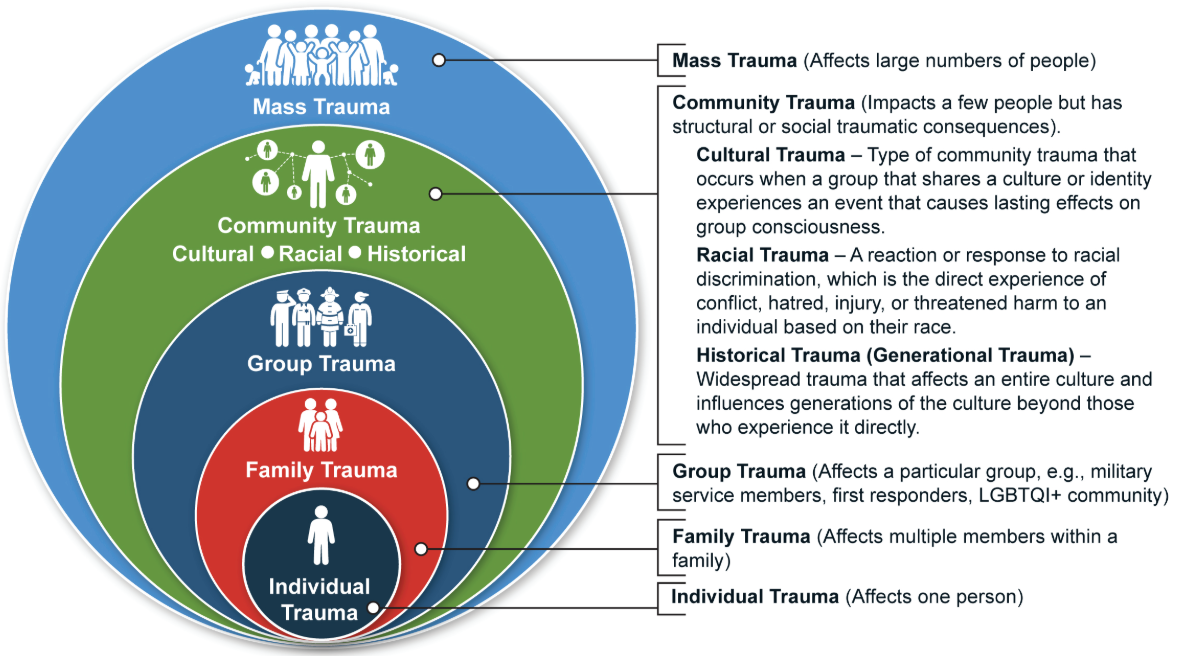
This public domain mage is from: Practical Guide for Implementing a Trauma-Informed Approach (samhsa.gov)
Examples of trauma include, but are not limited to:
- Childhood neglect
- Racial discrimination
- Poverty
- Homelessness or housing instability
- Experiencing or witnessing emotional, physical or sexual abuse
- Natural disaster
- Bereavement
- War
Past or current experiences of trauma may be associated with classroom conflict. Tertiary students (or educators) who have experienced previous trauma or are currently experiencing trauma may be more likely to experience a fear response upon encountering stressful stimuli or "triggers", even when these stimuli seem benign to others. For example, a student may be triggered by raised voices or increased tension in tertiary classrooms. Such a fear response may lead to escalation and interpersonal conflict and can negatively affect the learning experience of students.
Trauma-informed practice
In an education context, trauma-informed practice involves taking steps to reduce trauma and retraumatisation in learning and teaching, by creating safe, inclusive learning environments.
Trauma-informed practice refers to “a program, organisation, or system that … realises the widespread impact of trauma and understands potential paths for recovery; recognises the signs and symptoms of trauma in clients, families, staff, and others involved with the system; responds by fully integrating knowledge about trauma into policies, procedures, and practices, and seeks to actively resist re-traumatisation” of people exposed to trauma (SAMHSA, 2014, p. 9).
Retraumatisation (sometimes referred to as “triggering”) is re-living stress reactions experienced as a result of a current or previous traumatic experience, when faced with reminders of that event or a new traumatic event.
There are six key principles of trauma-informed practice (illustration adapted from SAMHSA, 2014). 
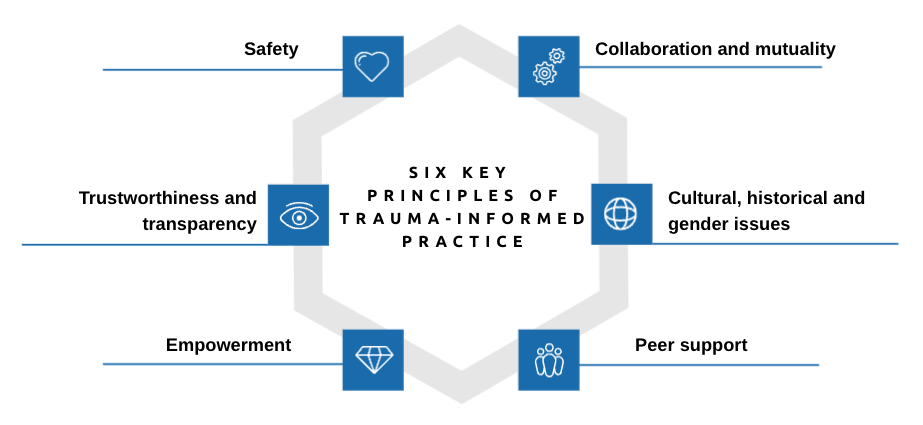
Adopting trauma-informed practice means having awareness of the impact of trauma on students and adopting approaches to maintain students' sense of safety, prevent re-traumatisation and promote recovery.
Trauma-informed practice in education
Trauma-informed practice provides educators with a framework to help them understand and respond to the impacts of trauma on students’ learning, emotions and behaviour. The aim of trauma-informed practice is to create a sense of safety in learning environments, thereby preventing retraumatisation and adverse responses to triggers in the classroom, including tension and conflict in the classroom.
Trauma-informed practice can also help educators to effectively manage secondary traumatic stress. Secondary traumatic stress refers to negative emotions and behaviours people may experience from knowing about another person’s traumatic experience, and stress resulting from helping or wanting to help that person.
Many other traumatic events may feature in classroom discussions, such as discussion of abuse, harassment, maltreatment, racism and global conflict. Use of trauma-informed practice can help educators to create safe, supportive learning environments that invite critical and respectful discussion and debate and promote intellectual challenge. They also create learning environments that recognise and are respectful of varied opinions, cultural traditions, religious symbols, dress, practices etc. These approaches can be deployed in circumstances where classroom tension and conflict arise, to help educators to effectively de-escalate classroom conflict and prevent re-traumatisation of students.
Implementing trauma-informed practices is essential, especially during periods of social tension and emotional distress. These approaches create a supportive environment that acknowledges the impact of trauma on learning and behaviour. Some practices that may be considered:
- Prioritise the learning environment as a space for enabling the demonstration of tolerance of difference, respectful dialogue and upholding academic freedom where all students enjoy the freedom to learn.
- Convey ideas in ways that would ensure that students and staff who hold and express different views would feel safe and included. Monash policy guides us to ensure that no staff or student should be subject to ‘threatening, or intimidating behaviour by another person or persons on account of anything they have said or proposed to say in exercising their freedom of speech’.
- Encourage diverse perspectives while maintaining an environment in which learners do not make assumptions. Facilitate constructive conversations by encouraging students to ask for clarification when they may not understand a point someone has made, or to not assume they know what others are thinking. Foster empathy and active listening skills among students.
- Provide sensitive content warnings when discussing topics within the classroom that might produce strong emotions.
- Offer opportunities for private discussions for students who may be personally affected by certain topics.
- Create opportunities for reflection and processing after discussing challenging topics.
- If any comments within classrooms cross the line and harm the safety and wellbeing of staff and students, it is important that the complaints process at Monash be utilised for reporting purposes. Students or staff can report concerning, threatening and inappropriate behaviour to the University’s Safer Community Unit, and Security is available on 03 9902 7777 for assistance on campus, or 03 9905 3333 for emergencies
Adopting trauma-informed practice in teaching and learning doesn’t require omitting or avoiding discussion of contentious or potentially-distressing issues. By implementing these strategies, educators can navigate sensitive subjects effectively, promoting intellectual growth while maintaining a supportive classroom environment.
Trauma-informed practice allows for the exploration of complex issues while anticipating and minimising the potential harmful impacts on all students' emotional well-being.
Prevent, manage and recover from conflict and tension escalation
View
This section focuses on how tertiary educators can use the principles of trauma-informed practice to prevent, manage and recover from rising tensions and conflict in tertiary classrooms.
Educators can use principles of trauma-informed practice to prevent escalation in tertiary classrooms. This includes setting clear expectations of acceptable behaviour and notifying students ahead of time about challenging classroom content. Educators should review unit content and use student feedback to predict potential areas of tension and conflict in their unit.
Practice guidelines
-
- Educate yourself about the principles of trauma-informed practice
- Provide students with an outline of the learning objectives and topics to be covered in the unit
- Acknowledge potentially distressing content, associated risk of trauma or retraumatisation, and content that may tigger student tension or conflict
- Develop lecture slides to educate students on appropriate classroom conduct and ways to interact with other students
- Provide advice to students on how to manage classroom conflict and tension should it arise
- Model for students appropriate ways to manage classroom tension and conflict. This can be done by sharing examples with students on appropriate responses to classroom conflict and tension
- Provide students with contact details of support services in the event they are in need of additional advice, services or support.
- Be aware of Monash policies and how to apply these if the need arises
Supporting your students section has useful links to Monash policies and support services.
-
- Realise the prevalence and potential impact of trauma on students
- Recognise the signs of trauma among students, such as withdrawal, trouble concentrating, low engagement or avoidance of certain topics
- Respond using trauma-informed policies, procedures and practices, such as those outlined in this resource
- Resist re-traumatisation of students by using the trauma-informed approaches outlined in this resource
Assumptions of a Trauma-Informed Approach
Realisation - Understanding how trauma can affect individuals, families, groups, organisations, and communities.
- Recognising that trauma can impact mental health and substance use disorders and often obstructs achievement of desired outcomes.
- Being aware that trauma is integral to all human services sectors.
Recognition Recognising signs of trauma through:
- Screening and assessment
- Supervision practices
- Workforce development
- Employee assistance
Response - Applying the principles of a trauma-informed approach to all areas of functioning of an organisation, such as policies, staffing, and organisational culture.
- Supporting a psychologically and physically safer environment.
- Ensuring appropriate workforce training, leadership buy-in, clear and informed organisation mission statements, and trauma-informed manuals.
Resisting re-traumatisation - Knowing how policies, practices, and interventions can interfere with the well-being of staff and clients as a result of inadvertently triggering traumatic experiences.
- Acknowledging trauma and its context in all operations to avoid reinforcing or repeating a traumatic experience.
From: Practical Guide for Implementing a Trauma-Informed Approach (samhsa.gov)
These principles of trauma-informed practice can be applied when anticipating or managing classroom conflict or escalation. For example, educators can anticipate classroom conflict by realising aspects of their units which may contribute to student distress and escalation. Educators can instruct students to recognise physical signs ( e.g. increasing heart rate, feeling flushed) which may indicate they are experiencing distress or agitation. Educators can help students plan how they might respond to situations of classroom conflict, rising tensions, distress and agitation. Taking these measures may resist further escalation and associated retraumatisation.
-
- Safety: Establish students' sense of safety through developing strong relationships and rapport with students, creating predictable schedules and routines for students, and regulating your own emotional responses. Provide accessible course and unit information to students in advance of delivery, so that students know what to expect and can determine their own level of comfort with sensitive material. Evaluate the sensitivity of course and unit material, anticipate what students may find distressing, and provide students with advice and links to support services should they experience distress, trauma or retraumatisation.
- Trustworthiness and transparency: Establish trustworthiness and transparency with students through establishing clear expectations and boundaries regarding acceptable classroom behaviour and student interactions, and communicate to students the process for managing classroom conflict and tension should it arise .
- Peer Support: Encourage peers to support each other and apply trauma-informed approaches when interacting with others, such as recognising topics of conversation that may be traumatising for others and ways to regulate their own emotions during periods of classroom tension or conflict.
- Collaboration and Mutuality: Collaborate with students on co-creation of ground rules and group norms for respectful engagement with course and unit content, and respectful discussion and debate with other students and educators.
- Empowerment and Choice: Empower students to recognise their own distress and encourage them to engage in self-care, such as leaving the classroom, or give students choices, such as accessing learning in an alternative format, if they feel unable to engage with a particular subject, at a particular time.
- Cultural, Historical or Gender Issues:Recognise that topics related to gender, sexuality, race, culture, disability, disadvantage and colonialism may lead to trauma or retraumatisation of students. Ensure that students are made aware when these topics will be discussed in class and encourage students to use their own self-care strategies and student support services when required.
-
- Learn students' pronouns, preferred name/name in use and pronunciation.
- Plan timetables to take account of religious and cultural events (e.g. allow flexibility to enable observation of prayer time).
- Educate students about potentially distressing course and unit content and ways they can respond to support themselves and peers.
- Encourage students to reflect on and recognise their own sensitivities or vulnerabilities, and to identify strategies to manage these.
- Ensure that course and unit material and content are representative of different families, groups, communities and cultural experiences, including gender, sexuality, race, culture, disability, disadvantage and colonialism. This includes taking an intersectional view and understanding how different aspects of a student’s identity can increase their experience of and exposure to trauma, discrimination and marginalisation.
- Provide opportunities for students to share feedback regarding the appropriateness and representativeness of unit content and materials. Student feedback can be used to identify any potentially triggering or distressing unit content and help educators to plan their response to support students and mitigate the risk of classroom tension and conflict.
- Ensure that students have effective and accessible channels to disclose and report exclusionary or discriminatory behaviours or practices in the classroom, and help students learn about channels for disclosing and reporting.
- Utilise Monash guidance and training for inclusive practice in your teaching and learning. Ensure your approaches for creating inclusive and safe learning environments are regularly reviewed and approaches are continually updated.
-
Planning and preparing yourself for a session involves thinking about what you might do in the event of conflict in advance of a conflict arising.
Reflect on your own patterns of response and indicators or warning signs of conflict. In doing this, you will hopefully have identified some useful planned responses to enact. These should include ways to recognise your emotions and not allowing these alone to determine your behaviour. Consider for example how you can control your breathing to remain calm; what would enable you to proceed mindfully (i.e. tuned into the situation) and manage it calmly; and how will you demonstrate calm behaviours.
The Common practices for engaging difficult conversations in the classroom handbook offers specific examples of methods and techniques to create a classroom environment where students can safely discuss important issues.
Trauma-informed practice can prevent or reduce the occurrence of classroom conflict and tension. Trauma-informed practice can also assist educators to manage student conflict and distress once an escalation has occurred.
Practice guidelines
-
- Plan responses for potential trauma, retraumatisation and/or classroom conflict (refer to previous section on Preventing Escalation).
- Reflect on your own patterns of response and physical signs that indicate you are experiencing distress, trauma or agitation.
- Recognise your own emotional responses and do not allow these alone to determine how you respond to classroom conflict and tension.
- Be aware of strategies you can use to regulate your own emotions when conflict and tension occurs in the classroom.
- Consider how you can model calm behaviours to students in moments of classroom conflict. The behaviours that you model will create a sense of safety for students and help students to regulate their own emotions and behaviours.
-
- Encourage students to identify potentially triggering or distressing areas of the curriculum (refer to previous section on Preventing Escalation).
- Teach students strategies to respond to potentially triggering or distressing course or unit content (e.g., take a break, leave the classroom, seek support).
- Role model or provide examples to students of your own approaches to practise self-care and self-compassion.
- Regularly provide students with contact details of support services and encourage them to reach out for support when required
Supporting your students section has useful links to Monash policies and support services.
-
- Recognise signs of student distress, trauma or agitation (e.g., raised voices, student withdrawal, student absences)
- Be vigilant to how students respond to unit content and materials, and continually check in with students as you present challenging classroom material and facilitate student discussion
- Enact methods for managing classroom conflict and tension established at the start of classes
- Starting to respond:
- Recognise your own emotional responses
- Pause before responding and observe the situation
- Take some deep breaths
- Use positive self-talk (‘I can handle this’, ‘I will not shout’)
- Demonstrate calm behaviours
- Taking action:
- Use non-threatening body language, neutral facial expressions, make slow movements, and avoid sustained direct eye contact
- Respect personal space and maintain a reasonable distance from others
- Be predictable by referring students to the expectations and boundaries established at the start of classes (refer to previous section on Preventing Escalation)
- Try to avoid power struggles. Challenging or exercising authority over individuals may further escalate the situation
- Consider whether the issue can be managed in a private space, without an audience (e.g. after class)
- Communication:
- Acknowledge responses emerging from the affected individuals, while also calmly communicating your own needs and expectations
- Speak quietly, calmly and assertively
- Acknowledge the feelings that students are displaying. This doesn’t mean that you agree with the student’s perspective or encourage their reactions, but instead you empathise with how they are feeling
- Try to understand the students perspective by asking open questions and engage in active listening by restating what students are telling you
- Try to focus on collaboratively finding a solution to the immediate issue. Statements such as “What do you think might be the next best step?” can be used
- Offer choices and set limits to these such as providing two or three alternative courses of action the student can take
- Consider carefully what are the current essential “non-negotiables” and what can be addressed at a later time when the student is calmer
- Allow the student time to process information. If they are anxious or distressed, this may take a little longer
-
- Conflict can be traumatising or re-traumatising for people who have past experiences of conflict, violence or trauma
- Conflict can also be traumatising or re-traumatising for educators who have past experiences of conflict, violence or trauma
- Encourage students to enact self-care and engage in support services, such as:
- University Counselling Services (including: in-person appointments, telehealth, as well as 24/7 telephone counselling, and specialist sexual harm and family violence counselling from the South Eastern Centre Against Sexual Assault).
- Safer Community Unit (for disclosing and reporting concerning, threatening and inappropriate behaviour. Staff are trained to listen impartially to student and staff concerns, discuss ways to keep individuals safe, help students and staff find the support they need, and provide staff and students with advice on reporting an incident)
- Enact your own self-care or seek services for yourself to manage your own thoughts, feelings and/or distress from classroom conflict
Supporting your students section has useful links to Monash policies and support services.
-
- Clarify when disclosures made by students can be kept confidential and when they cannot by referring to the University's Safeguarding Policy (section 4). Staff who have received a disclosure from a student in relation to any harmful behaviour are encouraged to contact the Safer Community Unit to debrief and seek advice.
A central pillar of trauma-informed practice is establishing safe and trusting relationships as a way to overcome distressing and traumatising events. Establishing strong relationships with students at the start of semester can aid student recovery after classroom conflict has occurred.
Practice guidelines
-
Educators can use the principles of empathy, congruence and 'unconditional positive regard' (Rogers, 1959 *) to help students overcome classroom tension and conflict:
- Be accessible to learners to address questions, concerns or to discuss their responses to unit content or classroom conflict and tension.
- Empathise with students and their experience of distress, traumatisation or re-traumatisation from classroom conflict and tension.
- Be genuine, open and non-judgemental during your interactions with students.
- Show unconditional positive regard by not holding students’ actions against them. Be there to support students and direct them to appropriate university support services.
Supporting your students section has useful links to Monash policies and support services.
-
Self-care is important for educators and students when managing distress or potentially traumatising classroom content.
It is important when recovering from classroom conflict and tension, that students and educators engage in self-care. Self-care are intentional, enjoyable actions, activities or interactions people can engage in to ease stress and distress. Examples include exercising, cooking, reading and spending time with friends or family.
-
Consider the need to follow up with individual students after the incident to explore any outstanding questions, offer support and confirm their wellbeing. This may be in person during future classroom interactions or via correspondence outside of class.
Encourage students to seek support from Monash University services, including counselling services. This includes students experiencing distress from exposure to classroom conflict and tension, as well as students who perpetrated the escalation during class.
Supporting your students section has useful links to Monash policies and support services.
-
Engage in self-reflection of what occurred and could have been done differently. Recognise how the incident has affected you and seek support from your supervisor, head of school, head of education portfolio or similar in your faculty.
Later on, consider the need to review any learning materials in light of the incident. Do these need to be managed differently in the future? Advisable actions may include those outlined elsewhere in this resource, including use of ground rules, sharing unit materials in advance, and use of content overviews or content warnings.
Acknowledgements: All video and text-based content prepared by trauma-informed educators and researchers, Dr Emily Berger at Monash University and Dr Helen Nolan from the University of Warwick. Additional input has been provided by Fiona Marshall, Director, Equity Diversity and Inclusion. The project is supported by the Monash-Warwick Alliance. We also acknowledge inspiration from the "Embedding Trauma-informed Pedagogies in an Inclusive Learning Community” project at Warwick University, funded by the Warwick International Higher Education Academy (WIHEA).
-
The Education Performance Standards identify the expectations of education practice at Monash – See the Education Performance Standards for more details.
Impact on student learning
Impact on educational knowledge
Impact on educational environment
Effective teaching and learning
Responsive program design
Student- centred orientation
Professional learning engagement
Pedagogical content knowledge
Education research performance
Education innovation
Education leadership
✓
✓
✓
You could address these Practice Elements by providing evidence of how you:
- Integrate trauma-informed pedagogies into your classroom management strategies, ensuring a safe and inclusive learning environment amidst sensitive issues like geopolitical tensions, sexual harm, racism, and trauma backgrounds.
- Predict and manage classroom tensions related to sensitive issues by adopting trauma-informed approaches that promote effective teaching and learning amidst potential triggers.
- Utilise trauma-informed approaches to prevent, manage, and recover from conflicts, thereby fostering a conducive learning environment.
- Foster professional learning engagement among educators by sharing resources and strategies for trauma-informed practice in tertiary education settings.
- Align responsive program design with trauma-informed principles to adapt curriculum and classroom interactions, supporting students with diverse trauma experiences effectively.
-
You can use the tabs on the left-hand side menu to navigate between the sections or click on the links below:
- The Supporting your students section provides you with important links to Monash policies and guides and counselling services available.
- The Related resources section provides you with additional resources
-
- Berzenski SR, Yates TM. Classes and Consequences of Multiple Maltreatment: A Person-Centered Analysis. Child Maltreatment. 2011;16(4):250-61.
- Davies E, Read J, Shevlin M. The impact of adverse childhood experiences and recent life events on anxiety and quality of life in university students. High Educ (Dordr). 2022;84(1):211-24.
- Rogers, C.R. (1959). A theory of therapy, personality, and interpersonal relationships as developed in the client-centered framework. Reprinted in H. Kirschenbaum and V. Henderson (Eds.) The Carl Rogers Reader (1989). Boston: Houghton Mifflin.
- Substance Abuse and Mental Health Services Administration (SAMHSA; 2014). SAMHSA’s Concept of Trauma and Guidance for a Trauma-Informed Approach (No. 14-4884). https://ncsacw.acf.hhs.gov/userfiles/files/SAMHSA_Trauma.pdf