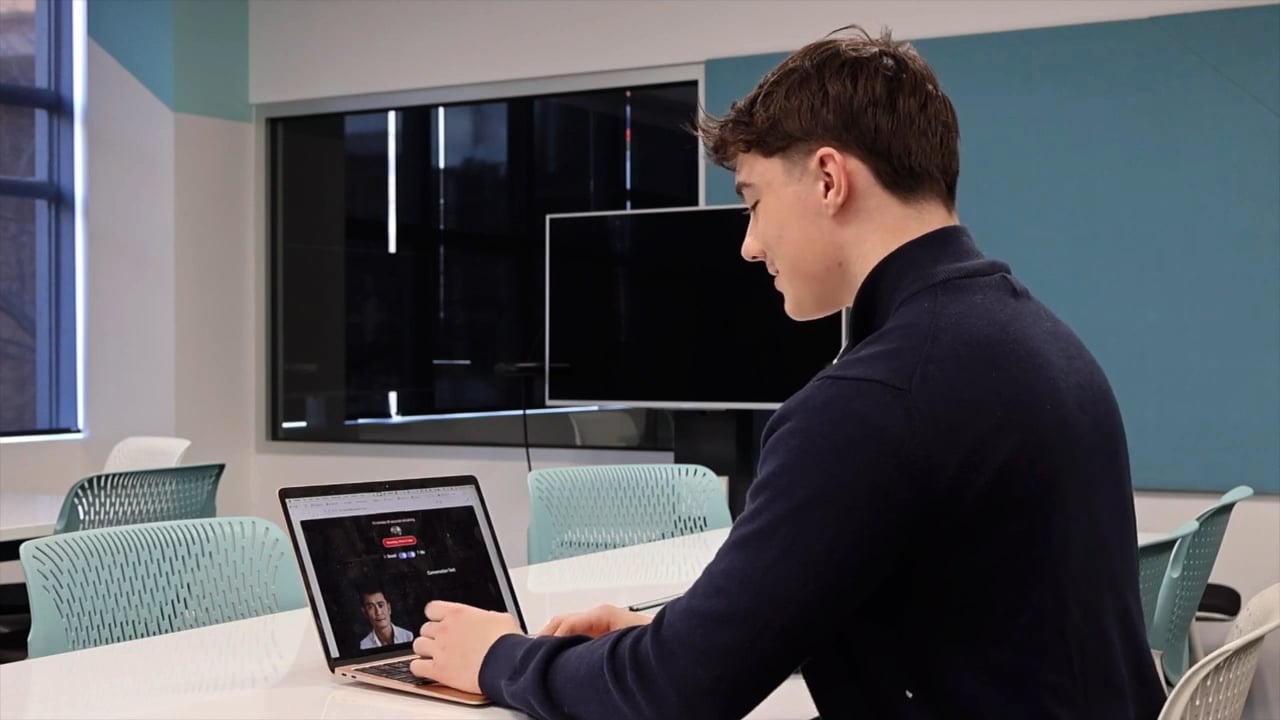
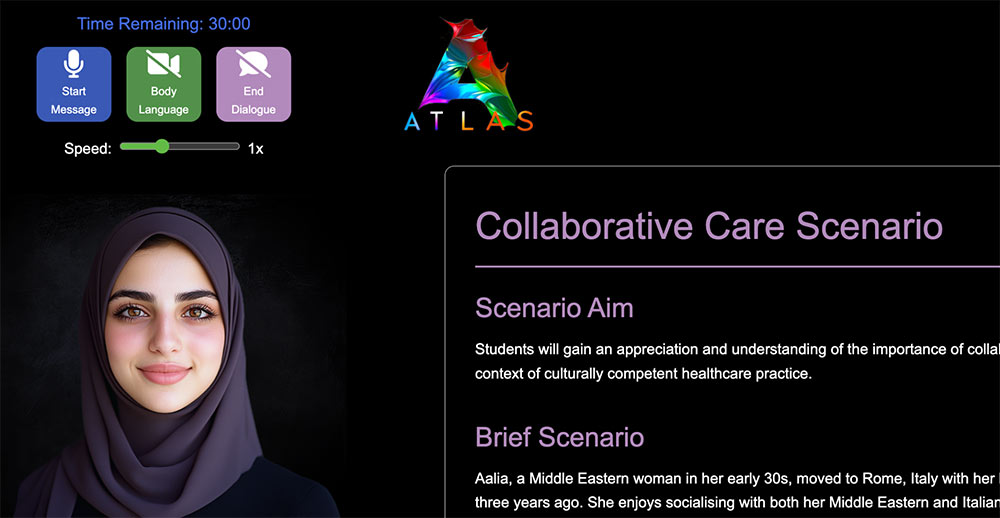
With funding from the MEA (Monash Education Academy), we developed a couple of different models in the ATLAS platform, the most frequently used model is one where the student interacts with a simulated persona.
The student can input text which goes through our algorithm and provides structured parameters for response, which is then fed through a large language model API ChatGPT in a very constrained way to give a response that's appropriate to that professional situation.
For example, a pharmacy student may take on the role of a professional pharmacist interacting with a simulated patient.
 | The student pharmacist conducts a medication history interview, asking relevant questions, documenting current medications, and identifying adherence concerns. |
 | The patient background including medical history and contextual details is stored in a secure database.
When the student interacts with the simulated patient, their voice is recorded and transmitted as text to the large language model. The persona then responds in the voice of the persona transmitted as audio, read back using text-to-speech with a very lifelike voice. |
 | During the interaction, the student spoken questions are transcribed into text and processed by a large language model. The simulated patient responds in character, with audio generated via lifelike text to speech technology. |
 | The patient visual representation dynamically reflects emotional states such as frustration or appreciation depending on the pharmacist actions and communication style. Meanwhile, the student body language is captured via webcam allowing their facial expressions and nonverbal cues to be recorded and reviewed. |
 | At the conclusion of the interaction, the student receives detailed educator led feedback tailored to specific evaluation criteria. This includes reflections on their body language, the appropriateness of their verbal communication, and their professionalism within the simulated context. |
Students are given the opportunity to iteratively practise these professional scenarios, receive feedback, and reflect on their performance supporting continuous improvement and readiness for real world clinical practice.