Embedding iterative drafts into major assessments with peer review
About this example
Introduction to Bioinformatics (BMS2062) unites biology, biochemistry and the biomedical sciences with computing, bioinformatics and networking. Peer review activities were used throughout the semester to encourage students to take responsibility for their own learning and learn about the time management skills required to complete a major project.
Faculty of Medicine, Nursing & Health Sciences
-
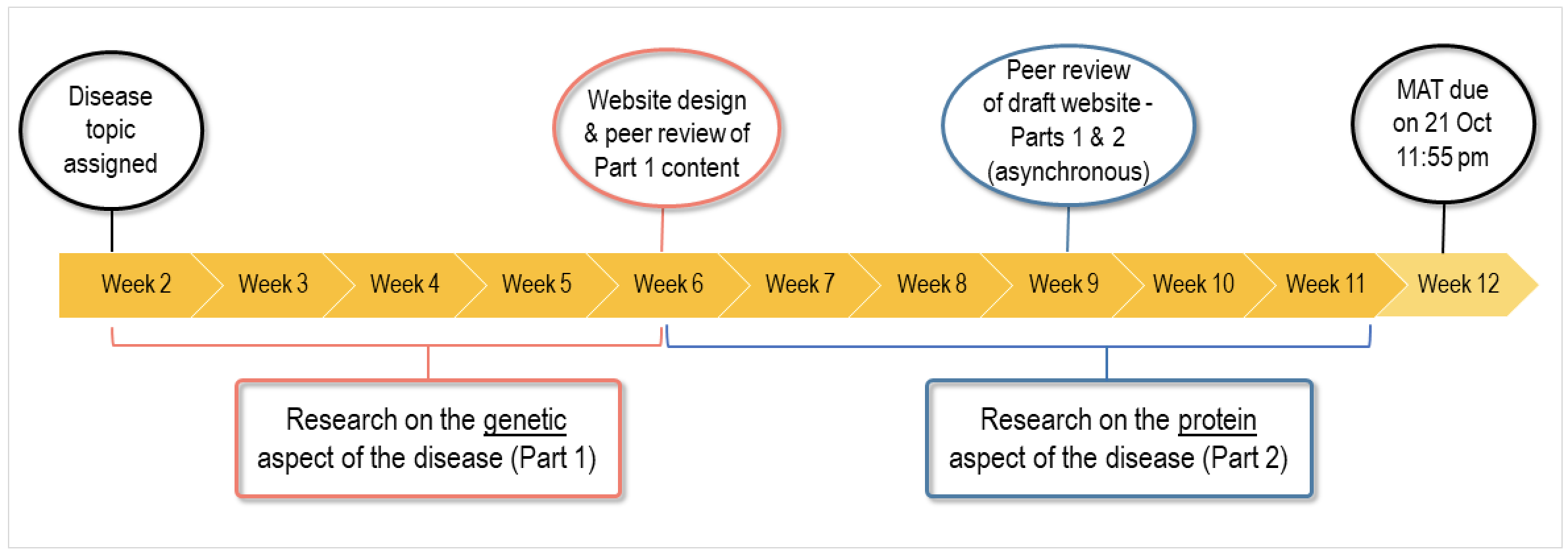
We have a major assessment that runs over the 12 weeks of the unit. It requires students to use a variety of computational software to analyse gene and protein sequences and then apply the knowledge to solve a case study about a given genetic disease. Students are asked to present their findings in the form of a website for final submission in week 12. During the weekly applied sessions, we provide opportunities for students to work on their project or ask TAs questions if necessary.
However, the challenge is that quite often students start working on their project only one or two weeks before the due date and end up running out of time to put together a well thought-through website for final submission. Or a lot of students didn't get around to completing a rough draft before the pre-submission Q&A session, which aims to give students feedback on their final drafts, and so students turned up without a proper draft and hence weren’t able to receive or fully benefit from the feedback.
Both time management and the ability to critically evaluate a piece of work, whether one’s own or others’, are important research and real life skills. Therefore, to provide opportunities for students to develop these skills, I introduced a peer review component in this major assessment.
-
This year, we designed the assessment to incorporate two student check-in activities. The first one is an early draft review in week 6 for the students to receive some early peer reviews and have a taste of how much work is required to put together a rough draft. This was followed by a second peer review, involving review of an advanced draft, three weeks later in week 9.
The peer review activities were weighted at just 2%. But because the weighting is really low, in principle the activities are formative. It was however important to ensure that the feedback criteria and rubric were the same for both check-ins and the final submission.
It was the very first time we have run peer review using the EdTech tool FeedbackFruits in the unit. We therefore ran the first activity in a face-to-face class of 120 students to make sure that we could help them troubleshoot the activity in class. This proved to be very effective and helpful for students, minimising the chance of students encountering technical problems outside of class or having to ask for help via email.
For the first peer review activity in week 6, students were asked to submit a draft of their website to FeedbackFruits by the end of the first hour of class, perform the aforementioned check and then review each other's work and also their own work, as we have included both the peer-review and self-review steps in the peer review activity using FeedbackFruits. We set up the activity so that students were also required to write a compulsory number of comments, at least one to two comments, for each criterion in the rubric. This step was also done in FeedbackFruits.
The second peer review activity in week 9 was similar but asynchronous, as our class in week 9 fell on a public holiday. The use of FeedbackFruits allowed students to do the activity easily outside class and in their own time. By this stage, students were familiar with how to use this tool to perform the peer review process after having run the software previously in week 6. Indeed, 99% of the students were able to complete the second peer review activity asynchronously and smoothly.
-
This year was the first time we have run peer review activity at this scale and it went without a glitch, so that was great! I found the software FeedbackFruits very user-friendly. And although the peer review activity was a new experience for most of the students, they found it intuitive. And when the students were doing it in class, some of them told their TAs that they really liked it.
To gather more feedback on how the students viewed this exercise, we also ran a student survey after the peer review activities. We got around 70 responses; most of them were positive.
Students saw the peer review activity as a positive experience because they could see other students' work and could also think about how to evaluate, revise and improve their own work accordingly.
Interestingly, we had mixed feedback from students about the self review component. Some liked it because they had never done it before and it was the first time that they had to critically look at their own work. While others responded that they didn't know anything about self review and didn't understand the reasoning behind it. Nevertheless, based on the student comments and reactions in class, students found it overall very rewarding and worthwhile.
Another notable observation was that most of the students' peer review was of high quality. After students had completed their feedback, we went into FeedbackFruits to look at what sort of comments students gave. We were impressed by the quality of their feedback because most of them were constructive and showed evidence of critical thinking.
-
Student feedback 1
"Reviewing others work was really helpful as I could see what others did and use that to improve on my own work."
-
Student feedback 2
"I found everything useful and positive. The comments were kind and useful and it helped me improve."
-
Student feedback 3
"It was really useful - would recommend it be used in future years for this assignment because it really forced me to stay on track!"
-
Try it out
This exemplar requires a medium level of effort to implement.
Recommended resources and training:
-
- Rather than getting students to do more assessments, encourage students to do one assessment thoroughly and to engage more deeply, while paying attention to the process.
- The multi-step peer review process provides a good opportunity for students to develop their critical thinking, evaluation and even time management skills, which I feel is sometimes lacking in undergraduate units.
-
Use an existing template I worked closely with my faculty educational designer to set up the peer review activities. She had previously set up another FeedbackFruits-based activity in another unit, so she was basically able to clone it and send me a copy for further modification. I used that existing FeedbackFruits activity as a backbone and was then able to edit it. For example, it was very easy to edit the text describing the purpose of the activity and the learning outcomes, the weightings for each step and the rubric. The built-in rubric section in FeedbackFruits was also editable, allowing me to easily tailor it to our specific assessment. The fact that the software is user-friendly made the innovation of this new peer-review-based assessment possible, because at first I was quite intimidated by the idea of having to learn a new app, which would have prevented or delayed its implementation.
Set up Moodle groups and groupings We have around 600 students in the unit so we can't put them all into one class. We had four different classes, each session had about 120 students, so we set up four different FeedbackFruit activities for each session during the week. I was lucky to have a colleague who was very experienced with Moodle to help me set up the Moodle groups. Once Moodle groups are set up, it's pretty quick and intuitive to update and sync the group information in FeedbackFruits, and then set up the final FeedbackFruits peer review activities for the individual sessions.
Provide clear instructions and support for students As undergraduates, students may have never been asked to give constructive feedback to each other. We therefore provided clear and detailed instructions for the activity, including a background and objectives of the activity, a summary of what peer review and self review involve, and a brief guide to providing quality constructive feedback. To consolidate that, I also verbally went over these instructions in class, and then gave students the chance to ask questions if they were still unclear about the learning objectives of the activity or what constructive feedback means.
Assign marks to the peer review activity The final website is worth 16% and each of the peer review activities was worth 2%, so the total peer review component is 4%; the entire assessment is worth 20% of the final grade. Although the weighting for the peer review activities was minimal, we found that the allocation of a small percentage of marks was essential to encourage students to do the activities. Another thing I learned was that even though the activity was only worth 2%, the students understood that the activity would help them improve their marks for their final submission, and they really appreciated it.

Explain the learning outcomes and the reason/value of doing peer review We explained in class the learning outcomes and the value of doing peer/self-review prior to students undertaking the activity. Students were extremely happy to do it and some of them were even very generous in their comments, showing that they generally wanted to help their peers to improve their work. And that was incredibly nice and gratifying to see!
Supporting resources
Here are some additional resources that you can browse to help you implement this assessment.