Transforming assessment approaches in nutrition and dietetics
About this example
The Nutrition and Dietetics team developed and implemented a world-first model for programmatic assessment in dietetics. This approach resulted in timely, responsive and improved learning and assessment experiences for students and their assessors, and enabled student progression and success to create work-ready graduates.
Watch the video to learn more
Medicine, Nursing & Health Sciences
-
We realised that our assessment system(s) in nutrition and dietetics had grown and developed organically over time, without a programmatic approach to the whole course.
Previous approaches to assessment were based on history and not evidence, used many non-authentic, isolated and narrowly focussed tasks and focussed on easy to measure, rather than hard to measure attributes (for example, professionalism was deemed difficult to assess so not assessed).
Preparing our graduates well for their future careers in an increasingly complex world meant we needed to ensure that they had a full suite of the professional skills needed - as well as the expertise to practise in the field.
We saw that we need to scaffold the growth of these professional skills throughout the whole course, ensuring that our students were enabled to develop them - from the very basics through to using them expertly in the complex and diverse situations in which they would be working.
-
We engaged our academic team with practice educators (work-integrated learning based educators) in a process of understanding the problems in assessment and working towards a solution. We drew from the expertise of practice educators to precisely understand the professional skills we should be purposefully developing in our students. We achieved this through the following series of steps:
Series of steps
Mapped all the different assessment tasks in the degree identifying areas of duplication and inconsistency in nomenclature for assessment tasks. This highlighted the volume of assessment and inconsistencies in progressive, scaffolded assessment for learning.
Redeveloped the assessment through all the units in the course, ensuring a holistic picture of assessment.
We chose only assessment tasks that provided evidence of competency development and which were both credible and dependable.
Identified the critical points in time in a student’s learning journey for intermediate review - looking at their performance on a range of assessment tasks.
Developed a student progress meeting whereby students who had performed below standard (at this intermediate point) could be provided a learning or remediation plan to support them to succeed. We saw this intervention as the best way to support them proactively, so they had clarity about how best to proceed in their course.
As we developed the programmatic assessment, we talked with practice educators and sought their feedback which was integrated into the approach. We were strongly focussed on ensuring alignment with the nutrition and dietetics community as a whole. -
We have developed a shared understanding between academics, students and practice educators so that they all have a key stake in the system in which student learning operates. The programmatic approach results in timely, responsive and improved learning and assessment experiences for students and their assessors, enabling student progression and success, especially for students who have previously struggled, preparing students to contribute to the profession.
Our program of assessment has achieved the objectives of its design by enhancing student success, participation, progression and experience throughout the course.
The assessment tasks themselves within the program have supported students to develop the required skills and attributes to improve the nutritional health of diverse individuals, groups and populations both now and in the future.
Our retention has increased, and those that struggle are supported to become, and be, their very best.
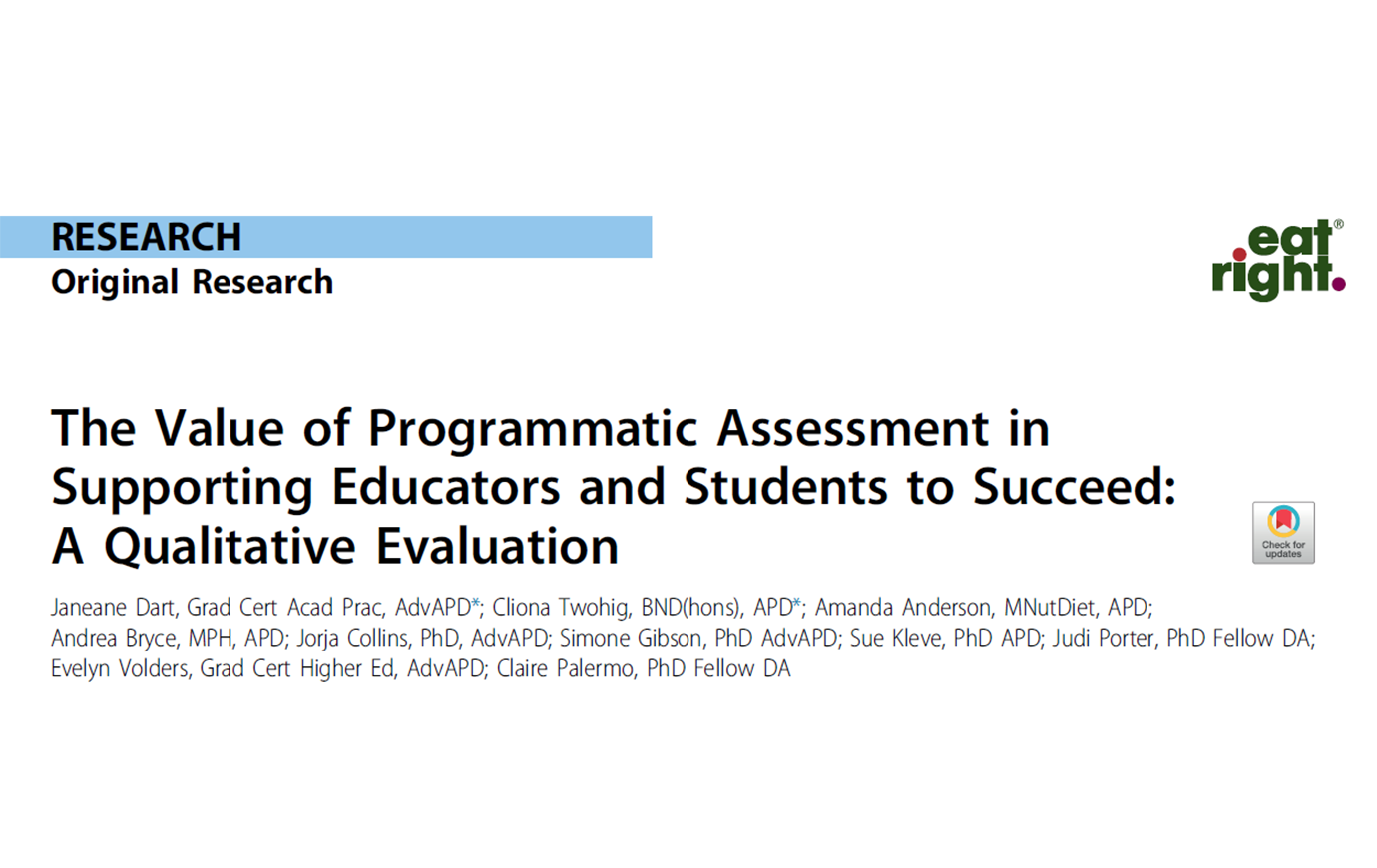
The research evaluating our programmatic approach to assessment revealed five key themes for both students and staff:
- It reduced the emotional burden of assessment
- It increased confidence in the defensibility of assessment decisions
- It enabled the earlier identification and remediation of ‘at risk’ students
- It increased the value of assessments and
- Philosophical and practice shifts are required.
-
Student feedback
"I think [all the assessments] contribute to a bigger picture.... just having exams at the end of the semester, I don't think that gives you a full picture."
-
Assesor feedback
"[the programmatic assessment] make[s] sure I am fair to the student and that I'm articulating and explaining my thoughts of their performance fairly."
Try it out
This exemplar requires a medium level of effort to implement.
Recommended resources and training:
-
Map all the different assessment tasks in the degree identifying areas of duplication and inconsistency in nomenclature for assessment tasks.
Redevelop the assessment through all the units in the course that provide evidence of competency development.
Identify the critical points in time in a student’s learning journey for intermediate review.
Set up an intervention for students that perform below standard through regular progress meetings. 
Evaluate the effectiveness and obtain feedback from students and other educators on what can be improved. -
- Build a cohesive team who learn together about strategic, programmatic assessment
- Ensure that the whole team understand the evidence base from which the teaching and learning innovation is derived
- Engage students and other key stakeholders in transparently describing the problem
- Provide clarity to all stakeholders on how this assessment approach addresses the problem
- Find adequate time to invest in the philosophical change needed to smoothly roll out the programmatic assessment approach
Supporting resources
Here are some additional resources that you can browse to help you implement this assessment.