
Emerging technologies and introduced species
New technologies are becomingly increasingly commonplace in conservation settings and are now finding application in the management of invasive species. This research will investigate ethnographically the affordances and challenges generated by the use of new, emerging, and future technologies for feral cat control and responsible pet cat ownership.
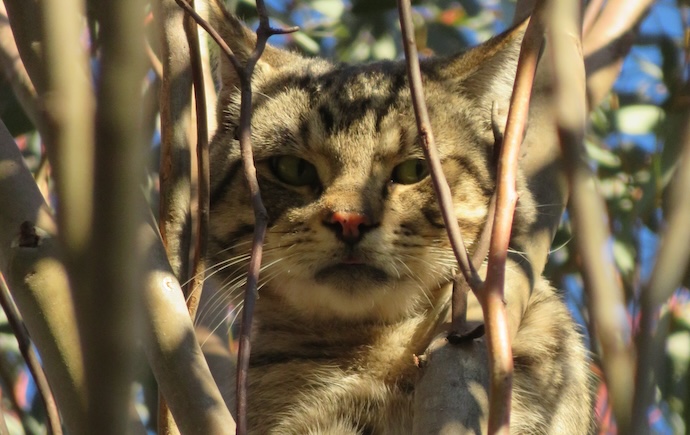
The presence and spread of invasive species are a major driver of biodiversity loss in Australia and a major focus for environmental managers. Sometimes intentionally introduced to the island continent of Australia as livestock, companion animals, or ill-fated biocontrol measures, and sometimes finding ways into new ecologies of their own volition, invasive species are the target of concentrated efforts to control. One aspect of these efforts to control is the use of new and emerging technologies. Monitoring technologies, various types of traps, and deterrent devices are increasingly being designed and fitted with AI capabilities. The possibilities entwined with these new technologies are potentially transformative but issues of scale, resourcing, funding, expertise, and regulation mean that such technofixes cannot represent a ‘silver bullet’ solution.
A particularly significant invasive species in Australia is the cat (Felis catus). Classified variously as feral, stray, or domestic, cats kill an estimated 2.5 billion native animals each year in Australia. They also impact on livestock and human health through the spread of cat-dependent diseases; diseases which are responsible for the deaths of over 500 Australians each year. In 2024, the Federal government announced a “war on feral cats” and, relatedly, a slew of funding for the development of new initiatives and technologies to tackle this problem. In many cases still in the early trial phases, there is an urgent need to understand what using these kinds of technologies for invasive species control does to human-environment relationships, and people’s values and perceptions around their multispecies interactions. In urban settings, there is increasing awareness around the responsibilities that cat owners have to minimise the harm that their cats do to other species and to ensure the safety and welfare of their cats. The urban domestic cat-space is also a site where increasingly technoscientific futures can be imagined. Where technoscientific solutions are envisioned, it is the work of social scientists to add nuance and texture to the conversation; the issue of feral and roaming pet cats is, importantly, just as social as it is ecological.
This project will explore ethnographically what kinds of affordances are generated by emerging technologies for human-environment and multispecies relationships in the context of invasive and introduced species. Through several case studies investigating the nexus between conservation, multispecies relating and technology in feral cat control and urban domestic cat ownership, this project will ask in what ways are emerging technologies and imagined technological futures enabling and constraining in terms of human-environment relationships. Further, this research will explore how new forms of relationality are realized in everyday and quotidian contexts, in conservation and land management work, and human-environment relating in urban spaces. Finally, the research will interrogate how imagined, future, and emerging technologies for cat ownership and control articulate with sustainability goals. The research will address these overarching concerns in several different settings, including National Parks, conservation stations and pastoral leaseholds in rural and remote Australia, and in domestic and community spaces in Melbourne/Naarm, Victoria.
Given Australia’s target to achieve the status of extinction-free, it is likely that new technological solutions will continue to play a role in environmental management. Controlling the spread of invasive species and minimising the harms that domestic introduced species can do to native animals and biodiversity will be key concerns for achieving Australia’s sustainability goals and the stated aim of becoming extinction-free. However, it is crucial that such technological interventions are analysed and interrogated, so that the cultural and social implications of their use can be understood. This research will provide particular benefit through its inclusion of the voices, perspectives, and experiences of a diversity of stakeholders, including environmental management practitioners, government employees, experts, and cat owners. It is anticipated that the research will contribute to the argument that environmental managers and other stakeholders need to be adequately resourced and engaged to confront the problem of biodiversity loss as a result of introduced and invasive species.
Project lead: Mardi Reardon-Smith (CI)
This project is funded by the People programme in the ARC Centre for Excellence Automated Decision Making + Society