
Home Futures report- a review of visions, people and values associated with future home life in Australia.
This report presents the findings of a review of visions, people and values associated with future home life in Australia, as represented in existing reports from industry, policy, government, academia and independent think tanks.
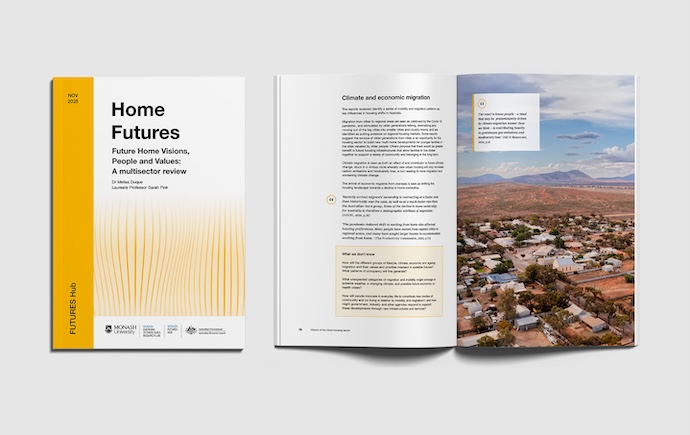
The report has been developed to generate new knowledge and awareness about how dominant visions of future home life are perceived, cohere and diverge across Australian organisations. These visions already are or are likely to inform advocacy, planning and policy across Australia. In identifying them we seek to evaluate the status of the current knowledge and foresight they propound for future home life, to assess its implications. We seek to indicate the gaps?- what we don?- in what the knowledge represented in current reports cannot tell us about possible future life.
This exercise is designed to inform and give context to a futures anthropological research agenda. Our ongoing FUTURES Hub work will productively and generatively complicate top-down claims by offering the new qualitative futures knowledge about possible future home life that we currently lack.
I hope this report will create new dialogues and share ideas about the futures of home with people working across the diverse challenges and opportunities in the housing sector.
Melisa Duque
This project is funded by an ARC Laureate Fellowship FL230100131.
Roles of authors: Melisa Duque - selection of reports, analysis of reports, report drafting, writing and editing; Sarah Pink - advisor on selection of reports, writing, editing, and executive summary. We would like to thank Emerging Technologies Research Lab colleagues for their advice and existing exemplary work in producing similar reports: Dr Fareed Kaviani, Dr Kari Dalghren, Dr Emma Quilty, Professor Yolande Strengers.
Extended thanks to the FUTURES Hub team research fellow Dr Robert
Lundberg, PhD candidates Zane Pinyon, Yuzhe Zhu for their weekly team meetings reflections. Bianca Vallentine and Hatoun Ibrahim for their contributions with the report design and layout.
Contact: melisa.duque@monash.edu