
WHO Design Principles and Tools
WHO Design Principles and Tools to improve use and impact of WHO Guidelines is a practical guide to support the design of WHO guidelines and other normative products. It starts with understanding who the end users of a guideline are, what their needs are, and what they hope to achieve by implementing a guideline. Ultimately, WHO is interested in developing products that are driven by country needs, improving implementation and measurable impact at country level.
The Principles and Tools are created for WHO technical staff who are responsible for the overall scoping, design, development, production, dissemination and implementation of WHO guidelines and other technical products. They provide guideline developers with resources that can be applied during conceptualization, development and writing stages, as well as during the process of adapting and implementing a guideline at country level. The Principles and Tools can enhance the ease of use of guidelines, and in combination with existing resources assist the development of technical content and promote relevant house style. The Principles apply to the work of responsible technical officers, authors, editors, and graphic designers who are involved in guideline development. The Tools include resources and templates that help put the Principles into practice. The Principles and Tools are designed to be used by different individuals, actors and/or stakeholders at various stages along the guideline development process.
WHO Design Principles and Tools to improve use and impact of WHO Guidelines should be viewed as complementary to existing documentation that supports the development of WHO guidelines, such as the WHO Handbook for Guideline Development, WHO House Style Guide, WHO Handbook for the Development of Normative Products, and WHO Brand Guidance, amongst others. Aligned with existing publications, the Principles and Tools outline approaches that have been informed by iterative co-design engagement with end users of WHO guidelines.1
How the Principles were developed
WHO Principles and Tools to Improve Use and Impact of WHO Guidelines is a set of design considerations and techniques that are informed by evidence to support guideline design and improve guideline use. They have been co-created by the Product Design and Impact Unit (in the Department of Quality Assurance, Norms and Standards, QNS) at the World Health Organization and Monash University’s Faculty of Art, Design and Architecture (Department of Design).
The work is informed by insights gathered from interviews that QNS has conducted with over 70 end-users, including policy advisors, advocacy groups, WHO collaborating centers, journalists, design experts and a focus group with patient representatives. Consultations showed that lack of a systematic approach to guideline design resulted in a disjunct between the authors of guidelines and the individuals who use them. This was identified as a limitation to meaningful use of guidelines by countries.
The WHO Principles and Tools were developed over two years (2022-2024), in four separate co-design workshops, involving participants from 15 countries.
The first workshop (April 2022) was used to discuss how the guideline creation process can be improved to make guidelines more accessible and easier to use, thus improving the likelihood of their implementation and impact. Participants worked through a fictional scenario to identify barriers to guideline use and reviewed a redesigned guideline chapter aimed at enhancing engagement and navigation of guidelines. Their insights contributed to the development of the Design Principles.
During the second workshop (September 2022) participants worked with a fictional scenario and four personas representing professionals involved in guideline creation and dissemination. Participants assessed how the draft Design Principles could be applied in practical terms, offering actionable insights for "re-prototyping" the Principles. The second workshop also commenced creation of the Design Tools.
The third workshop (September 2023) was with WHO headquarters staff, which included experts in the areas of accessibility, clarity, translation and the publishing process. This workshop focused on the Design Principles related to accessibility, clarity and translation and participants evaluated the Design Tools that were relevant to these Principles. Workshop insights contributed to further validation of the Design Principles and the refinement of the Tools to ensure their applicability and complementarity with existing WHO tools.
The fourth and final workshop (June 2024) focused on the Design Principles and Tools related to accessibility, clarity and translation. Based on feedback from the third workshop, the revised Tools were reviewed, validated and further aligned with existing WHO tools (e.g. WHO Style Guide). The workshop also discussed the need for WHO design and layout processes and technologies to be improved support the Design Tools.
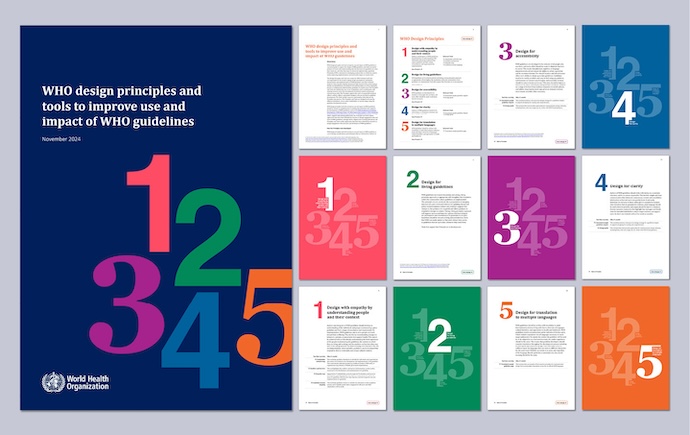
The Design Principles
The Principles to improve use and impact of WHO guidelines are:
- Design with empathy by understanding people and their context
- Design for living guidelines
- Design for accessibility
- Design for clarity
- Design for translation to multiple languages
Read the Monash Lens article