
Learn more about Generative AI
An important aspect of responding to ChatGPT and other generative AI tools is learning more about how they work, and their limitations and ethical considerations.
How reliable is AI?
As with any information source, it is important to take a critical view of content produced by artificial intelligence technologies. Artificial intelligence applications are not primary sources of information—they generate information based on information in their database. They are programmed to provide a response based on relevance, whether or not it is based on accurate data. They do not engage with information the way humans do, and they do not operate according to moral or ethical principles.
Below is an example of an AI query (generated January 2023)
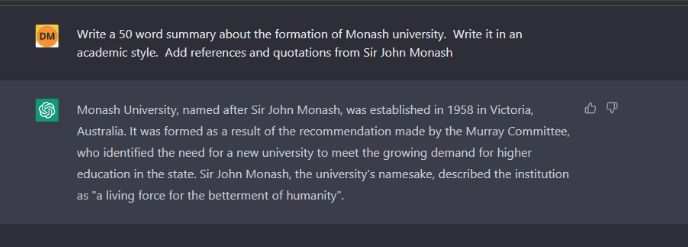
Note: Sir John Monash died in 1931, while Monash University was not founded until 1958. It is impossible for him to have said this about the university named after him.
How could AI be used for learning and teaching?
Generative AI technologies present opportunities for learning and teaching. This section provides some examples.
 Critical analysis of AI-generated content
View
Critical analysis of AI-generated content
View

 Generating example scenarios
View
Generating example scenarios
View
 AI-assisted creative approaches
View
AI-assisted creative approaches
View
 AI-assisted study strategies
View
AI-assisted study strategies
View
Responsible and ethical engagement with AI
The use of AI technologies has ethical implications that should not be ignored. For example, ChatGPT builds economic value by making use of data generated by others, including its own users. OpenAI, the company that makes ChatGPT, has received billions of dollars of investment funding from a range of investors, including Microsoft, Elon Musk and others.
This means that decision-making and design choices are not free from political and economic influence, and that the way ChatGPT works is not accessible to the public in order to protect its intellectual property. Further, running ChatGPT consumes huge amounts of energy and is, therefore, environmentally destructive.
At the same time, there are ethical implications of not using (or stopping others from using) AI technologies, such as ChatGPT. Such technologies are already being embedded into everyday software and devices (e.g. within Microsoft Office, Google Maps, SMS) and it is becoming difficult if not impossible to avoid them. Educators have a responsibility to support students to learn how to navigate the present and the future.
There are no simple answers to how AI should be dealt with in relation to learning, teaching and assessment. it is also important for staff and students to inform themselves about the opportunities and risks of these technologies and, where possible, to discuss them with students in relation to their particular unit and educational context.
ActionsTo do now: Apply policy guidelines on responsible use of AI to each unit to clarify what, if any, use of generative AI tools is unacceptable and that any use must be acknowledged. This must be recorded in the learning management system for each unit. Looking forward: Review assessment regimes in relation to validity, academic integrity, educational principles and in the light of responsible and ethical use of AI. Discuss the possibilities and challenges of AI with students. |

This work is licensed under a Creative Commons Attribution-NonCommercial-ShareAlike 4.0 International License