Building critical thinking skills with low stakes peer assessment
About this example
This jointly run unit from the Science faculty and the Bioethics centre used scaffolded low stakes peer assessment to build the skills and confidence of students from multidisciplinary backgrounds to critically read journal articles and develop argumentative ethical reasoning skills.
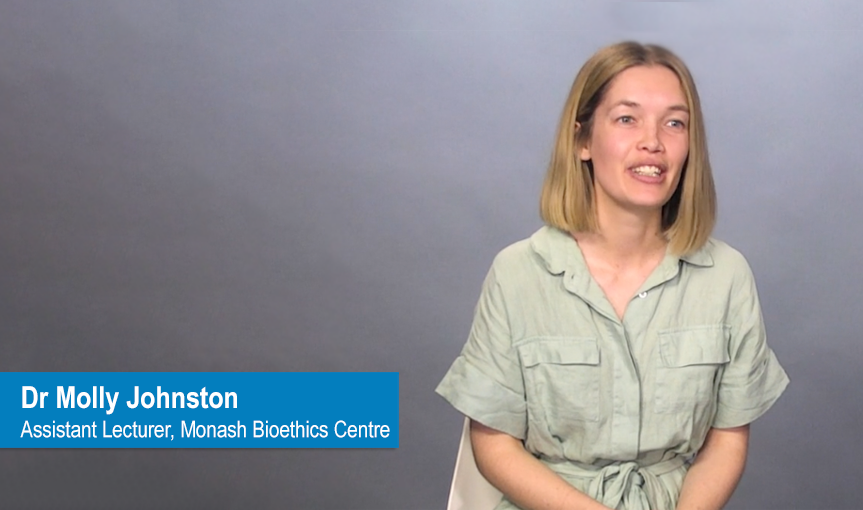
Watch Molly Johnston explain how low-stakes assessment encouraged peer feedback and self-learning.
Arts/Science faculty
-
Genome curation(GNA5120) is a new unit offered in the science faculty that is jointly run with the Bioethics centre. One of the learning objectives of the unit is for students to demonstrate understanding of the ethical issues surrounding genome analysis and datasets. We found that forum discussions and debates are an effective way to promote engagement with and critical thinking around ethical issues with students in the Arts faculty, so we were interested in doing something similar with our students in science.
However, we were aware that our students may not have a background in this type of assignment or writing style, which requires a very different way of thinking and critical reasoning than what they may be used to. We knew that they would need more support and scaffolding to develop skills like argumentative ethical reasoning in order to critically analyse ethical issues.
-
In GNA5120 we had four assessment tasks. It was really important that each subsequent assessment built on the skills that students developed in the assessment task before it. Using low stakes assessment to develop skills before moving onto more complex tasks was a really good way to scaffold the learning for students, build up their argumentative skills over time and clearly communicate to students what was required of them.
I set up each assessment to have a peer review component because I wanted the students to engage with each other's work and promote self-guided learning. Click through the tabs below to learn about each assessment task.
Guided reading was chosen as the first assessment task as it was an effective way to give students exposure to the style of writing common in philosophy and ethics, as well as to support them to identify the key components of the text, which are critical for understanding the purpose of the article. This activity was then repeated (assessment task 1, assessment task 2) so that students were able to apply the feedback received from their first attempt, building upon their comprehension and laying the groundwork for them to construct their own arguments.
- Using a collaborative reading platform, students were assigned a reading (an article published in peer-reviewed journals in the fields of ethics and philosophy) and asked to identify the key proponents by highlighting and annotating the text, including:
- The author's central argument
- The reasons that the authors used to support their argument.
- Students provide feedback on the task, specifically one thing that they thought they did well and one thing that they thought they needed to work on. This was part of their overall grade for the task, to encourage students to reflect on their own learning. Student feedback was also used to inform our classroom discussions, so that we could respond to any areas of concern.
- At the end of the assessment, students could go back to the article and review the responses of their peers, to see if they had identified the same argument as them, or if they had similar critiques.
This assessment task was pitched to students as a low stakes activity; an opportunity for them to practice their argumentative skills as well as constructive feedback skills. We set the FeedbackFruits activity up so that completing the task was weighted more heavily than what score their peers provided their response. This was done because we were more interested in students building these skills and reviewing their feedback as opposed to what scores their peers gave them.
- Students were provided with an ethical question and were required to write a short response (300-400 words) which argued their position and provided reasoning.
- Students submitted their written response via the FeedbackFruits Peer review tool.
- Students anonymously assessed the responses of three peers using the rubric we provided within the FeedbackFruits activity.
- Students were then required to review the feedback that they had received from their peers.
Similar to assessment task 3, for assessment task 4 we provided students with an ethical question. It was important that students knew that the skills they were being assessed on were based on the same criteria as the previous assessment task, and that assessment 4 was building upon the previous assignment, which was reflected by using a similar but more advanced rubric that students used in assessment task 3 with additional levels.
- Students were prompted with an ethical question in and were required to write a short response (300-400 words) which argued their position and provided reasoning.
- Students posted their response to a forum.
- Students were required to respond to one of their peers' responses to the prompt, either building upon it or critiquing it.
- Teaching staff then marked the students' response to the prompt and their response to their peers in the forum using the advanced grading function.
- Using a collaborative reading platform, students were assigned a reading (an article published in peer-reviewed journals in the fields of ethics and philosophy) and asked to identify the key proponents by highlighting and annotating the text, including:
-
In the SETU feedback, the students were very positive. Students were able to navigate the FeedbackFruits platform easily and all of them completed each task. Even though the weighting of assessment tasks was minor, students really engaged with the activity and understood that the assessment tasks built upon each other.
Specifically, we had really great feedback from the students for a self-assessment/feedback component within assessment 1 and 2. Students were required to nominate one thing that they thought they did well and one thing that they thought they needed to work on. These comments were reviewed by staff, who were then able to target areas where students needed support in the following tutorial.
-
"It gave me more confidence"
"I found the task easier than the first time due to the workshop discussions held in class. This has helped me think further down the line and along with the discussions with my peers, it has given me more confidence in critiquing the author’s arguments."
-
"Discussions in the workshop were really constructive"
"I found the task less difficult this time around, I think our discussions in the workshop were really constructive and definitely helped break down the article and arguments."
-
"The class discussion really helped"
“I still find criticising the most difficult part here, but on top of having the past experience (guided reading 1), as mentioned, the class discussion really helped me know what to expect which allowed me to work through that section more easily than I did in the past guided reading.”
-
Try it out
This exemplar is easy to implement.
Recommended resources and training:
-
We used a range of technologies to facilitate a peer review component in each of the assessment in our unit.
Technology used Assessment 1 FeedbackFruits Comprehension Assessment 2 FeedbackFruits Comprehension Assessment 3 FeedbackFruits Peer Review Assessment 4 Moodle forum activity (making use of the advanced grading function) With FeedbackFruits, we were easily able to set up the activity, and decide the number of people we wanted each student to review for our unit of about fifty students. I think FeedbackFruits would be quite suitable for larger groups of students as well. Both tools integrated with Moodle Gradebook for seamless, automatic grading.
Note: The Feedbackfruits comprehension tool was available during the FeedbackFruits pilot in 2021. Under the current licence agreement, FeedbackFruits Group Member Evaluation and FeedbackFruits Peer Review are available. For collaborative reading tools similar to the FeedbackFruits Comprehension, see Perusall.
-
Consider the learning objective and what you are actually trying to get students to achieve. For example, ask yourself the following questions:
What is your starting point? What is your end point?
Think about the core skills that students will require for the major assessment task or what you want students to demonstrate. Then look at those skills and figure out which one is the most fundamental, and that's where you want to start.
What skills do you want the students to be able to demonstrate? How can you help students achieve these skills?
Think about how can you enable students to establish those skills and then add subsequent skills or opportunities to advance those skills before reaching the final assessment task.
What help or support do students need to be able to get to that point?
Rubrics can be really helpful to guide the students’ thinking. Providing the rubric to students before the assessment can help clarify and enable students to identify what we are looking for in the assessment, so students can tailor their response to what is actually being assessed in the assignment. Ensure there are opportunities for the students to provide feedback to staff so that areas of concern can be targeted in class time.Once you have the answers to these questions, you can work backwards in order to create assessment tasks that will enable students to demonstrate these skills, and ensure students have adequate support to achieve success.
So for my example, I started with that Forum discussion (Task 4), and then I went backwards to pull out these crucial skills that students could build upon with each subsequent assessment before getting to that final assessment. This enabled students to demonstrate the skills that we wanted to teach them through our unit.
Make sure you also clearly signpost and scaffold your activities and provide clear instructions. For example, I created short videos showing students how to access the platform, what it would look like to the students and where to find further instructions.
Supporting resources
Here are some additional resources that you can browse to help you implement this assessment.