
Student Profile: Stavya Datta
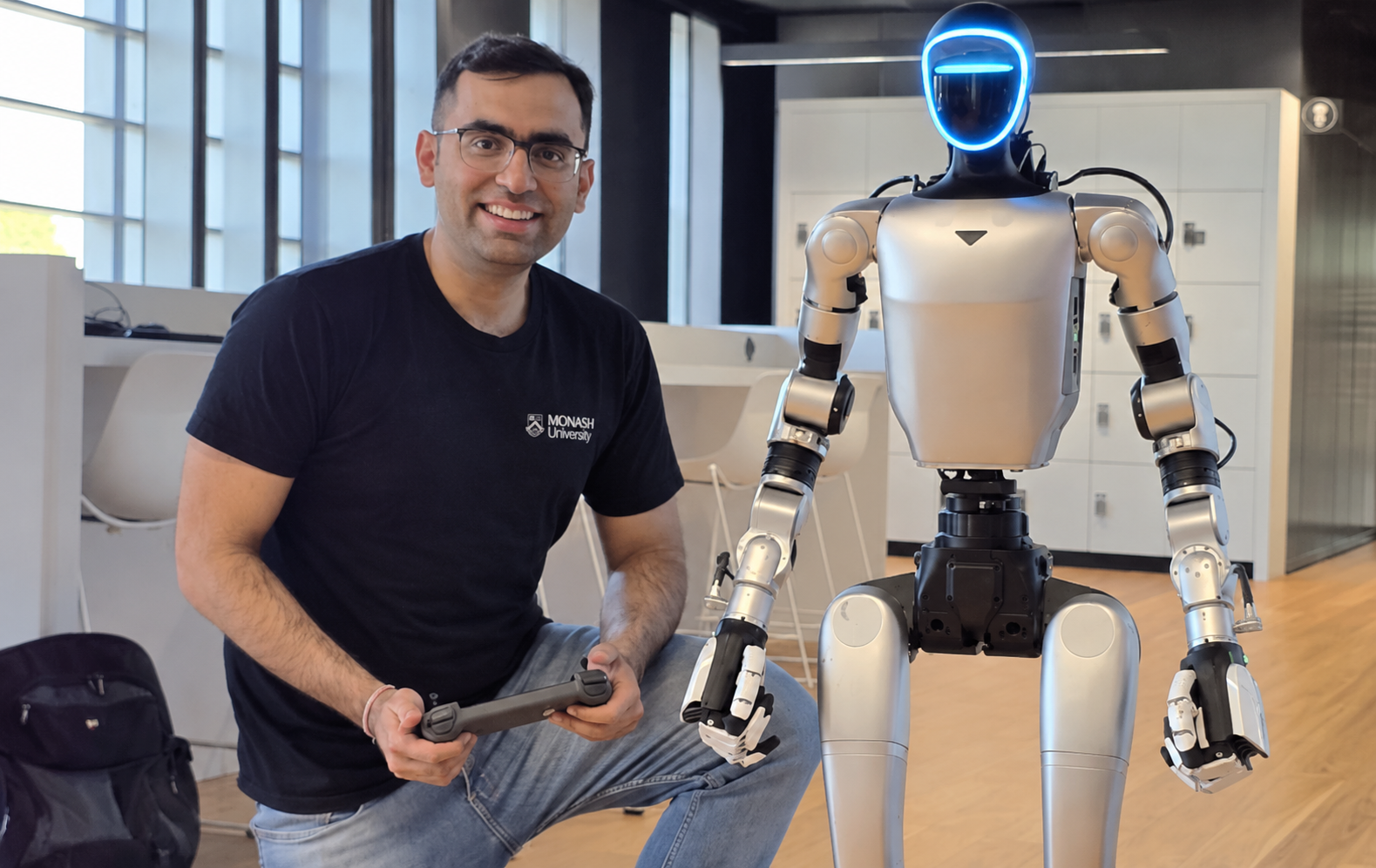
From robotics research to social impact: PhD scholar Stavya Datta on exploring commercialisation pathways with Future Frontier
Could robots help older adults stay engaged and connected? Monash PhD scholar Stavya Datta isn’t just exploring this possibility through his research - he’s learning how to maximise the impact of his work through the Future Frontier AI & Deep-tech Pre-Accelerator Program.
Supported by Innovation Victoria, the Future Frontier program is co-delivered by Monash AI Institute and Illume Ventures. Led by Monash AI Institute Director Professor Shonali Krishnaswamy and Dr Jyoti Joshi Dhall and Illume Ventures’ Laxmi Pun, the program addresses a longstanding challenge in Australia's innovation ecosystem: translating world-class research into successful commercial ventures.
Delivered over ten weeks, Future Frontier helps participants transform their research into commercially viable ventures through weekly workshops and dedicated support from experienced entrepreneurs and ‘venture fellows’, business professionals and MBA graduates paired with the participants.
Working alongside peers and dedicated entrepreneur- in-residence (Venture leads), the participants explore customer needs and test their business propositions, leading to a well-rounded understanding of how research translation and commercialisation operates in practice.
As an inaugural participant in Future Frontier, Stavya shares how his PhD has been uplifted by the rich learning opportunities facilitated through Monash, and gives his top tips for making the most of your graduate research experience.
What brought you to Monash, and how did your master’s research become a PhD?
While working in computer vision and AI in India, I received informal advice from Professor Hamid Rezatofighi of VL4AI lab that helped me get one of my first papers published. I found Monash staff receptive and helpful, and the opportunity to work with leading researchers drew me to the University.
During my Masters of Artificial Intelligence at Monash, my social robotics project gained traction. Continuing into a PhD gave me the opportunity to take it further than I’d imagined.
What is your research about, and who could benefit?
I’m working on enabling a robot to interact naturally in a group conversation. Robots and conversational agents tend to be limited to one-to-one interactions. We want to make them more active and engaging in group settings.
Through demonstrations and informal conversations with older adults and aged care workers, we learned about opportunities for robots to help keep people engaged throughout the day.
Our aim is to enhance care. Robots can’t replace human touch, but they could potentially take on routine tasks, leaving more room for human-to-human connection.
What has been an exciting breakthrough?
During my Masters and early PhD, we developed a flexible harness for the robot’s actions. This technology evolved over time with great results.
It was exciting to ask the robot to carry out a sequence - give me a high five, move around and give me two high fives. With our harness ARIS, the robot was able to perform complex sequences as technology around robotics grew without much changes to code..
What Monash resources and opportunities should graduate researchers explore?
My research involves collaboration between IT and Engineering, so access to different expertise is valuable. Living on campus also helped me meet people who could offer advice and technical support. I recommend reaching out to colleagues and mentors for a coffee chat or collaboration - you don’t always know what support is available until you ask.
Presenting at events gave me opportunities to speak with various demographics including older adults and aged care workers, helping me understand the technology’s potential impact.
In particular, I wanted to explore pathways to impact through commercialisation. I heard about Future Frontier through Professor Shonali Krishnaswamy, Academic Director of AI Innovation at Monash.
An accelerator specifically for researchers appealed to me because I wanted to understand how the market might respond to our work and learn from others who had successfully taken their research to market.
What has Future Frontier taught you about research commercialisation?
One important lesson is that an interesting research problem may not always be market-ready.
I’ve learned about approaching potential clients, understanding their needs and exploring how technology could reach the market. It needs to work consistently and reliably for the person using it.
Talking to the commercialisation experts and your fellow participants in the Future Frontier cohort also brings different perspectives on whether an idea might be viable.
The main thing I’ve learned is to not be afraid to start conversations and ask questions. If you have an idea you think might be appropriate for a commercialisation pathway, talk to the people it could help and find out whether it meets their needs.
What advice would you give someone considering a PhD?
Start by collaborating with a professor and finding out whether you enjoy the research. A PhD is a long-term commitment, and working on a project can help you decide whether it’s something you want to explore further.
Look at the resources, technology and people you could work with. During my PhD, I’ve learned how important collaboration is, especially hearing perspectives different from my own.
And reach out, even if you feel underconfident. You might think other people are so smart they won’t accept you, but if you’re willing to learn and do quality work, doors can open. It worked for me.
Keen to explore research commercialisation pathways? Register now for the Future Frontier Showcase and Deep-Tech Mixer on Thursday 26 November.