
ReMSTEP Video on Knots

ReMSTEP Video on Knots
This video is intended for pre-service and in-service maths teachers to provide inspiration for classroom activities that deal with the underpinning concepts, rather than the technical and computational aspects, of mathematics.
This video is one of three produced as part of the ReMSTEP Project.
The presenter, Dr Norman Do, is a self-proclaimed mathematics geek, and a lecturer at Monash University. He loves to study and teach mathematics and aspires to engage people in study mathematics and to appreciate the diverse and varied jobs that exist for mathematicians. His main research interests lie in geometry and topology, including knot theory. (view Dr Do's profile here)
“We need to celebrate our mathematical heroes like Terry Tao, and we need to understand that if you’re a mathematician you can work behind the scenes in jobs as varied as biochemistry, animation and finance.” -- Dr Do
 Before viewing the video.... instructions for teachers
View
Before viewing the video.... instructions for teachers
View

- Consider some maths associated with torus, e.g. the surface area or volume. Are there opportunities to investigate these in your maths lessons? Identify the level(s), strand(s) or substrand(s) of the Australian/Victorian maths curriculum where it might be appropriate. What level of mathematical understanding is required?
Hint: see https://www.mathsisfun.com/geometry/torus.html - Dr Do uses the example of PACMAN, a popular video game character in the early 1980s. Is PACMAN culturally relevant to today’s secondary school students? What alternative(s) could you use today which demonstrate this same form of movement?
- Consider satellite navigation (Sat Nav) using global positioning systems (GPS) as an example where variations in the surface of the earth is important. Research GPS and autonomous transport (driverless cars & trucks) and the key maths ideas that are involved in Sat Nav?
- Make a Mobius strip yourself and devise an approach that could convince another person that it has only ‘one’ side and ‘one’ edge.
Hint: see https://brilliant.org/wiki/mobius-strips/ for step by step instructions for creating a Mobius strip. - Three manifolds are of great interest to mathematicians and physicists. So what is the shape of our universe?
How could you help students to consider the concept of the size and shape of our universe?
Dr Do talks about knots from a historical perspective but where might students come across representation of knots in their everyday lives?
- When do students learn about DNA molecules and replication in Science at your school (see Australian or Victorian Curriculum).
- How could you collaborate with your class’s science teacher to explore the potential learning opportunity for your students?
Investigate how ciprofloxacin and knot theory is connected to immunity & cancer treatment? Does this perspective impact on the way you view mathematics contexts and maths education? Explain your answer.
In everyday life like when sailing, rock climbing or even when tying our shoe laces, we talk about ‘knots’ but are these knots according to a mathematician? What characteristics must a ‘mathematical’ knot have?
For example, the Clove Hitch. This is a very useful knot when sailing.
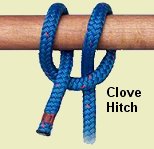
- Can you tie a clove hitch?
- If you remove the rod, will it shake out and untangle?
- Is this an example of a ‘mathematical’ knot?
- How could you change this to make it a ‘mathematical' knot?
What other knots can you tie?
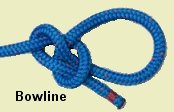
- Winsor knot?
- Square knot?
- Rolling hitch & Reef Knot?
For more examples, See: Animated Knots
You have 2 nails in a wall. How can you hang a picture from them in such a way that the picture falls down if either of the two nails is removed, but remains hanging while both nails remain in place?
Brainstorm the ‘beauty of maths’ and how it can simplify or help us understand real life situations.
Further resources
Links
- Australian Curriculum – mathematics
- Victorian Curriculum – mathematics
- Interesting sculptures by Keizo based on knots
- A mathematically correct breakfast bagel demonstrates how it is possible to slice a bagel in half and still keep it connected.
- How to slice a bagel into a trefoil knot
- Wolfram MathWorld is a collection of resources for teaching many aspects of topology including knot theory.
- Aussie Educator: Mathematics resources is a website of resources and links to other websites to support teaching mathematics.
- Mudd's Math Fun Facts - a couple of hands on activities to try – Rubber bands stuck on a torus.
- August Ferdinand Möbius - Explore where the name mobius strip come from?
- The Geometry Junkyard: Knot theory - lots of links about the geometry of knots
Books and articles
- Adams, C. C. (2004). The knot book: An elementary introduction to the mathematical theory of knots. Providence, RI: American Mathematical Society.
(We use knots to moor our boats, to wrap our packages, to tie our shoes. Yet the mathematical theory of knots quickly leads to deep results in topology and geometry.) - Crato, N. (2010). Figuring it out: Entertaining encounters with everyday math. Berlin: Springer-Verlag.
(This is a book of mathematical stories — funny and puzzling mathematical stories. Chapter 12 explains how GPS works.) - Pickover, C.A. (2006). The mobius strip: Dr. August Mobius’s marvellous band in mathematics, games, literature, art, technology, and cosmology. Thunder’s Mouth Press.
- Sumners, D. W. (2011). DNA, Knots and Tangles BT – The Mathematics of Knots: Theory and Application. In M. Banagl & D. Vogel (Eds.), (pp. 327–353). Berlin, Heidelberg: Springer Berlin Heidelberg.
(This article describes how the maths of topology has helped understand DNA recombination.)