
Insights from our 3rd Mel-Based Professional Learning Day for theSTEMproblem

Insights from our 3rd Mel-Based Professional Learning Day for theSTEMproblem
#theSTEMproblem is a research project funded by an ARC Linkage Grant, and involves researchers, teachers, and support staff from Monash University, the University of Queensland (UQ), Melbourne Archdiocese Catholic Schools (MACS) and Brisbane Catholic Education (BCE) working together to refine and implement a framework for Problem Based Learning (PBL) in primary and secondary school STEM education.
In this project, participating MACS and BCE teachers are positioned co-researchers, meaning they are key decision makers who understand their school and classroom context, and can critically examine their own practice. This project aims to build teacher knowledge, capacity and confidence to design and implement authentic and relevant STEM education. Working closely with teachers, exemplars of practice about PBL will be developed, which will support the development of a sustainable pedagogical framework to support school-based STEM education for all.
We are currently in Phase 2 of the project, which involves the running of five professional learning (PL) workshops for participating MACS and BCE teachers, and facilitated by researchers from Monash and UQ, with the help of support staff from MACS and BCE.
On Friday 14th October 2022, our participating MACS teachers attended their third all-day PL workshop for theSTEMproblem, which was facilitated by Assoc. Prof. Kathy Smith (Monash), Dr Peter Ellerton (UQ), and Dr Jen Mansfield (Monash). This PL was delivered in an in-person format, and was divided into three sessions.
Session 1 Highlights
The first session of the day involved teachers from different school groups reflecting on their experiences as co-researchers on theSTEMproblem, and sharing artefacts with each other to highlight their progress to date with implementing a PBL approach to STEM education in their school contexts.
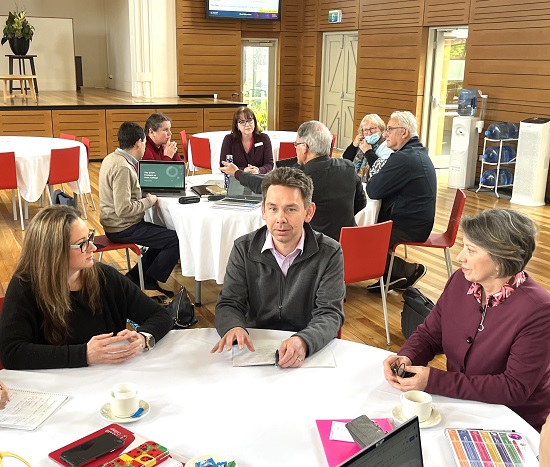
Teachers' experiences as co-researchers have changed over the course of the project, as summarised by one of the participants on the day:
Last year when we first started the project … I suppose my initial reaction [about being a co-researcher] ... was like ‘what does that mean?’. We were feeling quite out of our comfort zone … But … I've come to learn that … My role as [a] co-researcher is actually quite a powerful and important one as a practising teacher. So, I see almost like a triangulation partnership here, … that triangulation between the academic side, with partners like Peter and Kath, and Jen and the team, and then … I see my role as a practising teacher, we’re at the forefront. So we take that knowledge and understanding, and I can share how we [as teachers] make sense of that. So, how I have knowledge and understanding, and .. what that looks like for me as a primary school teacher in that context ... I don’t feel that sense of uncomfortably anymore, I actually feel quite empowered, and quite important, that what I’ve got to share is quite valued, and it’s at the forefront of making sense of it all.
Session 2 Highlights
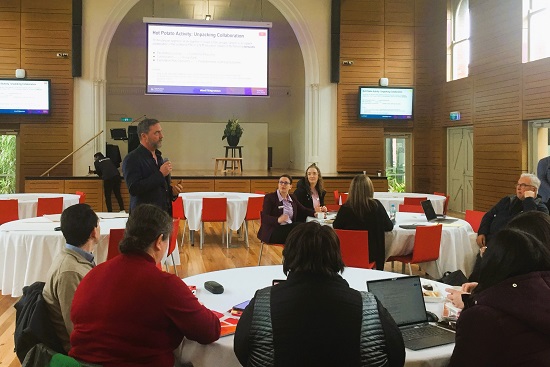
The second session of the day involved teachers and facilitators exploring the nature of collaboration in PBL, and unpacking some of the tensions/challenges of collaboration. These tensions included the role of teachers in fostering collaboration through facilitating/guiding versus controlling/requiring, the notion of ‘collaboration’ as opposed to ‘group work’, and the concept of ‘exploration/play/discovery’ versus having predetermined learning outcomes.
Session 3 Highlights
The third and final session of the day involved teachers further shaping their research question and school action plans that they began crafting in our first PL workshop in 2021, with guidance from the research team and MACS support staff.
Teachers found taking part in the PL workshops as co-researchers to be a meaningful experience, as highlighted by one of our teachers on the day:
It’s actually really quite exciting, because rather than just … consuming … the knowledge or information like in a normal PL, you actually get to collaborate toward something. … It’s interesting as well because you get to be able to put a different spin on it … so I can put my perspectives … my views, towards what we’re looking at, what we’re researching … that fit within the contexts that are meaningful to me and my school.
Teachers will be further supported in their role as co-researchers through school visits/check-ins by MACS support staff at the end of 2022, and will then participate in two more PL workshops in 2023, where they will be working with the research team to develop illustrations of practice for PBL in a school-based STEM education setting.
For more information on our participating MACS schools, please click here.