
Science Education in the Anthropocene Lab
Science Education in the Anthropocene Impact Lab
Reimagining our relationship with the natural world
About the Lab
Our vision is of a science education that addresses the complex realities and challenges of the Anthropocene.
To make this a reality, we must reimagine science education as being positioned at the intersection of nature, culture and society.
Young people are facing a range of interconnected problems in their lifetime: climate change, pandemics and food insecurity are among the most immediate. Science education needs to engage students in addressing these complex issues by recognising the relationships between ecological systems, political and economic structures, and sociocultural practices that have shaped our current planetary conditions.
The SEA Lab is a place to tackle these challenges and reimagine science education in the Anthropocene. Our goal is to bring together a diverse collective of voices, including science educators (from early childhood to tertiary), community activists and organisers, Indigenous knowledge keepers, citizen scientists, artists and storytellers, policy makers, students, environmental justice advocates, industry partners and all those committed to transforming science education to meet the challenges of our planetary crisis.
What we mean when we talk about science in the Anthropocene
What is science?
Simply put, science is a way of understanding the natural world. It encompasses diverse ways of understanding, engaging with, and making knowledge about the world.
In the Australian K–12 curriculum, science is defined as ‘a dynamic, collaborative and creative human endeavour arising from our desire to make sense of our world. ... Science gives us an empirical way of answering curious and important questions about the changing world we live in.’ Scientific practice has been enriched through the exchange of knowledge and ideas around the world, while also being shaped by the exploitation and appropriation of Indigenous knowledge through colonisation. Indigenous and First Nations peoples, however, have maintained their own distinct, systematic, place-based knowledge traditions that have evolved over millennia through rigorous observation and experimentation.
What do we mean by the Anthropocene?
The term Anthropocene was recently coined to describe our current geological era in which human activity has increasingly influenced Earth’s systems that sustain life, resulting in large-scale changes to systems such as the carbon cycle, global climate and sea levels that are long-lasting and potentially irreversible.
Often framed as a scientific designation referring to measurable human impacts on the global environment, it is nevertheless a contested concept, subject to debate about its origins, causes and implications. More than a neutral geological designation, the idea of the Anthropocene raises profound questions about responsibility, justice, and the need to reimagine our relationships with each other and with the natural world.
While recognising the term Anthropocene is not universally recognised and remains contested, we find it useful as a way to orient our discussions around the various interconnected crises we collectively face – the ecological, social and political challenges that science education must address.
Science education in the Anthropocene
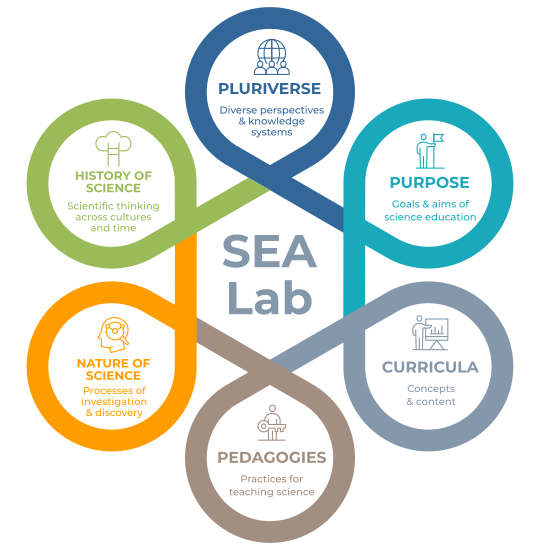
Our work embraces a ‘pluriverse’ approach to science education. Science education in the Anthropocene should address not only the formal methods associated with dominant scientific traditions, but also the sophisticated observation, experimentation, and theory building practised in Indigenous sciences. When learning science, students who draw from multiple knowledge traditions, as well as from community-based approaches and other cultural contexts, build their capacity to actively construct, evaluate, and take ownership of knowledge. By broadening our conception of what counts as science education in these times, we create space for productive dialogue across different knowledge traditions – not to collapse the differences but to recognise how multiple approaches can contribute to addressing the challenges of the Anthropocene.
Initial questions
Based on ongoing reimaginings of science education, the following questions illustrate the things we are curious about and will guide the SEA Lab’s program of work.
- What should be the goals and aims of science education in the Anthropocene?
- How will we know such a science education is worthwhile and working?
- What is the role and responsibility of science educators and the science education community in addressing the multiple, intersecting challenges of the Anthropocene?
- How can diverse knowledge systems be integrated into science curricula in meaningful ways that equip citizens of all ages to address the challenges of the Anthropocene?
- How can science education move beyond human exceptionalism towards an understanding of the interdependent systems that sustain all life?
- Given the troubled history between science and colonisation, how can we create ethical spaces of engagement that recognise Indigenous and First Nations’ knowledge systems?
- How do we support students to explore and question the influence of power and politics in science education?
Read more about science education in the Anthropocene in the following open access books.
About the team
We are committed to working with educators, policy makers, practitioners, professional bodies, students and researchers from multiple disciplines and knowledge traditions to transform science education. If you support our vision, please contact us to explore how we can work together.
Interested in being supervised on a research degree by members of this lab?
Please visit the How to Apply website, and follow Steps 1 and 2 before making contact.
Monash profiles and the Faculty's Find a Supervisor tool can help inform your decision about who to approach too.

News

Media
Sara Tolbert joins the EPI.STEM podcast 4 June 2025
SEA Lab’s Sara Tolbert joins the EPI.STEM podcast to discuss the contested literature that is currently reimagining science education as a theoretical and social movement, including futuristic thinking about science, intersectionality, education and inclusion. This vibrant discussion raises new questions and invites us to rethink how we teach science and how we can equip young people with capabilities to address complex issues by recognising the relationships between ecological systems, political and economic structures and sociocultural practices that shape our current planetary conditions.