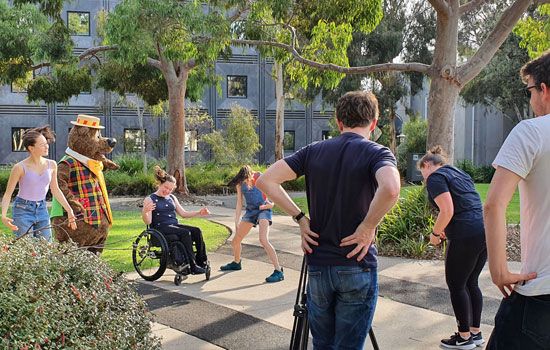



This World Autism Awareness Day (2 April) we bring our attention to how teachers can best support autistic students. There is no ‘one size fits all’ approach but there are many ways to improve autistic learners’ education experience.
Monash Krongold Clinic’s investigators highlight the evidence-based strategies from the AllPlay Learn research program, which is part of Monash Education, to provide advice for teachers.
As a teacher, knowing how to select the strategies or approaches that will best support autistic students in busy classrooms can be challenging. This article offers practical evidence-based strategies to help you in your classroom. Most of these strategies will benefit other students in your classroom too.
1. Get to know student strengths
Understand each student as an individual with their own strengths and interests. Knowing a student’s preferences, strengths and interests can provide starting points to engage them in the classroom.
When students draw from their strengths, they can experience confidence and success in their learning. Create opportunities and provide choices in learning activities such as topic or format to cater to a range of student interests and communication strengths.

2. Provide a clear schedule and routine
Visual schedules and consistent routines can help students understand what is happening and when to transition from one activity to another.
Most students will benefit from a reminder when a change or transition is coming up. Those who find it difficult to move from one activity to another will feel more settled if they are alerted to the transition. An example of incorporating such a warning could be as simple as announcing: “In five minutes each small group is going to pack up their lab equipment, and go back to their workbooks to complete the questions on page x.”

3. Design learning experiences that support all students
To support all students, you can use concrete materials alongside abstract concepts. This could be using images to supplement text, and blocks to model maths. Teachers can integrate text and pictures showing how to complete a task.
It will help engage the student if their strengths and interests are included into the learning process. For example, if a student is motivated by cars, offer toy cars for addition and subtraction, and when the student completes their maths, encourage them by giving them some time to play with the cars.

4. Provide positive feedback
Give positive feedback and discrete correction immediately when students are learning a task or behaviour. This can be reduced gradually as they build their capability.
Teacher emotional support and encouragement can help students achieve better results. Let the student know that they are valued and supported.
Some students may be highly motivated by their interests, so allowing them to engage in an activity related to their interests can be an encouragement for their efforts.
"When teachers take time to focus on the student's mental health and wellbeing in each lesson, or even just every few lessons, just checking on how everyone's doing, that makes me a lot more comfortable to consult my teacher as I know that they do care about my wellbeing." – Ellen, an autistic secondary school student, sharing how teachers can support her in the classroom.

5. Offer opportunities to practise tasks
Practising a task or behaviour many times can be very helpful, so offer plenty of time to practise in different settings and with different materials so students learn to use that skill across multiple situations.
Fewer tasks with more opportunities to practise is more beneficial than many tasks with little opportunity to practise.
When a task is new, students will learn best with prompts, demonstrations, and encouragement from teachers and peers.

6. Encourage collaboration
Students can get to know each other better and build stronger friendships through working together and observing others. Get to know the student and explore ways to help a student’s interactions with others in a group.
Consider giving specific roles or tasks to students in a group if an autistic student is working with tailored materials or instructions. You could also select a student in a group to be a tutor or mentor.

7. Create a safe space
Creating a safe space will help all students remain focused and attentive on the learning activities.
Allow the use of noise-reducing headphones if the student finds the classroom or outdoor spaces too loud, and ensure background noise is minimised when giving instructions. Provide a safe supervised room or space students can access if they are overwhelmed.
Consider modelling social skills, and prompting students to use these, such as asking for help, asking another student to play, or to share, or wait their turn.

Resources
Download teacher resources on: Primary School Teacher Strategies for Autism - AllPlay Learn and Secondary School Teacher Strategies for Autism - AllPlay Learn
Free professional learning for Victorian teachers on Inclusive Foundations for Children with Disabilities is available from: AllPlay Learn Online Professional Learning Courses
Access guides and resources for school leaders, teachers and School Learning Support Officers (SLSOs) on: Inclusive Practice hub (nsw.gov.au)