
Alan John BISHOP (1937 - 2023)
Professor of Education (1992 - 2002)
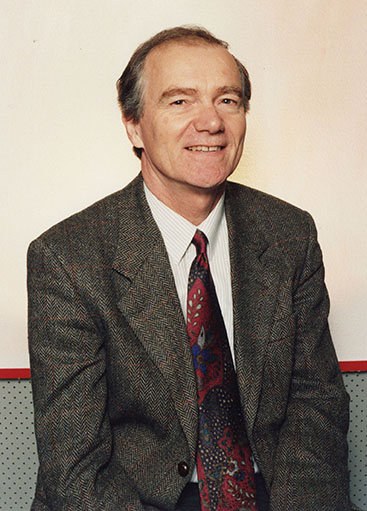
An octave has been described as a mathematical reality with an emotional meaning. Few would understand this better than Emeritus Professor Alan Bishop, a mathematical pedagogue and musician who dedicated his career to the psychology of teaching and learning maths.
Professor Bishop, who died on November 18, 2023 aged 86 years, understood the complexity of delivering a subject feared by many and made important scholarly contributions which benefited students and teachers alike. He recognised that research needed to play a role in education, in particular in the investigation into better ways to teach maths. He risked straying from well-trodden research paths into unknown territories, challenging colleagues to think more deeply about their untested assumptions regarding students and learning.
Bishop first came to Monash in 1977 as a visiting research fellow to the Faculty of Education, after being invited by his friend, the late Peter Fensham, who was Professor of Science Education at the time. On sabbatical from Cambridge, famed for its ease of access, Alan was amazed to discover the campus locked its gates at dusk and in a letter to the then Vice-Chancellor, lamented as to why the university had to “barricade” itself.
Clearly the experience didn’t totally put him off, as he successfully applied for the role of Professor of Education, arriving at Monash in 1992, by now a well-known international academic with a rounded research pedigree.
Professor Bishop immersed himself within the administration of the Faculty, holding different roles as Associate Dean at various times for Research, International Affairs and then as Deputy Dean. He set up the Values and Mathematics Project after securing an Australian Research Council grant, later collaborating with science education colleagues to broaden the scope of the investigation. He was also heavily involved in a joint project between the University and the Australian Association of Mathematics Teachers (AAMT) which explored the leadership and teaching skills of senior mathematic teachers. The teachers were asked to view and analyse teaching episodes captured on video using a technique pioneered by Alan years before.
On arriving at Monash, Professor Bishop took over the supervision of some research students but it wasn’t long before he was supervising additional local and overseas students. Mirroring his efforts at developing a group ethos among students at Cambridge, he introduced monthly late afternoon seminars which were often attended by an eclectic bunch of local and overseas students as well as visitors to the Faculty.
Alan John Bishop was born in England in 1937 just before the outbreak of the Second World War. His father was a maths teacher and high school principal who played the violin, and his mother a seamstress and a cellist. With music flowing through his veins, it is not surprising that he became a bassoonist and successfully auditioned for the National Youth Orchestra.
In 1956 after leaving University College School, a public high school linked to London University, he faced a difficult decision: should he make a career out of music or maths? He took the advice of a visiting musician from Holland who warned him that if he really loved music to “stay an amateur.”
Next, he completed two years of national service with the Royal Air Force as an air-radar fitter, which involved trouble-shooting the huge analogue computers then used for navigation. It was his first introduction to computers decades before they came into circulation.
Afterwards, he studied natural science and maths at Southampton University, drawn by the music and sports options. Here, he met his wife Jenny, a linguistics student. On graduating with a BSc in 1961, he enrolled at Loughborough College to undertake a diploma in education, with a view to becoming a teacher of both maths and PE.
On advice from a respected friend and colleague, he successfully applied for a scholarship through the Ford Foundation to study for an MA in teaching at Harvard to familiarise himself with the innovative curriculum being practised in the US called ‘New Math’. It was at Harvard he started to see the possibility and the excitement that could be generated from good research.
Back in England, he found himself rejecting prestigious teaching jobs in top public schools to pursue research. In 1965 he was appointed a full-time research fellow at University of Hull, working on visualisation and the impact of this on learning maths. His interest in visualisation and indeed spatial abilities of children grew, actively engaging him for the next 15 years.
After completing his doctoral studies, Alan moved to Cambridge University to take up a lectureship in the Faculty of Education that lasted 23 years. His experience at Cambridge led him to focus attention on the cultural, social and political issues involved in maths education. He was active in various ways within mathematical education throughout England and became a frequent speaker and convenor of workshops. Alan strove to engage directly in research within education and dispel the notion that it was best left to social scientists rather than educationists.
On sabbatical in Papua New Guinea in 1977 (the same year as his visit to Monash) he became interested in the cultural background of mathematics and mathematics education and how it is carried out in different countries. His subsequent 1988 book, Mathematical Enculturation: A Cultural Perspective, was ground-breaking in that it developed a new conception of mathematics, i.e., as a cultural product embodying different cultural values.
In the 1980s, when Britain was boycotting South Africa in protest over apartheid, Professor Bishop supported the attendance of academics from the country to a conference held by the International Group for the Psychology of Mathematics Education, of which he was a member. His approach was to find ways of helping colleagues disadvantaged by political situations and he organised the PME Skemp Fund which continues to support the travel of colleagues to major conferences.
Bishop was President of the British Mathematical Association, founding member of the British Educational Research Association, a member of the Royal Society’s Mathematics Education Committee and a founding member and co-director of the International Basic Components of Mathematics Education for Teachers (BACOMET) research group.
In 2015 he received the Felix Klein Medal for life achievement in research on mathematics didactics. He retired from Monash in 2002 and was awarded the University’s Excellence in Research Supervision Medal. He was also appointed the title Emeritus Professor.
Professor Bishop was the author and editor of many reports, articles and papers on mathematical education. He edited (1978-1990) the international research journal Educational Studies in Mathematics, published by Kluwer (now Springer). He was the Managing Editor of the research series Mathematics Education Library, also published by Kluwer/Springer and the Chief Editor of the two International Handbooks of Mathematics Education published by Routledge.
On retirement, he returned to the UK to be with his two sons. He never lost his joy of music and singing and was President of the Muzika Esperanto-Ligo, intertwining his love of language, patterns and sound.
Published 26 February 2025.