
June Margaret HEARN (1931 - 2023)
Deputy Chancellor (2001 - 2006)
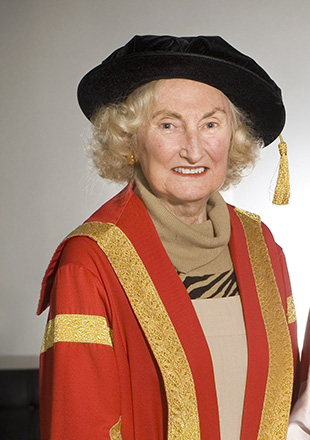
Dr June Hearn, the first woman appointed as Deputy Chancellor at Monash, used to joke that she was educated at Cambridge. She meant, however, the primary school that served the hoi polloi of Collingwood, rather than the hallowed halls of England.
Dr Hearn, who died on October 1 2023 aged 92, was a trailblazer who broke the glass ceiling using good manners and common sense rather than ruthless ambition. She was the academic who refused to apply for a tenured job because she felt her colleague was more entitled to it, yet ended up in positions of power throughout Victoria.
As well as her role as Deputy Chancellor (2001-2006), she was the Foundation Director and Chief Executive Officer of the Hawthorn Institute of Education (1987-1998), becoming the first woman in such a position in tertiary education in Victoria. Prior to that she worked at Victoria College (now Deakin University) where for a time she was Foundation Dean of the Faculty of Arts; at the time, the only woman dean in the college.
Although Monash was just 23 kilometres from where she grew up, it was light years away from the world she knew as a child. Raised in Melbourne’s working-class heartland, Dr Hearn was the first in her family to attend high school, winning scholarships to University High School and the University of Melbourne, where she told the interview panel she aspired to become a secretary. “I had never heard of professions much at all,’’ she recounted, so she picked a word she thought sounded good.
Other pioneering achievements saw her as the first woman to be appointed as senior lecturer in the Graduate School of Business Administration at the University of Melbourne (1978-1982 ) and the first woman to be elected President of its Staff Association (1978-81). And yet she was something of an accidental feminist, never really conscious of her pioneering role until it was pointed out. She followed a “disorganised” trajectory rather than a deliberate path, learning to say yes when opportunities came her way.
As a student she studied Arts, majoring in political science and history, and became a passionate Labor party activist. Afterwards she successfully applied to do a DipEd, but was refused on the grounds that she had recently got married. On graduating, however, she was permitted to work as an untrained teacher due to shortages, and taught at Preston Girls (later, Preston Girls’ High School). In the early 1960s, following the birth of her two sons Bruce and Ian, she went to work for the Australia-USSR Society before returning to further study. In 1974 she wrote her PhD on the pioneering study of migrant experiences in trade unions and described achieving it as her “biggest intellectual thrill.” As a child she had been imbued with a missionary zeal to “save the world,” and she felt that non-English speaking migrants were often neglected by established institutions.
Following an appointment as lecturer in politics at Swinburne Institute of Technology, Dr Hearn moved to the University of Melbourne as a research assistant and tutor in political science. She became a lecturer in industrial relations within the economics department at Melbourne University (where she refused to compete with a male colleague for a tenured position as she felt he was more entitled to it) before her ground-breaking appointment as senior lecturer. After being approached to run for the Dean of the Commerce Faculty, she instead successfully applied for the position as Foundation Dean of the Faculty of Arts and Head of Toorak Campus at Victoria College, cutting short a sabbatical to Oxford University in 1982 to take up the post. As a single parent of two teenage boys following a divorce, she swiftly told those who raised an eyebrow at her decision that she couldn’t afford to be snobbish. It proved memorable. As Professor/Director of the Hawthorn Institute of Education, she described pulling off the affiliation of the college with the University of Melbourne as her “greatest achievement”.
Dr Hearn came to Monash in 1985 as a Member of Council, a position she held until 2006. Her appointment came nine years after her son Bruce Hearn Mackinnon was part of a group of student radicals who “kidnapped” then prime minister Malcom Fraser during a demonstration outside the campus’s Krongold Centre. (Bruce, incidentally, went on to front the ska band Strange Tenants and gain a doctorate in employer de-unionisation strategies). As well as the first woman to serve as the University’s Deputy Chancellor, Dr Hearn was a Member of the Board for Mount Eliza Business School (1995-2000).
June Margaret Hearn was born on July 5th, 1931, the second daughter of Dorothy (née Collis) and William Mackinnon, who were both factory workers in the boot trade, small business operators, and active in the Communist Party. Despite – or because of – their circumstances, her mother went “overboard” in providing extra-curricular activities; the young June learnt ballet, tap dancing, gymnastics and elocution. Meanwhile her father, a keen reader, treated her and her sister, Thelma, as if they were sons, affectionately calling them both “Mick”.
As a scholarship recipient at high school, she often felt the odd one out and forged friendships amongst the children of Jewish migrants. At university, she encountered large numbers of people from private schools and was struck by the disparities in appearance and mannerisms. It reinforced her sense of alienation that no amount of performing ever overcame (she supported her studies by singing and appearing in revues, which she hated, as well as working in retail). Throughout her life she was galvanised by a deep awareness of injustice and inequity and a desire to even the playing field.
Over the course of her career she authored numerous research publications on the changing nature of the Australian workforce and the impact of post-war immigration, the structure and behaviour of the Australian unions, multiculturalism, women in management and education management. She also consulted widely on industrial relations and management issues across government, industry and union sectors. She was President of the Victorian Migrant Workers Trade Union Committee (1975-78), a Member of the Academic Board of the University of Melbourne (1991-1996), a Professorial Associate of the University (1991-1998) and undertook numerous broadcasts for the ABC on public affairs. In the wider community, Dr Hearn served as a Member of the New York Academy of Science, as a Board Member of the Victorian branch of Alzheimer’s Australia and as the President of the Court Network Victoria, a service for all those who come into contact with the law.
She was a recipient of the King Mongkut University of Technology (Thailand) Award for Distinguished Contribution to Education and Training and in 2003 was awarded Membership of the Australian National Pioneer Women’s Hall of Fame. That same year she was also awarded a Centenary Medal for service to industrial relations research and scholarship. In 2009, Monash University awarded her an Honorary Doctor of Laws.
Throughout her life June remained a staunch supporter of Collingwood Football Club, an outward expression of loyalty to her working-class roots, even though today’s Collingwood is a world away from the one in which she grew up. She was a Foundation Board Member of the Collingwood Industrial Magpies; an outreach organisation focussing on Indigenous Australians in remote communities.
She died peacefully, just a few hours after her beloved Pies took their seventh premiership in her lifetime. She is survived by her sons Bruce and Ian, grandsons Alex and William, and step-granddaughters Nik and Piyathida.
Dr Hearn never felt bitter about her tough start in life, instead crediting it for teaching her compassion.
As she put it: “it’s much easier to understand deprivation if you’ve been through it”.
Edited version of article published in The Insider, 13 October 2023.