
Ian James POLMEAR (1928 - 2025)
Professor of Materials Science (1967 - 1986)
Deputy Vice-Chancellor (Research) (1987 - 1990)
Personal Chair in Materials Science (1991)
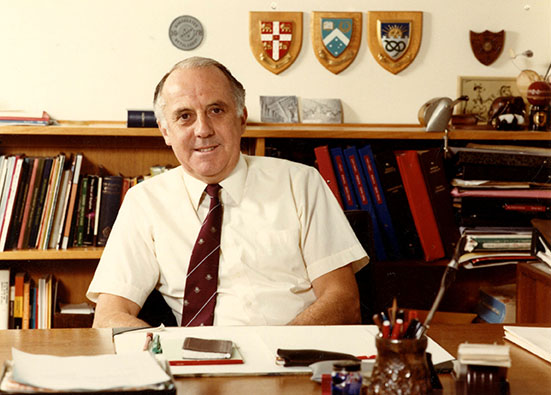
Emeritus Professor Ian Polmear, who died 3 May 2025 aged 97 years, was the first person in his extended family to attend a university. He ended up pioneering the Department of Materials Engineering at Monash and later was appointed Deputy Vice-Chancellor.
Professor Polmear was a renowned metallurgist with outstanding achievements in personal research, academic leadership and consulting. His focus was mainly on light alloys, particularly ones containing aluminium and their use in modern aircraft, as well as investigating problems such as metal fatigue.
His work in stress corrosion cracking, and the addition of silver to prevent this, contributed to lowering the weight of the US Space Shuttle’s main aluminium alloy fuel tank. In the 1990s, he managed a French/Australian investigation to determine whether an aluminium alloy he had developed could be used for manufacturing the fuselage of a possible replacement of the supersonic Concorde aircraft.
The Materials Engineering Department he established at Monash in 1970 was ground-breaking in engineering education in Australia, leading the transition from the field of metallurgy to materials science. It proved to be an outstanding success and its graduates were widely sought after. As important as its academic achievements were its personal ones; Professor Polmear was renowned for creating a happy and harmonious team with distinguished international practitioners in materials making extended visits to the department.
The story of Ian’s success had its roots in childhood. As a boy he was drawn to chemistry, setting up a small laboratory on the back veranda of his tolerant parents’ home in Sandringham and using his spare pocket money to buy chemicals from the local pharmacist. His youth could have come straight out of an Enid Blyton novel; he and his friends swam, flew home-made kites, climbed trees, and built billy carts and bonfires. In his teens he joined the Sandringham Athletic Club and was selected to represent Australia at the British Empire and Commonwealth Games in New Zealand in 1950, where he won a bronze medal in the triple jump. The following year he was a Victorian Triple Jump Champion.
In secondary school at Caulfield Grammar he shone at maths and science and, after matriculating in 1945, applied to study metallurgical engineering at Melbourne University. During his course, he and a friend hitch-hiked around Tasmania visiting several mines. Years later he was amazed to discover that his great-grandfather, who had migrated to Australia in 1856, had been a Cornish tin miner.
After graduating in 1949, he worked for Australian Paper Manufacturers, before moving to General Motors at Fisherman’s Bend where he was concerned with the quality control of components being supplied for the first Holden car engines. Whilst he was there, the Commonwealth Department of Supply invited applications for new research positions in its defence laboratories. Particularly appealing was the requirement that new appointees agree to go to England for two years to gain relevant research experience. Ian applied and was delighted to be offered a position as Experimental Officer at the Aeronautical Research Laboratories (ARL) in Melbourne. Whilst there, he was summoned into an office and asked “what are you interested in?” Looking up at the ceiling the word “athletics” crossed his mind but he duly answered “aluminium metallurgy”.
Three months later and newly married, he and his first wife, Valerie, were on a ship bound for England where he joined the Fulmer Research Institute 25 miles west of London, working closely with aluminium alloys. His particular research interest was the phenomenon of age hardening; a complex process by which certain alloys can be strengthened by heat treatment due to the formation of fine particles (precipitates) throughout, that were unable to be seen in microscopes available at that time. He also investigated the way minor (trace) additions of some other metals could improve mechanical properties by modifying these precipitation processes.
In carrying out this research, Professor Polmear gained valuable experience investigating these processes using optical and elementary electron microscopy. He also constructed an apparatus to measure the unique thermal changes that accompanied precipitation. It was this experience that ignited his desire to pursue a career in research in aluminium alloys that lasted more than sixty years.
Professor Polmear returned to Melbourne in 1953 and received an MSc degree from Melbourne University in 1956 for a thesis describing his research in England. In 1965, he was awarded a Doctor of Engineering on the basis of his published work at ARL, where he was appointed a Principal Research Scientist in 1963 and leader of the Aircraft Materials Group.
At ARL, Professor Polmear initiated a study of stress corrosion cracking which was observed in some age hardened aluminium alloys used for constructing civil and military aircraft. On the premise that this problem may be associated with the precipitation process, he also studied the effects of selected trace elements and found that minute additions of silver could be beneficial in delaying or preventing cracking. Furthermore, he also found that the addition of silver could improve the strength properties of some other age hardened aluminium alloys by promoting formation of new precipitates. Understanding the underlying mechanisms involved was central to much of the research he and various colleagues at Monash and overseas carried out over the years.
In 1967 Ian was appointed Professor of Materials Science in the Department of Civil Engineering at the infant Monash University where, in 1970, he established a separate Department of Materials Engineering, in line with developments overseas. Initially anxious as to how many students it would attract, he was relieved by the first intake of 16. He did not discriminate, recognizing the growing importance of non-metallic materials, such as plastics and ceramics. Today, the Department’s teaching and research relating to metallurgy is highly ranked both in Australia and the wider world; an impressive legacy.
Professor Polmear remained head of the department until 1986 when he was appointed Deputy Vice-Chancellor (Research) under the late Vice-Chancellor and President Professor Mal Logan, a position he held until 1990. During that time, he sat on 26 committees, nine of which he chaired, and was the inaugural chair of the Equal Opportunity Advisory Committee. With his interest in sport, he served briefly as President of the Sports and Recreation Association at Monash and was Chair of the Blues Award Committee (1968 - 1993). He was also an elected member of the Monash University Council (1979 - 1987). He was appointed to a Personal Chair in Materials Science in 1991 and Emeritus Professor in 1992.
Over the decades Professor Polmear’s research interests took him to England, Europe, North America, and Asia. He was a visiting fellow at Cambridge University and at Manchester University’s Institute of Materials Science where he was invited to write a book on light alloys which he completed at Monash and published in 1981. Since then four more editions of Light Alloys have been produced, the last in 2017 with the help of three co-authors. The book has been translated into Chinese and Russian.
After his retirement from Monash, Ian was a Visiting Professor at Tohoku University in Sendai, Japan (1993 – 1995). He also worked part-time for 18 years at CSIRO Materials Science and Technology next to Monash in Clayton, where he was asked to introduce a light metals research program, and served as a consultant at the former Comalco Research Centre for several years.
Professor Polmear was elected a Fellow of the Australian Academy of Technological Sciences and Engineering in 1978, and in 2002 he became the second Australian to be made a Fellow of the British Institute of Materials (formerly known as the Institute of Metals).
In 1988 he received the first award of the silver medal of the Institute of Metals and Materials Australasia (now Materials Australia) of which he was an honorary member. His memory lives on through its Ian Polmear Early Career Research Award. Meanwhile at Monash, the Ian Polmear Room within the Engineering Faculty is named in his honour.
Professor Polmear was appointed an Officer of the Order of Australia (AO) in 1993 “for service to materials science and to engineering” and was awarded a Centenary of Federation Medal in 2003. In 2008 he received one of the University’s 50th Anniversary Research Awards.
Ian always thought he would live close to the sea. But on returning from England in 1953, he and Valerie found they could not afford to move back to Sandringham. They ended up buying a block of land in recently bulldozed orchard country in Mont Albert North, where they had a modest five-room house built. Over the years more rooms were added to cater for the needs of their expanding family of three children. He continued to live there with his second wife Margaret, a botanist and microbiologist whom he married in 1988, and they each gained much pleasure from gardening.
Throughout his long and happy retirement Professor Polmear maintained a close connection with the University through continuing research, publishing in learned journals well into old age. He witnessed many changes over his working life, both at a macro and micro-level. When he was an engineering student the lecture theatre was full of men; today, while the numbers of female students are still comparatively low, he was pleased to see them increasing.
He recalled that at the start of his career, when he peered at alloys down an optical microscope, the features he saw on a polished surface could only be magnified about 2000 times. Now electron microscopes and other sophisticated instruments can see and identify single atoms in the interior of a specimen.
Whilst his life’s work was performed through a microscope, Professor Polmear never lost sight of the bigger picture and was widely known for his collegiality and foresight. He retained a deep gratitude for his role in teaching and research during what he acknowledged as remarkable times.
Edited version of article published 7 May 2025, and in The Insider edition of 8 May 2025.