


Teaching is a challenging profession and many would say that over the past two years it has never been tougher. How then can teachers be supported to stay in Education and have a rewarding and sustainable career?
The most recent Monash Alumni Network Masterclass presentation held in late 2021 considered the question — how do we keep teachers in the profession? In this piece, we share some of the research and practices that were discussed.
Developing teachers with strong professional identities and capabilities is core to the work of school and system leaders. There is extensive focus and resourcing for this work in both research and policy spaces. We came together in late 2021 to think about this issue from our different perspectives. We also considered how the context of the COVID-19 pandemic during 2020 and 2021 had made teaching in our communities both more visible than ever and in many ways, more challenging.
As we know, the extreme COVID induced challenges for educators, although changing, continue into 2022 and so discussion about the ways that teachers can be supported to feel that the profession is a sustainable and rewarding career are more important than ever.

Trust and regard for the teaching profession
In some recent research we found that prior to the pandemic, teachers felt underappreciated by the public. Of the 2,400 teachers we surveyed, 26 percent planned to leave the profession within five years.
However, our research in 2019 and 2020 that surveyed a representative sample of the public, found that there is considerable respect for, and trust in, teachers as these messages from the Monash 2019 World Teacher’s Day campaign show.
“I wouldn’t be who I am today without these incredible teachers.”
“They engaged my will to learn. They nurtured my emerging intelligence and motivation to learn and succeed.”
“They listened and cared for me as an individual, not just a number and saw to my wellbeing and happiness.”
“Thank you to my teacher who always believed in me and my potential when I didn’t myself. You’ve done more for me than you could ever imagine.”
Australians really do value the work of teachers. In our follow up 2020 study we asked participants to tell us about teachers who had influenced them and why. We found that the most common explanations featured the relationships formed with teachers and care that was shown to students.
Messages such as these are so important for educators to hear, as our research also found that the media and policy discourse can undermine teachers’ feeling valued and we’ve seen this throughout the COVID-19 response.
Ecosystems of support and development
It is important to have a strong ecosystem, both within schools and beyond, that surrounds teachers so they feel supported and empowered to survive and thrive in their teaching careers.
In her experience as principal and in her role at the Bastow Institute for Educational Leadership (now the Victorian Academy of Teaching and Leadership), Kate Morris focused on the core concepts of professional identity, belonging and growth in her work to develop and retain teachers.
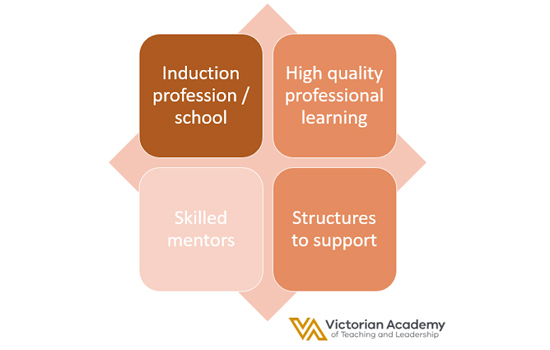
There are four important areas that have been shown to support teachers as demonstrated in the model below. These four areas are all equally as important to the development of resilient and effective teachers:
- Induction to both the profession and specific school context.
- The availability of high-quality professional learning that is needs and interest based.
- The provision of skilled and appropriate mentors (as opposed to mentors of convenience).
- School and system structures to support teachers’ improvement (for example, teacher learning communities and timetabling to enable collaboration).Across those four areas, there are some key themes that require attention. These include:
Across those four areas, there are some key themes that require attention. These include:
- Contributing to the school’s ‘vision’.
- Working collaboratively to co-design learning and wellbeing for excellence.
- Building learning confidence and participation through teacher learning communities.
- Gathering and acting on evidence.
- Raising student achievement.
- Influencing the teaching culture.
- Discussing expectations around issues such as work-life balance.
- Creating networks for learning and wellbeing.

With an ecosystem that attends to these important components of teachers’ professional identity and practice, a more robust sense of belonging and contribution can be engendered. Pairing this with highlighting the community’s appreciation for educators, teachers’ sense of satisfaction in their important roles can be enhanced, their professional capacity developed and their likelihood of staying in the profession increased.
References
Kelly-Ann Allena, Christine Grovea, Fiona S. Maya, and Nicholas Gamblea. Educational Psychology and Inclusive Education. Faculty of Education, Monash University, Australia
Ashiedu, J. A., & Scott-Ladd, B. D. (2012). Understanding Teacher Attraction and Retention Drivers: Addressing Teacher Shortages. Australian Journal of Teacher Education, 37(11).
Amanda Heffernan, Fiona Longmuir, David Bright, Misol Kim. Perceptions of Teachers and Teaching in Australia. Faculty of Education, Monash University, Australia
Heffernan, A., Bright, D., Longmuir, F., & Magyar, B. (2021). Perceptions of Australian schooling: What matters in 2021. Monash University.
Kearney, Sean. Teacher Attrition, Retention and Mobility: Where Does Australian Stand?. Education and Society. Volume 32, Number 2, 2014, pp. 5-24(20)