



There’s a disturbing trend occurring in classrooms. Many women teachers are reporting increased challenges to their authority and expertise with students echoing language echoed from online influencers. It's linked to a growing online movement known as the Manosphere. These digital spaces promote anti-women ideas that don’t stay confined to the internet – they spill into classrooms, shaping how young people interact with their teachers and peers.
In this TeachSpace article, Dr. Stephanie Wescott and teacher Simone Nguyen join Associate Professor Rebecca Cooper to unpack what the Manosphere is, why it’s seeping into classrooms, and what schools can do in response.
Listen to the full discussion
This article is based on a discussion from the Let’s Talk Teaching podcast.
A cultural shift in classrooms
More and more women teachers are noticing something unsettling in their classrooms: a rise in gendered disrespect and overt challenges to their authority, often laced with misogynistic undertones. These aren’t isolated incidents, but symptoms of a broader cultural movement quietly shaping attitudes – particularly among boys.
At the centre of this change is the Manosphere – a growing online space of interconnected communities, personalities, and influencers whose messages often centre on anti-women sentiment. The most well-known figure in this space, Andrew Tate, is just the tip of the iceberg.
What is the Manosphere?
Dr. Wescott defines the manosphere as ‘a loosely connected collection of mostly men united around anti-women and anti-feminist sentiments and ideas’.
Groups include:
- Incels (involuntary celibates)
- Pick-up artists
- Men's rights activists
- Men going their own way (MGTOW)
While each group has unique ideologies, they share a desire to reclaim power they believe has been lost to feminism and to speak out against injustices perpetuated by the gender equality movement. Thanks to social media algorithms, these ideas are no longer fringe.
“Once a social media platform identifies an account belonging to a young men between a certain age range, that account will receive manosphere content,” says Wescott.
“Once a social media platform identifies an account belonging to a young men between a certain age range, that account will receive manosphere content.”
How it shows up in classrooms
Simone Nguyen has taught for over a decade. She’s seen firsthand how the rhetoric of the manosphere manifests in her classroom:
Simone isn’t alone. “It’s consistent across women’s experiences,” says Wescott. Tactics include using clever ways to try to aggravate women by questioning and undermining women's authority and expertise. “And if you identify openly as a feminist, you’re a target.”

Why schools must respond
Schools are uniquely positioned to address these behaviours – not only to protect teachers, but to prevent long-term patterns of violence.
“Some of the young men in our schools will go on to be perpetrators of domestic violence,” Wescott states plainly. “We can identify early signs in teenage behaviour, and that’s exactly when intervention is most effective.”
Yet there’s still a reluctance to label this behaviour as misogynistic or violent when it comes from students. That needs to change.
“Some of the young men in our schools will go on to be perpetrators of domestic violence. We can identify early signs in teenage behaviour, and that’s exactly when intervention is most effective.”
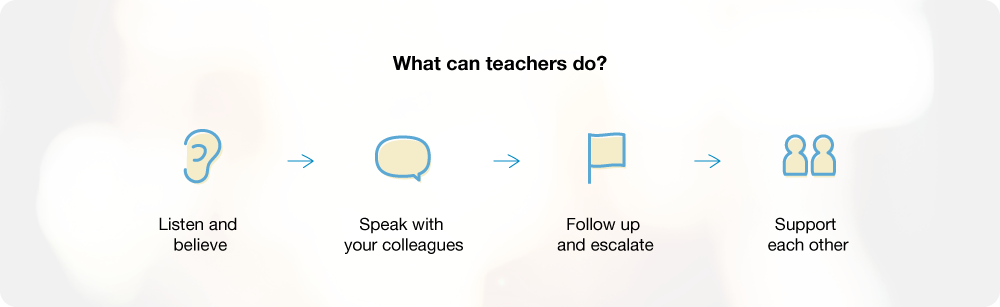
What can teachers do?
Wescott and Nguyen agree: this isn’t a classroom management issue – it’s a whole-school cultural issue. But teachers can take important steps:
1. Listen and believe
When students disclose harassment, listen without judgement. “They’ve chosen you for a reason,” says Simone. “They know you’ll hear them.”
2. Speak with your colleagues
Sharing experiences helps identify patterns. "Until I left my first school, I didn’t realise how many others had gone through the same thing," Simone reflects.
3. Follow up and escalate
Don’t let reports fall through the cracks. Follow through matters and help your colleagues follow these up. Simone says “Leadership must know that inaction has consequences.”
4. Support each other
Both Wescott and Nguyen stress the importance of allyship – especially from men colleagues. That means:
- backing up women staff in meetings and decisions
- avoiding dismissive responses like, “I’ve never had that issue”
- reinforcing authority without taking over.
The role of leadership
School leaders set the tone for the entire school culture. Their role is crucial in:
- Acknowledging and naming the problem.
- Recognising patterns of gender-based harassment
- Supporting teachers consistently – especially early-career teachers
- Prioritising respectful relationships beyond one-off programs like Man Cave. These are good programmes but one annual workshop is not a solution for an ongoing problem.
“This isn’t something that can be fixed by inviting a speaker in once a year,” says Wescott. “It has to be embedded in the school’s DNA.”
“This isn’t something that can be fixed by inviting a speaker in once a year, it has to be embedded in the school’s DNA.”
Respectful relationships: an untapped resource
Victoria already has a framework for addressing these issues with the Respectful Relationships whole-school approach.
This was mandated by the 2016 Royal Commission into Family Violence, because it was recognised that schools are an important part of primary prevention work. However, implementation remains patchy, especially in Victoria.
Data suggests that in Victoria the “whole school approach” has not been embraced by all schools. Wescott sites a lack of support and resourcing for training for teachers and a lack of clarity around what a “whole school approach” are contributing factors. She says “A whole school approach means that there should be zero tolerance across the whole school from leadership down; in policy, in everyday language from the staffroom to the yard for gender-based violence is visible in policy, practice, and daily school life.”
“Schools are both a place for intervention when there’s problematic behaviour, and prevention, so that young people don’t grow up and learn these lessons in more ways with more serious consequences. We can actually teach them now”. Dr Wescott
“A whole school approach means that there should be zero tolerance across the whole school from leadership down; in policy, in everyday language from the staffroom to the yard for gender-based violence”

Final thoughts: a message for teachers who may experience this behaviour
- Know that it’s not your fault.
- You deserve to feel safe in your workplace.
- You have a right to be heard and that you will be taken seriously.
If your school doesn’t support you, speak up and seek allies. And if you’re a teacher preparing pre-service educators, have these conversations early. Empower them with the tools and language to act. Change doesn’t happen if we stay silent.
Listen to other episodes: