




“It was about Kangaroo. He was feeling angry - it was actually about emotions - and the kangaroo feeling angry and trying to get better. The Kangaroo tells us what you can do to stop yourself from when you’re really mad.” - Primary school child
Movement breaks are a practical and meaningful approach to support children's self-regulation and wellbeing. Creating a culture where teachers feel equipped to positively respond to children’s emotions in the classroom is important.
Researchers at the Monash Krongold Clinic have developed a suite of resources for primary school aged children and a professional learning course for teachers. These draw on findings from our research of the Joy of moving program in Australia and support teachers in using movement breaks to improve children’s emotion regulation.
The Joy of moving program in Australia, established by Professor Nicole Rinehart, Dr Nicole Papadopoulos and Dr Chloe Emonson in 2018, assessed the feasibility, acceptability and efficacy of using psychoeducation about emotion regulation through movement breaks in primary schools with a suite of Mood Breaker resources. In the first pilot randomised-controlled study and PhD research, almost 250 teachers at 24 mainstream and specialist schools in Victoria brought movement and mental health activities to their classrooms.
“Our findings showed that teachers recognised the value in the program, its alignment with the curriculum, and potential for integration into the school day. The flexibility of the program, allowing teachers to choose when and which movement break activities to use, emerged as a real strength.” - Dr. Nicole Papadopoulos, Clinical Psychologist and Chief Investigator
Scaling the Joy of moving program in Australia
Phase 2 of this program aims to scale the Joy of moving program in Australia by making the Mood Breaker resources available online, and providing an online professional learning course for mainstream and specialist primary school teachers. Drawing on a decade of research, the scale in this phase has also involved co-design with children, caregivers, educators, and allied health professionals, and expert advice from key stakeholders.
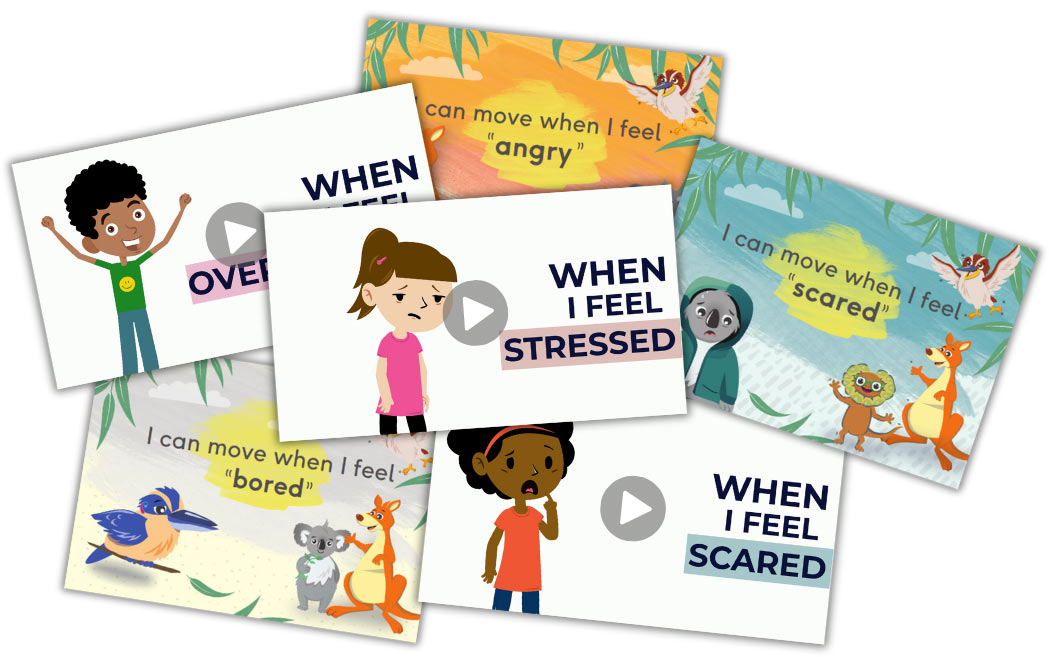
About the Joy of moving program in Australia Mood Breaker resources
The Mood Breaker resources feature iconic Australian animals and characters that children can relate to. Designed for use both at school and at home, they are suitable for primary school aged children and their families, teachers and allied health professionals. The practical and evidence-informed resources include 9 storybooks, 9 animation videos, 54 individual movement activities and 26 group activities for schools, families and children with the aim of
- Providing a child-friendly and accessible way to understand how movement and emotional wellbeing are connected.
- Giving children the opportunity to develop emotional literacy.
- Innovating the way we communicate the science behind the connection between movement and emotions using various modalities to suit diverse learners.
- Showcasing examples of brief movement activities that children can engage with independently or in groups.
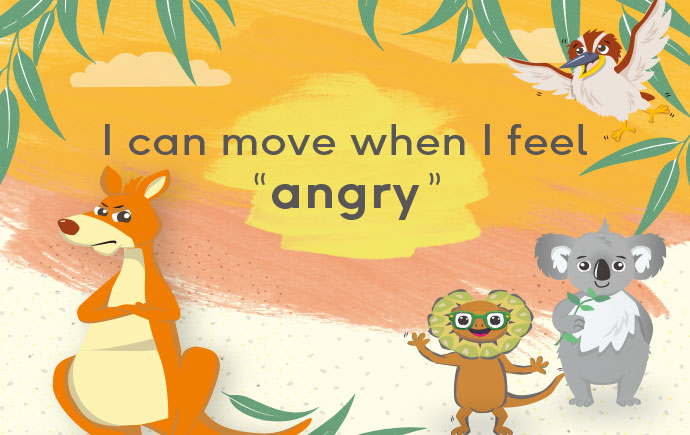
The animation is about “When you (do) not have your friends. When you feel like nobody likes you or everyone hates you - how you can cheer up and make friends with them by doing movements and playing and trying to cheer up.” - Primary school child

How you can bring the Joy of moving program in Australia to your classroom
The professional learning course has been designed to help teachers use the program in the classroom. Through four short lessons, the course supports teachers to build an understanding of emotional development in primary school aged children, and how to support emotion regulation through movement with the Mood Breaker resources. Teachers will also learn accessibility tips and adaptation suggestions to support participation of children with diverse learning styles, disability and/or developmental challenge. The course will take approximately 1 hour to complete the full sequence, with flexibility for teachers to focus on their preferred lessons.
I took that whole idea of movement break as not another thing I have to put in my planner. It's a philosophy for me to follow as a teacher. To know that “No. That child is not going to cope. They need a movement”. They bring back the joy relating to their body. – Primary school teacher
Some of the benefits is teaching teachers the neuroscience - like, the language. It's now in my brain and I can now look at a child and not just say, "Stop wriggling." It's more than just a wriggle. It's a whole body composition. There's something that the body needs. … using the correct neuroscience terms is actually helpful. I think that will cut down a whole lot of behavioral or problems in the room because then you understand neurologically what's going on. - Primary school teacher

Join our Joy of moving in Australia research program
By participating in the course, you are invited to join the Joy of moving program in Australia research that brings teachers and researchers together to make meaningful changes to teaching practices for student wellbeing.
Enrol in our professional learning course to get started!

More about Joy of moving
The Joy of moving program in Australia is proudly supported by Ferrero. The local research program is based on the ideologies of Ferrero’s global Joy of moving program, an innovative play-based methodology that was first created by Foro Italico University in Rome. The methodology aims to help children develop key skills in four major areas; physical fitness, motor coordination, cognitive functions and life skills.
References
Understanding the Benefits of Brief Classroom-Based Physical Activity Interventions on Primary School-Aged Children’s Enjoyment and Subjective Wellbeing: A Systematic Review.
Papadopoulos, N., Mantilla, A., Bussey, K., Emonson, C., Olive, L., McGillivray, J., Pesce, C., Lewis, S., Rinehart, N. (2022).
Journal of School Health, 92(9), 916-932
The feasibility and acceptability of a classroom-based physical activity program for children attending specialist schools: a mixed-methods pilot study.
Emonson, C., Papadopoulos, N., Rinehart, N., Mantilla, A., Fuelscher, I., Boddy, L., Pesce, C., & McGillivray, J. (2022).
BMC Public Health, 22(1), 1–19.
A Preliminary Investigation of the Relationship between Motivation for Physical Activity and Emotional and Behavioural Difficulties in Children Aged 8–12 years: The Role of Autonomous Motivation.
Farmer, E., Papadopoulos, N., Emonson, C., Fuelscher, I., Pesce, C., McGillivray, J., Hyde, C., Olive, L., & Rinehart, N. (2020).
International Journal of Environmental Research and Public Health, 17(15), 5584.
Class Time Physical Activity Programs for Primary School Aged Children at Specialist Schools: A Systematic Mapping Review.
Emonson, C., McGillivray, J., Kothe, E.J., Rinehart, N., Papadopoulos, N. (2019).
International Journal of Environmental Research and Public Health, 16(24), 5140.
Promoting Physical Activity in Children with Disabilities: An Investigation of Preference, Enjoyment, and Classroom-based Programs.
Emonson, Chloe M. (2022).
Deakin University. Thesis.