
Intergenerational play strengthens relationships, fosters mutual understanding, and supports wellbeing across the lifecourse. By creating playful encounters that honour diverse interests, experiences, and capacities, intergenerational play becomes a powerful bridge between generations, cultures, and ways of being.
In our latest TeachSpace article Monash University’s Lisa Kervin explores how important intergenerational play is. Drawing on her Future Fellowship research, she shares how intergenerational play can be understood as a practice that nurtures social bonds, emotional wellbeing, and a sense of belonging. Play is reframed not as something confined to childhood, but as a lifelong human capacity that brings joy, meaning, and connection.
Why intergenerational play (IGP) matters
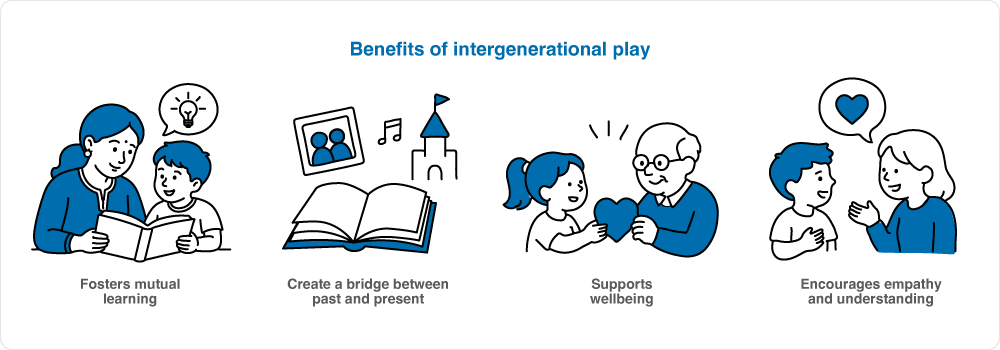
IGP fosters mutual learning
At its heart, intergenerational play is grounded in reciprocity. Children bring spontaneity, imagination, and openness to playful possibilities. Adults (of all ages) bring lived experience, cultural knowledge, and reflective insights. When these dispositions meet, play becomes an opportunity for mutual learning rather than a one-directional exchange. This reciprocity challenges assumptions about who teaches and who learns, instead considering all participants as contributors to the shared play experience.
IGP creates a bridge between past and present
A defining feature of intergenerational play is its ability to create shared meaning-making. When generations play together - whether it be through storytelling, movement, music, games, or making - they co-create narratives that celebrate both tradition and innovation. Children access histories, memories, and cultural practices. Adults gain insight into contemporary childhoods, new forms of expression, and the evolving worlds that shape children’s lives. Play becomes a bridge between past and present, memory and imagination.
IGP supports wellbeing
Intergenerational play also supports wellbeing. For children, playing with adults who are attentive, responsive, and genuinely interested makes them feel safe, valued, and connected. For adults - particularly older adults – taking time to play with children can reduce loneliness, bring joy, and provide a renewed sense of purpose.
IGP encourages empathy and understanding
When people of different ages play together, they encounter each other beyond stereotypes or assumptions. Children see adults as playful, creative, and emotionally present. Adults see children as capable, thoughtful, imaginative, and fun! This mutual recognition helps build more inclusive, respectful, and compassionate communities.
These benefits are amplified when intergenerational play occurs in community settings such as parks, libraries, neighbourhood centres, cultural organisations, and shared public spaces. Such environments create low-pressure opportunities for generations to meet, interact, and build relationships in neutral and shared spaces.
How can educators support intergenerational play?
For educators, community workers, and practitioners, supporting intergenerational play involves a shift in mindset. Rather than designing programs or activities for intergenerational play, think about how this can be part of everyday interactions. Rather than positioning adults as the ones in control, look to how open-ended experiences in flexible spaces can enable everyone to contribute meaningfully.
For example, in educational settings, this might involve facilitating opportunities for grandparents and community members to participate in storytelling sessions, collaborative art projects or play-based learning experiences. Such activities provide opportunities for children and adults to engage playfully with different perspectives while developing empathy, communication skills and understanding of each other.
Consider the following:
Creating shared meaning through play
Ultimately, intergenerational play offers a powerful way to support wellbeing, connection, and building of community. It reminds us that play is not something we outgrow, but something that continues to shape how we relate to others, understand ourselves, and imagine new possibilities. By creating bridges between generations, we create opportunities for belonging, joy, and collective wellbeing.
Intergenerational play brings people of all ages together in shared curiosity, creativity, and connection. It strengthens relationships, supports emotional wellbeing, and fosters mutual understanding across generations.
When communities create spaces where children and adults (of all ages!) can play side by side, they nurture empathy, belonging, and resilience. In this way, intergenerational play becomes a vital bridge – linking experiences, cultures, and generations in meaningful, thoughtful, and joyful ways.