


Have you ever wondered what the earliest form of a concept is that children first experience?
Many children start their learning journeys in childcare centres from a very young age, even before preschool. But have we thought about how to support their learning and the best teaching approaches for infants and toddlers?
Take education in science, technologies, engineering and mathematics (STEM) for example.
Most STEM teaching approaches are developed for 4-year-old children and older with very little research into the learning that takes place prior to this age. Given differences in how learning is organised for toddlers compared to school age children, more research is needed to equip preschool educators with the tools and resources to teach STEM to teach the infant/toddler age group.
And that research is exactly what the Conceptual PlayLab at Monash Universityhave been doing. In a world-first study over the past five years, we have explored how infants, toddlers and older children form concepts in STEM. And how this can nurture imagination and innovation in their formative years and beyond.
Our researchers have studied and built teaching models to support educators in science and play-based learning of infants and toddlers.
The magic of imagination in nurturing innovation
Australia, like many countries, wants to encourage a culture of innovation. It is crucial to future economic growth. To nurture innovation in our children, they need exposure to imagination, creativity and problem-solving in their early years.
The first three years of life are when children develop important cognitive abilities and this can influence a lifelong capacity for learning and inquiry. Therefore, the preschool age is an ideal opportunity to engage and stimulate young enquiring minds with fun, play-based STEM activities.
The Conceptual Playlab researchers looked at imagination in play and imagination in STEM – infants, toddlers, 3-year-olds and pre-schoolers.
Over five years the researchers worked with teachers and developed the Conceptual PlayWorld model. This model aligns to the Australian Curriculum and Early Years Learning Framework. It involves intentional and play-based learning for STEM which sets the stage for learning within the imaginary world of a storybook.
‘Family’ is often the earliest STEM concept children experience
The family system is for many children the first form of a concept they experience. The research findings suggest a strong link between the experience of being in a family and their learning experiences in the childcare centre (Conceptual PlayWorld).
What this means is that a child’s experience of being in a family, gathering/presenting food and being fed, sleeping, and living together in a home, is personally meaningful and integral to play. Educators can build on this by creating play scenarios where children use their family experience to expand their understanding of how to think with concepts.
“We do a lot of pretend cooking in our home corner area. We eat food, and talk about it, and learn about it in our mealtimes. So the food thing seemed to be a really tangible concept that the babies already understand. We would as the grown-up people get food for babies.’ - Teacher interview
How to plan for imaginary play
A Conceptual PlayWorld is full of drama and action – Just what infants and toddlers relate to. Take a look at The March of the Ants story as an example.
Building blocks of a Conceptual PlayWorld
1. Select a story.
In the example, the teachers choose the story of The March of the Ants. The story allows the children to build empathy with the ants when they are hungry, tired and needing to rest.
2. Find space to use as the imaginary world.
The reading couch becomes the ant colony, and the rest of the room is turned into an ecosystem that the ants explore.
3. Plan how the infants, toddlers and teachers enter and exit the imaginary world.
The teachers begin singing The March of the Ants, whilst making marching actions. The children follow the teachers marching into the imaginary world.
4. Introduce the problem.
Setting up an authentic problem that the children are motivated to solve is essential. In this example, the teachers pretend to receive a phone call from the Queen Ant, her babies are hungry, and she needs help finding food.
5. Decide on the teacher's role.
In The March of the Ants, the teachers march alongside the infants and toddlers, they pretend to eat food as though they are hungry ants, they look for and find pretend food. Through pretence the infants and toddlers are positioned in the imaginary world, ‘as if’ they are hungry ants or the Queen Ant feeding her babies.
The Conceptual PlayWorld enriches a child's learning
Using the ‘family’ system as the key foundation for all forms of concepts, imaginary play is used to build on this concept of family. For example, in The March of the Ants story the children draw their family experiences into their ant family imaginary play.
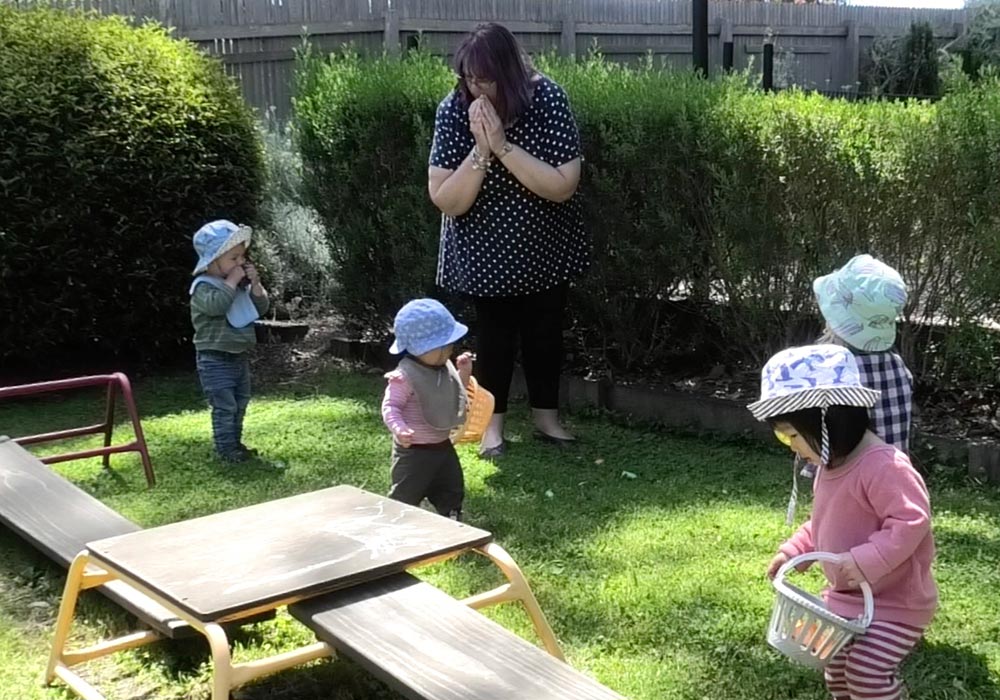
“The baby ants interested them. They used their imagination. They pretended to eat the food, share the food. It was really lovely to see how deep the imagination went with our babies.” - Teacher Interview
It was clear the concept being developed, from family system to an ant family system, expanded their foundational system. That is, the foundational lived experience of being in a family as the first form of a concept was made conscious to the infants and toddlers when they were acting ‘as if’ in an ant family.
The role of educators was crucial in facilitating this conceptual shift. In addition to planning the conceptual shift from the family system to the ant family, educators enhanced the dramatic elements by introducing a character, the Queen Ant, who contacted the children and sought their assistance.
The imaginary play was enriched by opportunities to explore the natural world, including observing real ants. Through these diverse experiences in the Conceptual PlayWorld, researchers noticed that the early stages of understanding the concept of an ‘ecosystem’ began to take shape in the young minds of the infants and toddlers.
Making a difference
Our study found that when infants and toddlers are taught STEM concepts through an imaginative and innovative model (Conceptual PlayWorlds) there are significant benefits for all.
These benefits include greater exposure to STEM concepts in their formative years and increased motivation and love of learning STEM from the earliest age.
The Conceptual PlayLab models are evidence-based and suitable for early childhood teachers to use. By adopting these models, educators can increase quality STEM experiences for infants and toddlers. This in turn can steer them toward further STEM education and STEM careers where their childhood imagination and innovation experiences have contributed solid foundations for their future prospects.
Explore our resources. We offer free online professional development and a range of PlayWorld scenarios that can be adapted for your centre, school or family day care.
Resources
The March of the Ants - PlayWorld starter
Conceptual PlayWorld website
Explore our resources. We offer free online professional development and a range of PlayWorld scenarios that can be adapted for your centre, school or family day care.


