
Kindness is promoted everywhere from social media memes to political speeches, but how can promoting kindness be better resourced and supported in schools?
Monash Education researcher Dr Sophie Lea has helped create a new program to foster kindness, and track its impact, in schools.
Did you know that Australia was the first country in the world to adopt World Kindness Day (Nov 13) into the national school calendar?
It sends a powerful message about the power of kindness to create change, not just on one day, but throughout the year.
Kind Schools was set up to enable schools to harness that power. It’s about creating evidence-informed resources to help schools raise awareness, educate and foster research in this space.
Neuroscience supports the benefits of kindness
Research shows that kindness activates all sorts of good things in our brains both when we receive it and when we act on it.
It releases our feel-good chemicals: dopamine, oxytocin and serotonin
- dopamine, the happy-pleasure chemical
- oxytocin, our love hormone
- serotonin, the neurotransmitter that, in part regulates mood and behaviour.
These positive endorphins also support the creation of new neural connections. Thanks to our neuroplasticity this means kindness can become a self-motivating habit.
The more acts of kindness we do, the easier it becomes. The frequency of our acts of kindness builds our momentum to keep doing good deeds.
Kindness supports our emotional regulation. Acting and experiencing kindness also increases our immunity, creativity and resilience.
Recent research has shown that when university students implemented self- kindness meditation, their depression, anxiety and stress dropped, both in the long and short term.
Kindness is something the medical and therapy professions increasingly value, adopting compassionate care approaches in their training.
The Greek Physician Hippocrates was right on the money when he said: 'Cure sometimes, treat often, and comfort always.'
Why kindness in schools is so important
We know a school's community culture influences students' academic achievement, social connection and psychological wellbeing. Problems within it result in poorer learning outcomes and negatively impact student mental health.
Research in schools shows that actively demonstrating kindness contributes towards students’ wellbeing and enhanced academic performance. This includes improved positive feeling states and a decrease in symptoms of anxiety and depression.
Acts of kindness make schools happier places to be. They improve feelings of positivity, optimism and build social confidence. Encouraging individuals to replicate kind actions they have experienced, creates a more connected school community.
Helping others – especially those less fortunate than ourselves – changes students' life perspectives and even better, when we are aware of our acts of kindness, it highlights and reinforces a gratitude mindset.
In turn, this increases feelings of self-worth, happiness and satisfaction, and a less cynical outlook towards others and our life circumstances.
The Kindness Model
Kindness matters and our school communities play a critical role in educating students' understanding, action and experience of kindness.
Kind Schools defines kindness as a commitment to awareness and action, to care for ourselves, others, and our world.
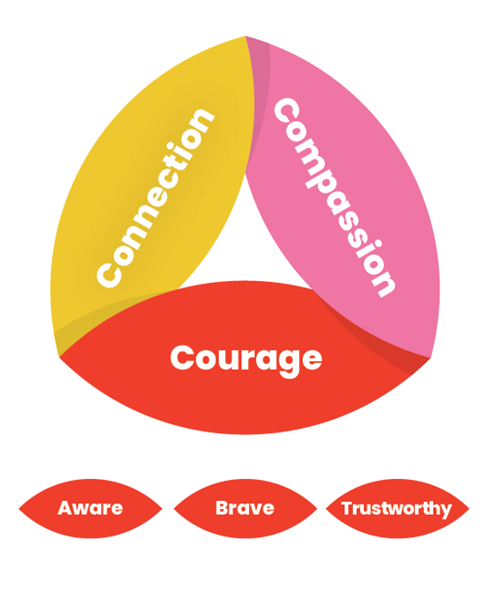
Their Kindness Model for schools was designed to reflect this. It is framed by three C's of Compassion, Connection, and Courage. These branch into nine key qualities of kindness, which include empathy and gratitude.


Kindness resources for educators, teachers and school leaders
Using evidence-based research to develop curriculum programs to elevate kindness, Kind Schools aims to reduce bullying and improve the mental health and wellbeing of young people.
Educators can access these resources including the Kindness Model, free lesson plans and grant opportunities for schools to create and implement their own unique community-led kindness projects.
There are resources that support kind classrooms, kind schools and kind communities – because acts of kindness may start small but create cascades of kindness around the world.
Dr Sophie Lea is a founding member of Kind Schools, a non-profit founded to support educators bring the value of kindness into the heart of everyday school life.
Resources
References
Ballatt J, Campling P. (2011) Intelligent kindness: reforming the culture of healthcare. London: RCPsych Publications.
Binfet JT, Gadermann AM, Schonert-Reichl KA (2016) Measuring kindness at school: psychometric properties of a school kindness scale for children and adolescents. Psychol Sch 53:111–126
Binfet JT, Passmore HA (2017) Teachers’ perceptions of kindness at school. Int J Emot Educ 9:37–53
Cowie, H., & Myers, C. A. (Eds.). (2017). School bullying and mental health: Risks, intervention and prevention. Routledge.
Datu, J., Mateo, N. J., & Natale, S. (2022). The Mental Health Benefits of Kindness-Oriented Schools: School Kindness is Associated with Increased Belongingness and Wellbeing in Filipino High School Students. Child psychiatry and human development, 10.1007/s10578-021-01299-z. Advance online publication.
Datu JAD, Park N (2019) Perceived school kindness and academic engagement: the mediational roles of achievement goal orientations. Sch Psychol Int 40:456–47
Gilbert P. The compassionate mind. London: Robinson, 2009.
Harbaugh, W. T., Mayr, U., & Burghart, D. R. (2007). Neural responses to taxation and voluntary giving reveal motives for charitable donations. Science, 316(5831), 1622-1625.
Hougaard, R., Carter, J., Coutts, G. (2016). Kindness. In: One Second Ahead. Palgrave Macmillan, New York.
Kaplan, D. M., deBlois, M., Dominguez, V., & Walsh, M. E. (2016). Studying the teaching of kindness: A conceptual model for evaluating kindness education programs in schools. Evaluation and program planning, 58, 160-170.
Kerr SL, O’Donovan A, Pepping CA. (2014) Can Gratitude and Kindness Interventions Enhance Wellbeing in a Clinical Sample? J Happiness Study;16(1):17–36.
Kok, B. E., & Fredrickson, B. L. (2010). Upward spirals of the heart: autonomic flexibility, as indexed by vagal tone, reciprocally and prospectively predicts positive emotions and social connectedness. Biological psychology, 85(3), 432–436.
Lea, S.H., Wicking, A., Wicking. P., & R. Dugan. (2022). The Kindness Model, Kind Schools.
Mackay, Hugh. (2021). The kindness revolution : how we can restore hope, rebuild trust and inspire optimism. Crows Nest, NSW : Allen & Unwin
McGrath RE (2015) Character strengths in 75 nations: an update. J Posit Psychol 10:41–52
Otake K, Shimai S, Tanaka-Matsumi J, Otsui K, Fredrickson BL. Happy people become happier through kindness: A counting kindnesses intervention. J Happiness Stud. 2006;7(3):361–75.
Peterson, C., Park, N., & Seligman, M. E. (2005). Orientations to happiness and life satisfaction: The full life versus the empty life. Journal of happiness studies, 6(1), 25-41.
Post, S. G. (2014). Altruism, happiness, and health: It's good to be good. Positive Psychology in Behavioral Medicine, 66-76.
Pressman SD, Kraft TL, Cross MP. It’s good to do good and receive good: The impact of a ‘pay it forward’ style kindness intervention on giver and receiver wellbeing. J Posit Psychol. 2015;10(4):293–302
Random Acts of Kindness Foundation (2016) Kindness in the classroom® curriculum.
Totzeck, C., Teismann, T., Hofmann, S. G., von Brachel, R., Pflug, V., Wannemüller, A., & Margraf, J. (2020). Loving-kindness meditation promotes mental health in university students. Mindfulness, 11(7), 1623-1631.
World Kindness Movement (1997).
Yurdabakan İ, Uz Baş A (2019) Factor structure, measurement invariance, criterion validity, and reliability of the school kindness scale: Turkish middle school sample. J Psychoeduc Assess 37:1002–1015