


Australian teachers and school leaders are increasingly encouraged to use research evidence to drive improvement – but there is often little guidance on how to do that well.
If a teacher was asked by a colleague for some advice on how to get better at using research well as an educator, what would they say? It’s a challenging question.
But work undertaken by the Monash Q Project with over 2,300 Australian teachers and school leaders provides some powerful starting points and some helpful resources to make research meaningful in the classroom.
In this latest TeachSpace article, Monash experts draw on the Q Project findings to share four practical ways teachers can use research more effectively.
1. Think ‘practice’ more than ‘research’
To use research well, there needs to be a clear purpose. It needs to be driven by a specific practice requirement within the school. So, start by looking inward to practice, rather than outward to research: what exactly do we want to improve in our context? As one school leader explained, “by coming up with something that’s really specific and focused … [that’s when] people are invested”.
“My advice for using research well would be to have a purpose – that would be number one. …You have to find something that you want to narrow in on.”
(Middle leader, interview)
As a starting point, teachers can:
- Map out the current sources of evidence in school that can be used to identify priorities.
- Consider what additional information or perspectives are needed.
- Work with colleagues to examine the evidence and identify a clear focus for improvement.
2. Think ‘adapting’ rather than ‘adopting’
To use research well, teachers need to engage with it thoughtfully. So, think about research as providing ideas to adapt rather than answers to adopt. This means being discerning about what research might mean for your practice and your context.
As one leader advised, “You need to understand your culture and your context and your people and then you can figure out how to use that [research] in your context”.
“Don’t think that what’s been put in the research will work wholly in the same way in a classroom … it might be [that you] have to make [your] own adaptations”
(Senior leader, interview)
To get started, teachers can:
- Identify the context detail (e.g., culture, demographics, current practices, priorities) that might affect the implications that are drawn from the research.
- Find out what colleagues need so the research can be adapted to suit the school and classroom context.
- Explore the setting’s readiness for change (e.g., motivation, capacity) to shape how to mobilise the research (e.g., professional learning, school frameworks, instructional playbooks).
3. Think ‘we’ rather than ‘I’
Research is often thought of as an isolated activity, but to use research well in practice, a collaborative approach is necessary. Working with others makes it much easier to find relevant research, to understand its nuance and to trial and implement it effectively. So, think ‘group activity’ rather than ‘individual pursuit’. As one educator told us, “You can't have just one person using research in isolation, it has to be a collaborative approach”.
“[Using research well means] unpacking the research together to gain a common understanding [and] working together to plan and implement the research effectively in the classrooms”.
(Teacher, interview)
To harness collaboration, teachers can:
- Consider when and where working collaboratively with research would be possible in their context and why that would be helpful.
- Identify who could be involved in collaborative efforts and why their involvement is important.
- Reflect on where the school already has productive collaboration happening and how that could be leveraged for research use.
4. Think ‘modelling’ as well as ‘supporting’
To use research well, leaders must model it. Leaders at all levels who use research well themselves have a powerful influence. So, think leading by modelling as well as leading by supporting. As one school leader reflected: “It’s about using research [yourself] and then encouraging more teachers to be developing their expertise with research”.
“Leaders [need to be] able to not only quote the relevant research but be able to
match it with what is happening in the school and then model the application of that
research to all teachers, staff and students.”
(Teacher, survey)
A few ways to do this include:
- Share research with others and explore together how it might be relevant to the school.
- Teachers can reflect on their research use practices and identify their professional development needs.
- Teachers could identify and contact colleagues in professional networks who may be able to help develop their research use, knowledge and skills.
Resources to get started and get better
Here are four resources to get started on the journey to use research well in the classroom.

Resources
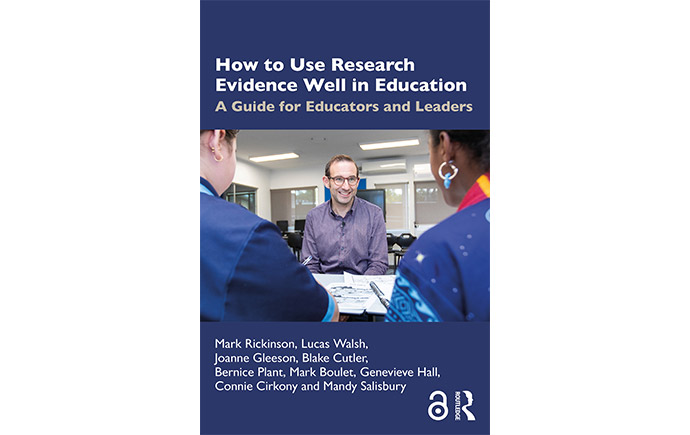
Rickinson, M., Walsh, L., Gleeson, J., Cutler, B., Plant, B., Boulet, M., Hall, G., Cirkony, C., & Salisbury, M. (2026). How to Use Research Evidence Well in Education: A Guide for Educators and Leaders. (1st ed.) Routledge.