
Celebrating Innovation in Education: ATLAS Wins 2 Prestigious ASCILITE Awards

Celebrating Innovation in Education: ATLAS Wins 2 Prestigious ASCILITE Awards
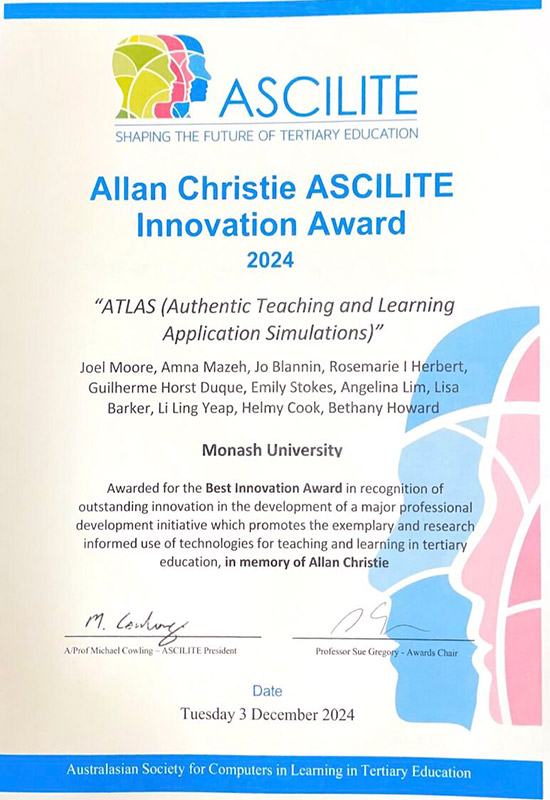
The ATLAS (Authentic Teaching and Learning Application Simulations) project has been honoured
with both the 2024 ASCILITE Innovation Award and the Allan Christie ASCILITE Innovation Award. Dr. Jo Blannin, Deputy Director of the Higher Education Development Institute (HEDI), is a key member of the ATLAS team. These accolades from ASCILITE highlight the exceptional work of the team at Monash University and the transformative impact of ATLAS on technology-enhanced learning.
These awards celebrate innovation, collaboration, and the use of cutting-edge technology in education. ATLAS represents a groundbreaking initiative aimed at bridging the gap between theory and practice by employing AI to create authentic learning experiences across various disciplines. It aims to prepare students for their professional futures by fostering applied, real-world learning through an AI-enabled, secure platform.
The ATLAS team, led by Joel Moore and comprising Helmy Cook, Lisa Barker, Jo Blannin, Amna Mazeh, Bethany Howard, Guilherme Horst Duque, Rosemarie Herbert, Emily Stokes, Angelina Lim, and Li Ling Yeap, collaborated to bring this innovated use of AI to life. These awards are a recognition of their collective dedication and achievement.
The 2024 ASCILITE Innovation Award celebrates innovative initiatives in the use of technology for teaching and learning, while the Allan Christie ASCILITE Innovation Award, named in honor of a key figure in ASCILITE’s history, acknowledges exceptional contributions judged from among Innovation Award nominees. Winning both awards underscores the impact and importance of the ATLAS project in advancing tertiary education.
This recognition has inspired the team to continue their work in this innovative technology-enhanced learning. The ATLAS team is excited to set a benchmark for transformative educational tools and methodologies, paving the way for future advancements in the field.