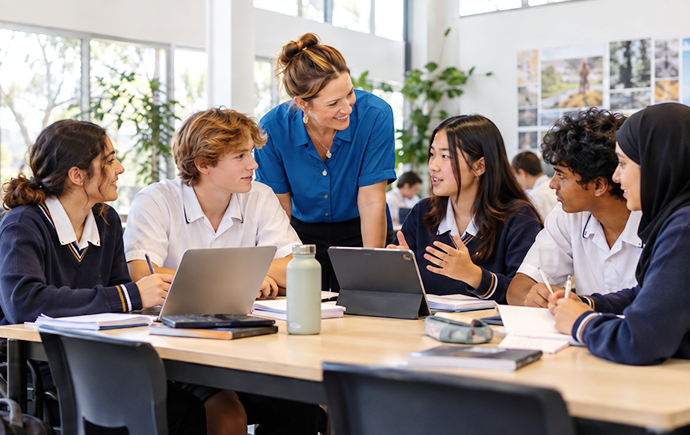
Maintaining prosocial classroom behaviour requires intentional action. The Positive Behaviour Support (PBS) framework can assist your initiatives in your classroom. Here are five PBS strategies you can start using today.
Monash researcher Pearl Subban (Faculty of Education) and primary school teacher Caitriona Dempsey (Monash Alum) discuss Positive Behaviour Support practices teachers can use in the classroom.
A classroom of compassion
A classroom should be a space where all students feel accepted, content and at ease. But achieving that is easier said than done.
Thankfully, teachers have plenty of practical strategies to use. Positive Behaviour Support (PBS) is a teaching framework designed for just this purpose.
PBS is a widely acknowledged means of addressing challenging behaviours in contemporary classrooms. Its ultimate aim is to instil prosocial behaviour and, in doing so, limit behaviours that may not be acceptable.
When students present with problem behaviour, PBS focuses on understanding the function of that behaviour – and addressing it with compassion.
So what does PBS look like in practice?
1. Acknowledge every student personally
Prosocial behaviour is connection-oriented. So why not begin each lesson with a personal greeting?
“Years before COVID forced handshaking into history books, one American teacher greeted his students at the door with personalised handshakes,” says Pearl.
“This might not seem very creative, but research shows it can increase on-task behaviours (Allday & Pakurar, 2007). Those early moments with students are critical.”
Caitriona agrees.
“I greet and chat to students individually as they come in each morning,” she explains. “It helps me keep tabs on students who need extra support.”
“Later, while I’m calling out the roll, I sometimes have students greet the person I call after them. Maybe in a language of their choice.”
“These small gestures help build community – and awareness of and respect for one another.”

2. Talk to families regularly – and positively
Students’ families heavily impact their views of the world – including their attitudes towards school.
“Some families have had poor experiences with previous teachers and schools,” Caitriona reminds us. “Or, if they’re from overseas, their educational experience could be very different.”
To address this, Caitriona habitually communicates with families when students show prosocial behaviour.
“My favourite method is to print notes that list various positive behaviours. I tick those off, sign the note and let a student take it home.”
“I hope to bring positivity into students’ homes this way. And if I need to discuss something negative, the family will have a bank of good experiences as a cushion.”
Pearl says the research supports this.
“Parental involvement can improve attendance and attitudes towards school,” she explains.
“A recent article (Subban & Sharma, 2021) reflects on school as a ‘village’, acknowledging parents as central to the learning process. Whether through phone calls, messages or a learning management platform, positive communication benefits students tremendously.”
3. Recognise and celebrate diversity
Recognising students as individuals – from individual cultures and backgrounds – is crucial for a prosocial classroom.
“Classrooms have become increasingly diverse,” says Pearl. ”So a genuine interest in students’ racial, cultural and linguistic backgrounds is critical.”
Individual interests should be recognised, too.
“I ask students to share their opinions on how the class is run – and learn about their interests, likes and dislikes,” Caitriona says. “Then I try to incorporate those interests into the class. Be they Minecraft or Pokémon cards.”
“I also discuss cultural holidays in class. Maybe I’ll provide books or set a learning task themed around them.”
“By taking an interest in students as people, I hope to create a space where all students feel welcome.”
4. Reward the good, address the bad
When it comes to problem behaviour, the PBS philosophy is to understand the function of those behaviours – but that doesn’t mean educators should let them continue.
“Altering behaviour takes planning, thought and patience,” says Pearl. “Behaviours of concern usually persist until the student’s needs are met.
“Penalties and punishments may only increase, or worsen, these behaviours (Durrant & Ensom, 2012).
“However, behaviour that places other students or the teacher at risk should be stopped immediately,” she says. “This is part of the teacher’s duty of care.”
In the classroom, Caitriona takes a multipronged approach.
“In my first week as their teacher, I tell my students what the consequences are for bad behaviour,” she says. “I also establish rewards for positive behaviour. If we ignore that, it can make students feel emotionally stagnant.
“When they do misbehave, we don’t dwell on it. I remind them that negative actions don’t define them: the incident is just a learning experience.”

5. Explain your thought process
“Why do we have to do homework? Why can’t we just play games? Why can’t we eat outside?”
Anyone who interacts with children is familiar with the “eternal why”. Caitriona is – but she takes it in her stride. Generally speaking.
“While I admit these questions can get annoying after the millionth time,” she says, “I try to answer them as often as I can.
“It shows my decisions have substance and reason. And explaining my thinking can set an example for when kids need to explain their behaviour.”
Pearl agrees.
“Curiosity is essential for learning, so encouraging questions is central (Jacobs & Renandya, 2021),” she says. “Answering questions encourages more questions – which can improve academic performance (Shah et al., 2018).”
The bottom line
PBS practices help build a culture of mutual respect, acceptance and understanding.
Anchoring activities, like a personal greeting, establish a sense of community. Respectful ties with a child’s family create a happy triad between them, their school and their child.
These and all the above practices assure students that they are seen and heard – addressing their intrinsic, human needs from the outset.
The outcome? Prosocial behaviour that is lasting and organic.
Want more of Pearl and Caitriona’s educational insights? Watch them chat further in the Talking Teaching series – available on YouTube.
References
Allday, R. A., & Pakurar, K. (2007, Summer). Effects of teacher greetings on student on-task behavior. Journal of Applied Behavior Analysis, 40(2), 317-320.
Durrant, J., & Ensom, R. (2012, Sep 4). Physical punishment of children: lessons from 20 years of research. Canadian Medical Association Journal, 184(12), 1373-1377.
Jacobs, G., & Renandya, W. (2021, 11/01). Any questions? Ideas for encouraging more and better student questions. LLT Journal: A Journal on Language and Language Teaching, 24, 349-363.
Shah, P. E., Weeks, H. M., Richards, B., & Kaciroti, N. (2018, 2018/09/01). Early childhood curiosity and kindergarten reading and math academic achievement. Pediatric Research, 84(3), 380-386.
Subban, P., & Sharma, U. (2021). Supporting inclusive education benefits us all. The Sydney Morning Herald.