




Research shows that integrating mathematics and science can enrich student learning by providing relevant, meaningful, and engaging learning experiences that promote positive attitudes towards both subjects. But how can teachers design lessons that effectively integrate these subjects?
Monash researchers, along with primary teachers Anita Green and David Jones, outline key steps in a new approach to learning and teaching science and mathematics.
Examples of integrated lesson sequences
Before we delve into the process of planning an integrated lesson, let us have a look at the two lesson sequences that we co-developed with primary teachers. These lessons apply knowledge and skills from both maths and science to investigate a real-world problem or scenario, relevant to upper middle primary aged students (year 4-6).
Upper primary teachers interested in experimenting with an integrated approach to teaching mathematics and science, may use these sequences as a springboard for collaborative planning discussions, and as an opportunity to adapt a learning trajectory depending on the prior learning experiences of students.
Lesson sequence 1: Keeping your finger on the pulse
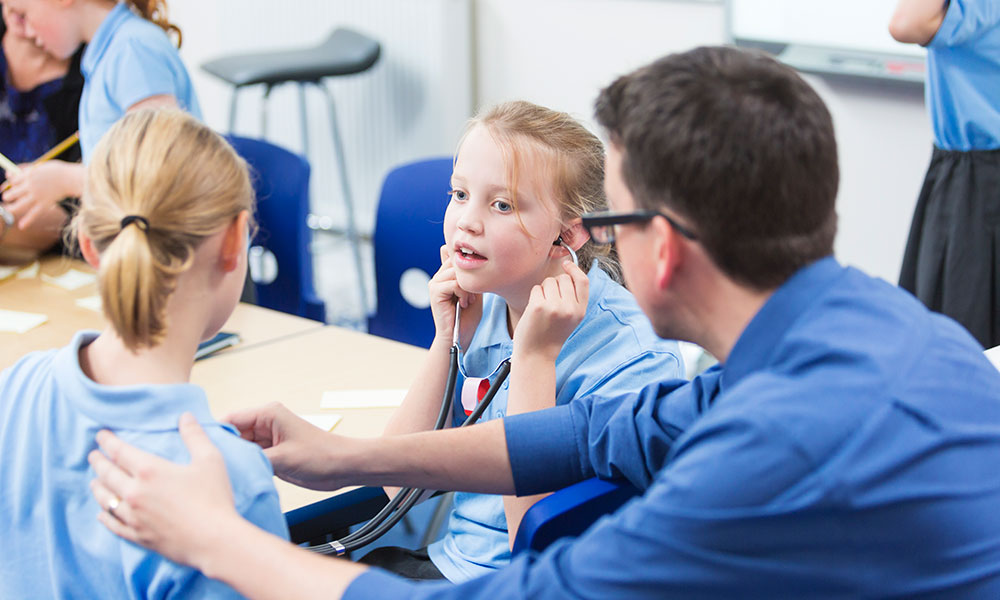
The first sequence we called Keeping your finger on the pulse. From a mathematics perspective, it aims to involve multiplicative (or flexible) thinking, as well as early proportional reasoning (i.e. the ability to identify and describe two things being compared), through activities such as measuring heart beats per minute to calculate heart rate. Proportional reasoning has been described as the capstone of primary mathematics and the cornerstone of secondary mathematics. Research has demonstrated that it is fundamental for understanding many higher level mathematical topics, as well as preparing students to be critical, numerate citizens.
From a science perspective, this sequence helps students learn about the function of the heart, pushing blood containing oxygen around the body to produce energy, and how the heart rate increases when the body needs to produce more energy. During the lessons, students measure, calculate and compare their heart rates over a specific time frame and calculate the percentage increase and decrease.
Download: Overview of the lesson sequence "Keeping your finger on the pulse"
 Lesson sequence 2: Journey through space – you plan it!
The second sequence, Journey through space – you plan it! asks students to name and rank the order of the planets of our solar system, noting the relative size of each planet and the distance between them. The activities of this lesson sequence help students to understand the relative magnitude of large numbers (again, an aspect of proportional reasoning), as well as giving them a better understanding of the sheer size and organisation of our solar system.
Download: Overview of the lesson sequence "Journey through space: You plan it!
How to prepare an integrated lesson
Based on our co-planning process, we developed a set of guidelines to support teachers and educators who are interested in learning how to integrate science and mathematics. Here are our six guidelines:
1. Design a planning framework first
To ensure the lesson sequence equally represents both mathematics and science, is age appropriate and engaging for students, it is important that educators involved in teaching mathematics and science plan together. We used a three-phase cycle – Launch-Explore-Summarise – for planning each lesson to support the integration of both subjects.

Critical to the planning process is collaboration in developing key questions – what we call prompting questions – to support student learning of the key content and process skills for each subject. These questions are recorded in the planning document for each lesson.
It is important to include support structures for student learning, such as a built-in review or reflection at the beginning of each lesson to look back, ask questions about learning and retune student thinking. This helps maintain continuity and encourages inquiry thinking to ensure connection between separate lessons.
2. Be open to thinking creatively when planning and connecting to the curriculum
We were willing to use different and creative approaches to develop the two lesson sequences. The first sequence started with a ‘big idea’ (maths: proportional reasoning) that fit the learning goals. The second sequence was based on making connections between curriculum content for mathematics and science. Both approaches presented some challenges, which required flexible and creative thinking, but were able to be resolved during the collaborative planning process.
In the first ‘big idea’ approach, the mathematics and science curriculum links were not immediately obvious, and the mathematics content seemed beyond that of the primary years. Initially we thought that investigating the effect of exercise on heart rate would involve calculating an increase in heart rate to 70% or 80% or its theoretical maximum (220 minus age), which the curriculum indicated was more appropriate for Year 7-8 students.
So, instead, we opted for a different approach, where all students could engage with proportional reasoning, if the focus was on the concept of ‘beats per minute’ (BPM). By asking students to calculate their maximum BPM when engaging in various activities, the task could be considered as appropriate Year 4 content, as the focus was converting units of time.
Following the challenges encountered with planning using a ‘big idea’, the process for planning the second sequence started differently. We began by identifying complementary curriculum content in both subjects to support student learning.
Setting our sequence in the context of the solar system, and asking the students to rank planetary size and calculate relative distance between planets was a great way of integrating maths and science. Using the curriculum as a guide meant that our process in designing the sequences was more efficient, but it did involve each member of the team being open minded and willing to engage with the process of continuous refinement of ideas and clarification of our learning intentions. We needed to sit comfortably with uncertainty as we worked through the process.
For both approaches, it was important to identify a relevant context with complementary science and mathematics content, and unpack both the content and related skills, and the implications for teaching the concepts within a timeframe of three lessons. It required us thinking in different ways, making creative connections and links between ideas.

3. Connect concepts and skills using an iterative process
Research suggests different ways mathematics and science can be integrated. South Australian researcher Nigel Bean suggests first identifying a big idea or theme, then considering how each subject contributes to the learning of the idea. Planning for deep connections means switching between ‘disciplinary lenses’. Bean proposes an iterative process whereby ideas and plans are continuously revised and further developed throughout the planning and teaching process. We found that:
- Each iteration allows opportunities to connect concepts and skills across disciplines and to refine the plan with the core learning focus in mind.
- An iterative process enabled us to deepen connections between the big ideas for both mathematics and science and the associated learning activities.
The aim for an iterative approach is for concepts and skills to become interconnected and interdependent — e.g., students can create a mathematical model to solve a scientific problem.
However, for the process to work, Bean found teachers needed to emphasise the key mathematical or scientific idea when teaching, rather than doing both simultaneously.
4. Aim for authentic integration
From the start of our planning we made a conscious effort to make sure mathematics — through data representation and interpretation — was not perceived as being a sub-strand of science, and superficial.
Through our planning conversations, we could see there were clear connections between the data interpretation aspect of the mathematics curriculum and science inquiry skills (as opposed to science content). We discovered it was possible to map the data aspects of the mathematics curriculum to aspects of scientific inquiry, and emphasise the importance of integrating data representation and interpretation in science.
Teaching mathematics from such a rich context made it relevant and provided a real-life application. For both the sequences, the science provided a rich context in which to build the mathematics and in effect ‘bookended’ the process by providing the initial ‘hook’ and final ‘take-away’ for the learning sequence.
Integrating the subjects through an inquiry or problem-solving instructional approach helped to bridge the gap between abstract mathematical ideas and real-life experiences and made the learning tangible, as well as strengthening the integration of maths with scientific process skills.
Beginning and ending with the science learning as a rich context, and adopting an iterative process to planning, meant that the ‘science was acting in the service of mathematics’ and vice versa. The relationship between science and mathematics was symbiotic, rather than an either-or choice about which subject would dictate the planning decisions and processes.
5. Collaborate with other specialist teachers
Collaboration between teachers within a professional learning community is central to effectively integrating subjects because it provides opportunity to share knowledge and expertise across fields.
Our project involved practising teachers, each specialised in one of the disciplines, and education researchers collaborating to design integrated lesson sequences. When we reflected on the process, we could see how the expertise and knowledge of each group member informed the process.
When planning the first sequence, Google Jamboard was a useful tool to enable everyone to participate and share ideas across both disciplines. We used it to organise ideas and develop a shared understanding of how to integrate the teaching of concepts from the two disciplines.
The sharing of different perspectives by group members, alongside active listening, helped to refine planning, stimulate new thinking and build conceptual awareness in discipline areas outside each person's expertise. Through this collaborative planning process, we came away with a stronger understanding of our own content knowledge, as well as developing a greater appreciation, and understanding, of our ‘out of field’ area.

6. Be flexible to allow the content and process to evolve
For this type of curriculum planning, flexibility, creativity and risk-taking are important teacher qualities. An important first step for our group was to build relationships and trust. This encouraged openness and a willingness to contribute. We did this by talking with each other about our experiences and backgrounds and what we hoped to gain through this planning process.
We were aware of the iterative and uncertain nature of the process, and this encouraged our comfort with uncertainty, repetitive discussion and continuous refinement towards our shared goal – all the necessary ingredients of a creative, collaborative process.
Risk taking – through the sharing of ideas, even if they did not seem immediately relevant – sparked and encouraged our creative thinking.
We were able to refine our plans through open discussion and critical questioning. Doing so helped us to feel more confident in decision making as we had considered multiple, informed options before making a final decision.
It was important to have clarity about what we were trying to achieve (i.e. our end product), and to continually reflect on how we were going, as well as maintaining flexibility to allow the content and process to evolve.
Resources
Overview of the lesson sequence "Keeping your finger on the pulse"
Overview of the lesson sequence "Journey through space: You plan it!
The making of a maths lesson (Primary Learning)
How to get your Grade 1 and 2 students to think like mathematicians (TeachSpace)
The Story of Launch-Explore-Summarize (Middle Grades Mathematics Project, Michigan State University)