
Many students are losing interest in school—especially in science. Yet at the same time, young people are stepping up to tackle big social and environmental issues. From climate change to biodiversity loss, students are speaking out, taking action, and making their voices heard–both online and in their communities.
In this TeachSpace article, Monash Education’s Professor Sara Tolbert shares practical ways that teachers can tap into this energy. By connecting science education to global challenges, teachers can help students feel more engaged, empowered, and inspired to make a difference.
The bigger picture: teaching science in a changing world
Our world is facing complex problems–from greenhouse gas emissions and deforestation to drought, bushfires and species extinction. These human-induced changes have brought countless social and environmental challenges.
Many scientists now call this era the Anthropocene–a time when human activity has become the main driver of environmental change.
These challenges can feel overwhelming for young people leading to disengagement, anxiety, and depression. Domestic STEM degree programs enrolments are diminishing and there is a declining interest in school which partly reflects a growing disconnect between school science and student interest.
For many students, school science can appear disconnected from real life. But this challenge can also be an opportunity.
A crisis or an opportunity?
While traditional classrooms may struggle to keep students engaged, outside of school many young people are actively involved in public campaigns, online advocacy, and climate action. They care–and they want to make a difference.
A recent study from the Australian Council of Education Research, shows that Australian students want to have a voice, feel valued, and engage in meaningful learning on topics they are passionate about. They crave opportunities to interact with others and make a real difference.
The problem of ‘student engagement,’ therefore, presents both a crisis and an opportunity–a turning point where science education can meet students where they are.
How can science education respond?
Here are three strategies that can help students feel more engaged, curious, and capable when learning science.
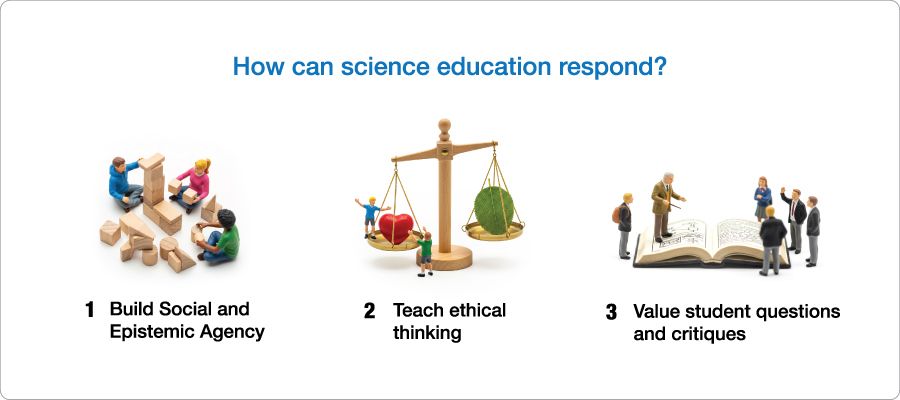
1. Build Social and Epistemic Agency
- Social agency means students feel they can act with others to bring about change.
- Epistemic agency means students feel confident in creating and sharing knowledge by exploring different viewpoints, asking questions, and using evidence to understand the world.
By working with local councils, and community groups and environmental organisations, students can turn abstract science into real-world action.
For example, participating in local environmental projects helps students become collaborators, not just learners. It also opens doors to other ways of understanding science, including Indigenous knowledge systems.
By participating in real-world science projects, students discover that science isn’t just a single set of facts–it’s different ways of thinking and acting ethically in our world.
2. Teach ethical thinking
Science isn’t always neutral. It affects people, communities, and ecosystems in different ways. Educators can help students understand these ethical dimensions by allowing them to explore these dilemmas and tough questions.
For example, how we protect the environment, or who benefits from scientific decisions. This builds their confidence to think critically and make responsible choices in the era of the Anthropocene.
3. Value student questions and critiques
When students express doubt or question scientific practices, use these moments as powerful learning opportunities:
For example, a 5-year-old student involved in a community science project raised concerns about euthanising moths for a reference collection. Instead of dismissing the concern, the teacher, the scientist collaborator and the school paused the project to explore the child's concerns. The result: the students helped design a more culturally respectful and ethical way to continue the research.
For example, students aged 14–16 who took part in a science action research project shared how collaborating with scientists and advocacy groups on science-related social justice issues in the community, such as the urban heat island effect and water contamination, changed their lives.
Here are some comments they made:
I used to feel like…I didn't understand anything, but I never had anything interesting to talk about. Now it's like, when people that my dad hangs out with, older people when they talk about stuff, I can add things in now and say stuff. I'm a little bit more aware about things when it comes to the science aspect. -Melanie
I used to come home and I used to sit on the computer and do nothing. Now, when I get home, I'm researching. I'm writing. I'm drawing out plans. I am trying to figure out ways to solve issues that are happening everywhere. My mum, she's, "You're always busy now." I'm, "It's because I have something to do. I have something to do with my free time instead of just sitting on the computer doing nothing." – Snoopy
Looking at how we can make those connections in the community with different organisations – that helped a lot. Because then the bigger the group of people that have the same ideas as you, or want to tackle the same issue, then the stronger the cause you have now to fight. - Larissa
Why this matters
When students learn science through global challenges:
- They feel more connected and engaged
- They are more interested in science careers
- They experience less anxiety by providing pathways for collective action
- They build confidence and agency
- They learn different ways of knowing, including Aboriginal and Torres Strait Islander perspectives
This approach doesn’t just improve science learning–it helps young people feel like they matter.
Science that empowers
If we want to inspire the next generation, we need to change how we teach science. By framing science education around the Anthropocene challenges, we don’t just teach students about the world–we empower them to change it.
Science is transformed from an abstract academic subject into something real, relevant and powerful. Through studying science through a global challenges approach, students develop a toolkit for understanding and addressing the most important issues of our time.
We already know that students care about the future. The real question is:
Will science education give them the tools to shape it?
References
Cirkony, C., Fragkiadaki, G., & Gunstone, R. (2025). School science: an approach to rethinking what students learn and how they might be better engaged. Science Education.
Sadler, T. D., Xu, Z., & Fortus, D. (2025). Restructuring the science curriculum around grand challenges. International Journal of Science Education, 1-20.
Tolbert, S., Hipkins, R., Cowie, B., & Waiti, P. (2024). Epistemic agency, Indigenous knowledge, and the school science curriculum: reflections from Aotearoa New Zealand. International Journal of Science Education, 1-17.
Tolbert, S., Snook, N., Knox, C., & Udoinwang, I. (2016). Promoting youth empowerment and social change in/through school science.
Tytler, R. W., Monroe, M. C., Eames, C., & White, P. J. (2025). Expanding the scope of science education to engage with Anthropocene challenges. Research in Science Education, 1-19.