


When it comes to creating virtual worlds, most kids are experts. But how can children use games such as Minecraft to build healthier environments for themselves in the real world?
Monash University researchers have explored ways in which Minecraft can help teaching and learning in primary school Health and Physical Education (HPE). The project is supported by VicHealth as part of our Future Healthy initiative.
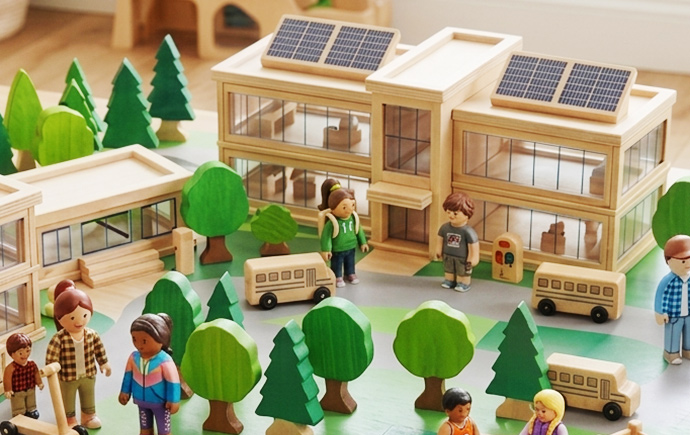
The ‘Kids building Future Healthy in Minecraft’ project is a new approach to health education. Focusing on ‘Personal, Social and Community Health’, Minecraft is used as an engaging tool to enhance student knowledge and literacy related to health and health promotion. Students then apply this knowledge and build Future Healthy places for themselves and their community in Minecraft and beyond.
Kids love to absorb themselves in virtual building games such as Minecraft. Minecraft is a collaborative world-building computer game that uses block-based landscape to explore, build, and interact with the virtual world.
Minecraft has an education-specific version that is used for cross-curricular learning. However, little research has been done on its potential impact within HPE.
Kids building Future Healthy in Minecraft
The ‘Kids building Future Healthy in Minecraft’ project invites primary school children aged between nine and 12 to design a Future Healthy community using Minecraft Education Edition.
Students act as community health researchers and designers. Their mission begins with one critical inquiry question they must answer:
How would you help your community be active, eat well, feel included and be socially connected?
They identify health issues in their local community and find solutions and design a Future Healthy world using Minecraft. This challenge uses strengths-based and design thinking approaches, with a focus on student voice and transformative agency, to support teaching and learning in HPE and education more broadly.
Vic Health’s Dr Sandro Demaio explains the challenge in this video.
How Minecraft can support teaching and learning?
Research shows that when technology is effectively integrated with our teaching goals, it can support strategies in the classroom to:
- accommodate diverse learning needs
- encourage and support cooperative learning
- help students develop personal responsibility for their learning
- connect to other students around the world and
- improve academic achievement.
The open, creative nature of Minecraft has been shown to offer educational benefits to primary and secondary school students. These benefits include the development of collaborative practices that mirror in-person activities like maintaining group members' attention on the task and asking and responding clearly to questions.
Minecraft offers a unique opportunity for kids to work either independently or together to research, design, and build fairer, healthier, socially connected sustainable futures. It continues to be one of the most popular games in the world for children and is available in every government school in Victoria.
How Minecraft supports flexible teaching and learning
Globally, 35 million children in 115 countries are registered to play Minecraft Education Edition. The platform is being used to engage kids in transforming their worlds from New York City to Melbourne and Ballarat. A further benefit of Minecraft is that it offers flexible learning – whether at school or at home kids can collaborate and build their Future Healthy world together.
Research has shown that Minecraft can increase students’ engagement and motivation for learning, leading to improved outcomes. As learners communicate with each other about the design, development, and building of their virtual worlds, they improve their collaborative skills. They become peer mentors and teachers of each other, modifying their support and collaboration to meet the needs and abilities of their group members. In this project, students create healthy virtual worlds together and discuss their learning and knowledge about healthy lives.
Increasing student engagement through Minecraft
Despite being in the early stages of the project, the Monash researchers and teachers have already witnessed opportunities related to Health and Physical Education through Minecraft.
Engagement is often seen as a key challenge to overcome in schools, and the participating teachers felt that Minecraft served as an ideal opportunity for sustaining engagement. They also agreed that the project strongly aligns with the Victorian Curriculum, and is thus not perceived as an ‘add-on’.
As the video below suggests, the students participating in this research were often highly engaged because they found they were learning and having fun at the same time.
Considerations when teaching and learning through Minecraft
Ensuring Ongoing Teacher Support
While technology, and Minecraft in particular, can serve as a useful tool to help to teach and to learn in HPE and beyond, it is important to support teachers in terms of how to best integrate these tools. For example, some teachers may need professional learning opportunities on teaching through Minecraft or about social determinants of health.
Equitable access to Minecraft
Some students may have had more access to Minecraft than others, so there is potential for students with more experience and interest in Minecraft to dominate the collaborative process.
Allowing adequate time to plan for teaching and learning through Minecraft
It is important for learning that students have opportunities to discuss and critically reflect on their Minecraft builds. Setting aside time and support will aid this. In this project the workbook offers excellent targeted learning support for teachers and students.
The project website is here and we will be launching the statewide challenge soon.

Sign up for our email list so we can get in touch once we have launched.
References
Investigating the role of Minecraft in educational learning environments (Educational Media International, 2016)
The Use of Minecraft to Foster Creativity, Collaboration and Motivation through Game-Based Learning and Gamification (International Journal of Game-Based Learning, 2018)
Playing in the Virtual Sandbox: Students’ Collaborative Practices in Minecraft (International Journal of Game-Based Learning, 2018)
Minecraft for Educational Impact (Dezuanni, M.,2020)
Science Hunters: Teaching environmental science concepts in schools using Minecraft (Action Research and Innovation in Science Education, 2019)
Acknowledgements
Huge thanks and appreciation go to VicHealth for funding this project. In particular, we’d like to thank Viv Yii, Ravi Teja, Julien Cayeux, Ross Green, Ellouise Hickleton and the rest of the team at VicHealth for sharing their time, expertise and support.
The pilot project that we reflect on here, owes its success to the children of Watsonia Primary School, and in particular Ingrid Noack, who fully embraced this new way of teaching about health.
We also wish to thank Dr Lisa Young, Dr Christine Grove and Dr Mohammad Jokar for their contributions to the project more broadly.