World Oceans Day is on June 8. This TeachSpace article focuses on how schools can mark World Oceans Day and what this year's theme ‘Catalyzing Action for Our Ocean & Climate’ means in practice.
It follows on from Australia’s annual SeaWeek in March, where our TeachSpace article ‘Planet Ocean’ - what have schools got to do with it? shared opportunities for schools to foster ocean literacy.
Written by Professor Alan Reid, we learn how ocean literacy can be encouraged through a focus on the arts, science and governance. There are some links to excellent teacher resources to assist you in class activities.
Alan Reid is a Professor of Education in Monash’s School of Curriculum, Teaching and Inclusive Education.
Ocean Literacy
The goal of educating for ocean literacy is to empower all students to value, protect, and advocate for our oceans.
As noted in our Planet Ocean TeachSpace article:
Ocean Literacy is defined as “an understanding of the ocean’s influence on you and your influence on the ocean”. An ocean-literate person understands key ocean concepts, communicates effectively about the ocean, and makes informed decisions regarding its resources. It's not just about knowing facts; it's about applying that knowledge for responsible decision-making.
Why Action for our Ocean and Climate is so important
Action is fuelled by inspiration, knowledge and engagement, and each aspect is crucial to how teachers and students can deepen their understanding of the marine world and marine health.
In marking World Oceans Day in 2024, educators are invited to consider how they can interest students in protecting the ocean and the sustainable management of its resources. Explore ocean stories from the UN World Oceans Day community.
World Oceans Day builds on basic facts related to our oceans.
Did you know that:
Teacher resources to foster ocean literacy
To build on these starting points and foster ocean literacy this World Oceans Day, educators can draw on a range of activities to catalyse action. We invite you to consider how you and your school might engage opportunities from three of the six key aspects of 2024’s action theme: Art, Science, and Governance.
Visit the World Oceans Day website to find out more about the other three: Youth, the Blue Economy, and Community.
1. Art ‘FOR PLANET OCEAN’ , Creative Instagram Challenge
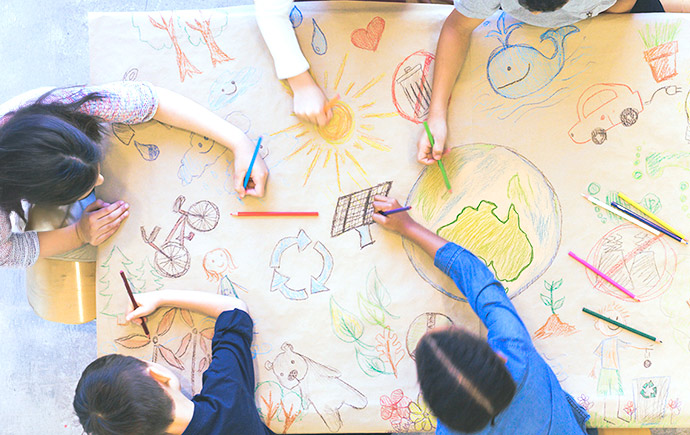
Get students involved in the World Oceans Day art challenge on Instagram. From 6-20 June, ‘For Planet Ocean’ is a social media based collaboration with the Australian Marine Conservation Society that offers a ‘gateway’ creativity activity for school communities to consider what inspires them, and what they might need to know and do about oceans.
The challenge is based on ARTivism, and aims to ‘celebrate, educate and build community around all that is ocean’.
How it works
Post artwork, a photo, video, poem or even a song’ on Instagram responding to any (or all) of the following 5 prompts:
- 6-8 June - Planet Ocean
- 12- 14 June - Wonders Beneath the Waves
- 15-17 June - Ocean Curiosities
- 18-20 June - The Ocean Unites
- 9-11 June - Stories of the sea
- Use the hashtags #ForPlanetOcean #ForPlanetOcean2024 #AMCS
- Tag @forplanetocean @marineconservation.au so they can identify and share your work
Tip: For further inspiration, check for news of the winners of this year’s photo competition for UN World Oceans Day, and this year’s Ocean Conference film festival entries!
2. Science The Great Southern Reef
The ocean is our lifeline. It regulates the climate and produces 50% of the oxygen we breathe. Fish from the ocean provide 20% of animal protein to about 3 billion people. Ten species provide about 30% of marine capture fisheries and another 10% account for about 50% of aquaculture production.
Major threats to our ocean include:
- climate change (the ocean has absorbed 90% of the world’s excess heat in our atmosphere).
- rampant overfishing (at least one-third of the world’s assessed fisheries are pushed beyond their biological limits).
Other local to regional threats to biological diversity include:
- shipping traffic
- deep sea mining
- overdevelopment of the coasts
- biodiversity loss
- plastic pollution
- polluted runoff from land.
Source: Climate Council Australia (2023)

Biodiversity is at the core of the United Nations’ SDG14 – ‘Life below Water: Conserve and sustainably use the oceans, seas and marine resources for sustainable development’. View fullsize infographic (PDF)
In Victoria and along the Great Southern Reef, teachers can draw on a range of high quality teacher guides that integrate Indigenous knowledge and non-Indigenous perspectives about Land and Sea Country, food webs, endangered species, marine research, sustainable seas and stewardship:
Great Southern Reef teacher guides
These guides combine STEM and STEAM-based approaches, showing how temperate marine ecosystems - such as those found on Australia’s southern coastlines - provide unique opportunities to engage in formal and informal education, alongside discipline-based or interdisciplinary approaches within and beyond the science curriculum.
3. Governance #30×30 and protecting the ‘blue ribbon’
Action-focused ocean literacy doesn’t stop at inspiration from, or knowledge about, Australia’s ‘blue ribbon’. There are practical steps for contributing to marine conservation efforts.
Currently roughly 16% of the world’s land and 8% of its seas are protected, however, in 2022, the Kunming-Montreal Post-2020 Global Biodiversity Framework was established. This includes a global target to protect at least 30% of terrestrial and inland water and at least 30% of coastal and marine areas by 2030, i.e. 30x30 for short.
To meet this 30x30 goal, world leaders need to dramatically increase and expand protected and conserved areas, and funding. They also need to ensure the full inclusion of Indigenous Peoples and local communities in conservation measures in order to protect our oceans.

Raising and integrating these themes in Australian schools is a great way to address all the cross-curricular priorities in the Australian curriculum, and ensure a broad-based, realistic and holistic approach to ocean literacy.
One way of doing this is to consider how your current school policy and practices support the following recommendations for ensuring sustainable oceans and coasts in Australia.
You might want to audit and develop resources and strategies to include the following themes in your teaching and learning, operations, partnerships and engagement activities. Choose ones that resonate with your school, to help foster ocean literacy and actions.
What’s next?
Leaders at the Our Ocean conference in Greece in April, promised to take action to help the ocean. They announced over $11 billion for 469 projects, including creating and managing marine protected areas, reducing plastic pollution, making ships greener, improving fisheries, and finding climate solutions for the ocean.
Since 2014, this conference has seen commitments over $140 billion for more than 2,600 projects. However, as with climate finance, it's important that these promises turn into real actions. Schools can play their part by teaching students about the importance of the ocean. This means fostering a deep – rather than shallow – ocean literacy.
The UN Decade of Ocean Science for Sustainable Development 2021–30 (Ocean Decade), aims that:
“By 2025, Ocean Literacy will be integrated into the curriculum and education policies of formal education systems around the world, with 70% of countries possessing an approved National Ocean Literacy Strategy”.
So perhaps bookmark this page, and check back in 2025? By then, we hope TeachSpace can highlight not only a visionary Sustainable Oceans and Coasts National Strategy for Australia, but also progress on an equivalent vision for ocean literacy for all Australians?
Resources
Code Blue: Our Oceans in Crisis
Climate Council of Australia (2023)
Diving into a sea of knowledge: empowering teachers to enhance ocean literacy in primary schools through an ocean education training program.
Environmental Education ResearchFreitas, C., Venzo, P., Bellgrove, A., & Francis, P. (2024)
Sustainable oceans and coasts national strategy 2021-2030
Future Earth AustraliaAustralian Academy of Science, Canberra, Australia (2021)
Threats to Australia's oceans and coasts: A systematic review
Ocean & Coastal Management, 231, 106331.
Laubenstein, T., Smith, T. F., Hobday, A. J., Pecl, G. T., Evans, K., Fulton, E. A., & O'Donnell, T. (2023)
Fostering ocean literacy through informal marine education programs
Marine Pollution Bulletin, 193, 115208.
O'Brien, M., Freitas, C., Venzo, P., & Francis, P. (2023)
Plastic pollution in the marine environment
Heliyon, 6(8), e04709.
Thushari, G. G. N., & Senevirathna, J. D. M. (2020)
Infographic: Life below water - a summary of SDG14
Recommendations from the Sustainable Oceans and Coasts National Strategy (Future Earth Australia, 2021, p.10)
Ocean Decade – The Science We Need For The Ocean We Want
Sustainable Oceans and Coasts National Strategy
Social media tag to follow:
#worldoceansday