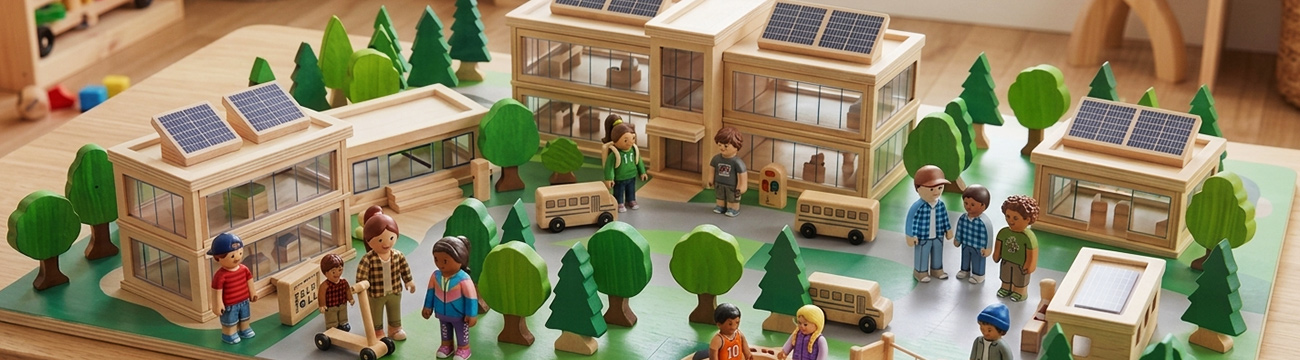


This Earth Day, we explore how net zero schools align climate ambition with everyday practice. From reducing costs to improving wellbeing, net zero schools offer more than environmental gains. Here’s why they matter — and what it takes to make them work.
Alan Reid is a Professor in the Faculty of Education, Monash University, and Isobel Talks is a postdoctoral researcher and lecturer at the University of Oxford. This Teachspace article has grown out of their ongoing collaborations researching environmental, sustainability and climate change education in the UK and Australia.
What is a “net zero school”?
A net zero school produces as much energy as it uses, reducing reliance on fossil fuels and cutting carbon emissions.
It goes beyond ‘carbon neutral’. While carbon neutrality limits increases in carbon emissions, net zero is more ambitious, focusing on reducing emissions at the source.
For schools, this is more than an environmental goal, it’s a practical way to improve educational outcomes, reduce costs, and embed sustainability into everyday practice — aligning with policy in both Australia and the UK.
The pros - and a challenge - of net zero schooling
Net zero schools are widely recognised for their many benefits, however, upfront costs can be a barrier. Government or sector subsidies may be essential to enabling widespread adoption. Another challenge is the risk of greenwashing - surface-level changes that overlook the scale, complexity and evidence-based pathways required to reach genuine net zero.
Installing solar panels alone isn’t enough. Meaningful change requires rethinking how schools are designed, operated and embedded in their communities.
Typical pathways to net zero include improving building design and energy systems, rethinking transport, reducing food-related emissions and adopting whole-school approaches to water, waste and community engagement.
A net zero journey can build energy literacy, support collaborative leadership, and position schools as sustainability leaders.
1. Environmental gains
Net zero schools use efficient design and renewable energy — like solar — to reduce their energy costs and consumption. In many cases, energy bills can drop significantly (nearly 30% in various climates), while carbon emissions are reduced at the same time [1] [2].
In Australia, governments are supporting this shift. In Victoria, hundreds of schools are part of programs to adopt renewable energy, cut emissions, and save money on power.
For example, the Victorian School Building Authority’s Greener Government School Buildings Program, has 415 schools currently taking part.
Once fully implemented, the program is expected to annually:
- achieve a total installed capacity of 17,400 kilowatts at connection across the school portfolio – enough to generate renewable electricity to power approximately 2,000 houses
- reduce greenhouse gas emissions by more than 23,400 tonnes – the same as removing over 3,400 cars off the road
- save schools more than $4.9 million on their power bills.
Bottom line: Upgrading inefficient buildings can reduce emissions, cut costs, and support broader emissions reduction targets. This is often a key strategy to enacting many government-level Emissions Reduction Plans.
2. Health and wellbeing
The indoor environment quality (IEQ) in schools is crucial for the health and wellbeing of students and staff. Poor IEQ can lead to increased absenteeism and lower academic performance [3].
Net zero schools are designed with this in mind. Improved ventilation, natural light, temperature, and air quality in net zero schools are linked to higher test scores and better overall health outcomes for students [4] [5]. By creating healthier learning environments, schools can enhance student engagement and wellbeing [3].
Bottom line: Net zero schools can enhance indoor air quality, thermal comfort, and lighting, which are critical for staff and student health and academic performance.
3. Economic advantages
Schools spend a lot on energy — sometimes more than on learning resources [3]. Net zero schools can significantly reduce these costs over time, while creating local jobs through building upgrades, green technologies and construction.
Even small changes can make a difference. Schools that participated in a low carbon pilot program achieved an average reduction of 20% in carbon emissions and saved about 15% in operational costs, often with minimal investment [6].
Bottom line: Net zero schools can save money, use public funds more efficiently, and deliver long-term value by reducing operating costs and creating healthier environments.
4. Educational tools
Net zero schools aren’t just buildings, they’re powerful learning tools. They can serve as living laboratories for sustainability education, allowing students to see sustainability in action and connect it to what they learn in the classroom.
Pre-service teachers working in net zero schools, for example, report that integrating the building's sustainable features into lesson plans enhances students' understanding of sustainability and climate change [7].
This approach—particularly when combined with working with mentors and school leadership to embed this work more holistically—aligns well with Jorgenson, Stephenson and White’s (2019) recommendation that schools committed to environmental education (p.168):
"adopt a vision and strategy on climate change and energy education that more explicitly addresses the role of collective action, multiactor networks, and sociotechnical innovation in shaping energy transition processes."
This hands-on approach helps foster a culture of sustainability and encourages more sustainable behaviours. It can also open up new pathways, allowing students to consider green skills jobs, and participation in workforce transition towards a ‘clean economy’.
Bottom line: Net zero schools can make sustainability visible and practical, helping students learn by doing. Success stories can serve as templates for future projects, careers ideas, and lifelong learning opportunities.
5. Community engagement
Net zero schools don’t just benefit students. They can influence the broader community by showcasing successful sustainability initiatives [8]. Schools modelling sustainable practices can inspire families and local communities to make similar changes, and students to become climate advocates beyond the classroom.
Bottom line: Net zero schools can spark wider change, helping communities towards sustainable ways of living, and empowering students to become climate advocates.
Turning ideas into action
Net zero schools offer clear environmental, health, economic and educational benefits [9]. While challenges remain, the opportunity is significant [10]. Net zero schools can reduce emissions, improve learning environments, lower operating costs, and bring sustainability to life for students in meaningful, everyday ways [11].
Earth Day’s theme in 2026 is “Our Power, Our Planet”, and net zero schools show what this can look like in practice - not just as a message, but as something students and communities can see, experience and be part of all year round [12].
Sources
- Al-Saadi, A., Al-Saadi, S., Khan, H., Al-Hashim, A., & Al-Khatri, H. (2023). Judicious design solutions for zero energy school buildings in hot climates. Solar Energy, 264, Article 112050.
- Mohamed, S., Smith, R., Rodrigues, L., Omer, S., & Calautit, J. (2021). The correlation of energy performance and building age in UK schools. Journal of Building Engineering, 43, Article 103141.
- Hu, M. (2017). Assessment of effective energy retrofit strategies and related impact on indoor environmental quality: A case study of an elementary school in the state of Maryland. Journal of Green Building, 12(2), 38-56.
- Finnegan, W. (2023). Beyond whole-school approaches to sustainability: Social practices and practice architectures at secondary schools in England. Energy Research and Social Science, 102, Article 103186.
- Kolokotsa, D., Vagias, V., Fytraki, L., & Oungrinis, K. (2019). Energy analysis of zero energy schools: the case study of child’s asylum in Greece. Advances in Building Energy Research, 13(2), 193-204.
- Odell, P., Rauland, V., & Murcia, K. (2021). Schools: An untapped opportunity for a carbon neutral future. Sustainability, 13(1), Article 46.
- Murley, L. D., Gandy, S. K., & Huss, J. M. (2017). Teacher candidates research, teach, and learn in the nation's first net zero school. The Journal of Environmental Education, 48(2), 121-129.
- Dolphin, G., Pahle, M., Burtraw, D., & Kosch, M. (2023). A net-zero target compels a backward induction approach to climate policy. Nature Climate Change, 13(10), 1033-1041.
- Liebhaber, N., Frick, M., Trummer, J., Michelsen, G., & Keller, L. (2026). Challenges of creating climate-friendly schools: How barriers develop out of organising processes at schools and prevent them from adopting transformative measures. Current Research in Environmental Sustainability, 11, 100343.
- Aldayri, H. M., Ambusaidi, A. K., & Shahat, M. M. (2023). Carbon neutrality in schools: How we can achieve it? In J. M. Falcó, B. Marco-Lajara, L. A. Millán-Tudela and E. Sánchez-García (eds), Crafting a Sustainable Future Through Education and Sustainable Development (pp. 1-23).
- Godoy-Shimizu, D., Hong, S. M., Korolija, I., Schwartz, Y., Mavrogianni, A., & Mumovic, D. (2022). Pathways to improving the school stock of England towards net zero. Buildings and Cities, 3(1), 939-963.
- Jorgenson, S. N., Stephens, J. C., & White, B. (2019). Environmental education in transition: A critical review of recent research on climate change and energy education. The Journal of Environmental Education, 50(3), 160-171.
Wider links
What’s the Buzz about Net Zero Education? – North American Association for Environmental Education webinar recording – and handout
Net Zero 101: what, why and how – UN free, self-paced e-learning resource
NetZeroED – Oxford University Department of Education project
Case studies of institutional change – Oxford University Net Zero Education initiative
Net Zero Academy – Climateworks Australia – professional development
Choosing Our Future: Education for Climate Action - World Bank report (2024)
Australian Federal and State Government Net Zero plans, e.g. Department of Education examples - NSW – VIC - TAS – QLD – WA – SA - ACT - NT
Examples of professional bodies supporting net zero schools
- Australian Association for Environmental Education
- Green Schools Alliance
- UK National Association for Environmental Education
- Global Environmental Education Partnership
Related TeachSpace articles