
Departing Ware Fellow delivers verdict on new Pharmacy program
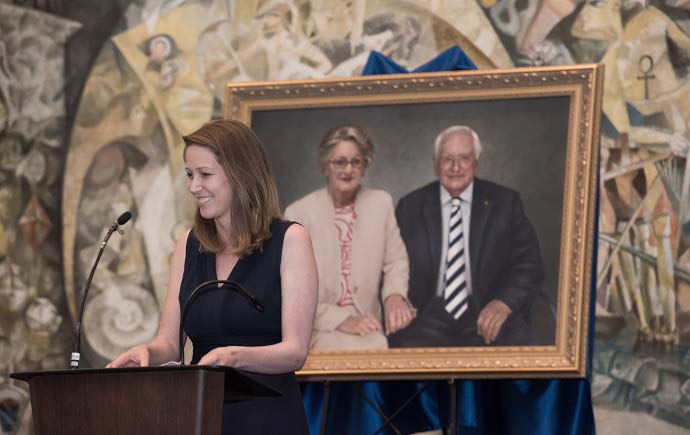
Inaugural Ware Scholar Kayley Lyons and the official portrait of John and Nariel Ware
Before she went to university, Dr Kayley Lyons was a self-described quiet nerd who loved maths and science. When she thought about the future, she imagined a secure job that would allow her to stay close to her home in Minnesota – in fact, after school, she chose to study pharmacy at South Dakota State because it was the closest university to offer the degree (South Dakota borders Minnesota).
At the age of 15, Lyons began working in a community pharmacy. She knew almost immediately that she wanted to be a pharmacist – it not only suited her talents, but was the kind of job that seemed to ideally fit her desire for stability.
Eighteen years on and she couldn’t be further away from home. And while she’s pursued her love of maths, science and pharmacy, she’s also some distance from those early career dreams. Lyons has just completed her tenure as the first John and Nariel Ware Fellowship in Pharmacy Education and Leadership at the Monash Faculty of Pharmacy and Pharmaceutical Sciences. She’ll remain in Melbourne, having taken up the role of Digital Health Workforce Development Lead at the University of Melbourne.
How did she find herself concentrating on health education 15,000 kilometres from her home town?
“During pharmacy school I got really interested in management. After that, I went to the University of North Carolina and completed a combined Masters of Science and Pharmacy Administration degree with two years of a pharmacy administration residency.
“I worked in a UNC hospital, [the equivalent of] an Austin or an Alfred, as a pharmacist and every five weeks in a different area – the ICU, a clinic, learning about an EMR and working with the informatics team.”
She remained at the University of North Carolina at Chapel Hill to undertake a PhD in Education, completing a thesis that concentrated on collaborative learning in pharmacy students while working as a pharmacist.
“Education is not a black box – you can’t just be like ‘Here’s a before student and here’s an after student’. What happens in the middle is really important,” she said. The fact she was so interested in, and uniquely suited to examining, that middle section was one of the central reasons why she came to Monash in 2019.
As she neared the end of her PhD she had to decide on a next career step and felt some trepidation: “I only knew one other person in the United States who had a pharmacy degree and a PhD in education. I was one year before him, so I had to decide. I could have gotten some jobs in the States but they were more teaching focused and less education research focused. This fellowship was a very rare opportunity because this was two years of protected time to build on my four-year commitment in my PhD to do education research.”
The Fellowship coincided with the Faculty’s major curriculum transformation and Lyons’ job as the Ware Fellow was to evaluate how the new curriculum was performing in relation to the old one. She also had to use her research to come up with insights on how it could continue to be improved. This involved multiple small studies that together “painted a larger picture”.
As part of one of those studies she interviewed preceptors who had been responsible for students under both curricula.
“I figured they had the best perspective. They said students were communicating better, taking more initiative. One preceptor said she used to have a hard time getting first-, second- and third-year students to talk with patients. But students coming through the new curriculum did it automatically – she didn’t even have to ask.”
It turned out students coming through the new curriculum also had demonstrably better problem-solving skills. Ultimately, the aim of the new model was to make sure that students were graduating with the ability to improve patient care. And Lyons found that they were. That project is now complete and so is her time at Monash. She said she enjoyed so much about working at the University but more than anything else it was the collaboration between peers that stood out.
What’s rare about Monash is the teamwork. In my time in the States I’ve been around other programs that have been through curriculum transformations and usually, at the end of them, everyone is burnt out. I was impressed at Monash how good the teamwork was and how well everyone worked together.
“It’s a small group but it seemed like a really efficient group and like they all really cared.”