
Pharmacy and Pharmaceutical Sciences Education
We conduct ground-breaking research that underpins our approach and informs our cutting-edge innovations in pharmacy and pharmaceutical science education.
.
-
Blended learning typically involves a mix of online and traditional classroom-based activities that offers students flexibility and accessibility. Whilst technologies and learning space are important supporting tools, desired learning outcomes (knowledge and skills) and factors that influence student engagement and success will be driving forces in optimising the curricula design. There's no one approach that fits all teaching and learning in various disciplines. In this project, the candidate will work with students, instructors, practitioners and industry experts to examine their perceptions, experiences, preferences and identify factors influencing blended teaching and learning in various disciplinary areas of Pharmacy and Pharmaceutical Sciences education. These findings will be integrated with evidence from the literature to generate an indicative framework for quality design, delivery and desired outcomes.
Research Placement
Undertake a placement of a defined period in an external institution, either domestic or international, gaining experience in a different research environment that will augment your PhD.
Contact
Leave this here so that Accordion nested does not detect this CT as not existing. -
Empathy, along with other skills such as communication and teamwork are essential healthcare professional skills. Pharmacists as healthcare practitioners are increasingly expected to be competent in empathetic communication and to provide person-centred care. As future pharmacists in training, pharmacy students receive training in, and assessment of, professional skills including empathy and cultural sensitivity, communication, problem solving and critical thinking, integrity and team work. This study will examine the interplay between these various core skills and undergraduate assessment performance, as well as determine factors that influence the attainment and retention of these skills by pharmacy students.
Research Placement
Undertake a placement of a defined period in an external institution, either domestic or international, gaining experience in a different research environment that will augment your PhD.
Contact
Leave this here so that Accordion nested does not detect this CT as not existing. -
Pharmacies are often the first place of contact to access healthcare advice and treatment for infant colic and reflux. Not much is known about the knowledge and skills of care providers in pharmacy including safe and effective use of pharmacological and other management options, counselling and education. The project aims to examine the role, competencies and training needs of the pharmacy workforce in management of infantile colic and reflux in primary care.
Research Placement
Undertake a placement of a defined period in an external institution, either domestic or international, gaining experience in a different research environment that will augment your PhD.
Contact
Leave this here so that Accordion nested does not detect this CT as not existing. -
Evidence suggests that developing resilience in health professionals is critical and training should begin at the student level.
Early career pharmacists and pharmacy students entering the workforce may be more vulnerable to mental and emotional pressures of the current work environment in the pharmacy profession (1, 2). Hence, there is a need to prepare a pharmacy workforce that is equipped in basic psychosocial skills, trained to reflect on coping strategies and psychological support mechanisms in line with the United Nations’ Sustainable Development Goals 3 and 4 which emphasizes the importance of good health and well-being for all as well as quality education (3, 4).Our overarching goal is to introduce the topic of resilience to students and educate students on strategies to develop their own resilience in parallel with their evolution to practising pharmacists.
Key research questions are: What is resilience? Can resilience be measured? How do we develop strategies to build resilience?
The project will involve surveys, qualitative data analysis and development of a set of recommendations for institution and educator use both within and outside the classroom.
References
1. Stoffel, J. M., Cain, J. (2018). Review of Grit and Resilience Literature within Health Professions Education. American Journal of Pharmaceutical Education, 82(2), 6150-6150.
2. Schlesselman, L. S., Cain, J., Divall, M. (2020). Improving and Restoring the Well-being and Resilience of Pharmacy Students during a Pandemic. Am J Pharm Educ. 84(6), 677-682.
3. Phillips, J., Bekelian, A. (2020). What pharmacy students need to know about burnout, resilience, and well-being. American Journal of Health-System Pharmacy, 77(12), 928–929.
4. Sanderson, B., Brewer, M. (2017). What do we know about student resilience in health professional education? A scoping review of the literature. Nurse Education Today, 58, 65–71.Research Placement
Undertake a placement of a defined period in an external institution, either domestic or international, gaining experience in a different research environment that will augment your PhD.
Contact
Leave this here so that Accordion nested does not detect this CT as not existing. -
This project is part of a Learning and Teaching project through the Australian Council of Deans of Science.
Teamwork skills are teachable qualities that students need to succeed in a 21st century workplace. However, teamwork does not automatically occur as a consequence of putting people together. Teamwork is a dynamic skill that requires instruction, guidance and mentorship. Although the importance of up-skilling graduates in effective teamwork skills is widely recognised, students participating in teamwork at the undergraduate or postgraduate level may face several cognitive, motivational, and emotional obstacles within their groups.
Our research question is: What are design principles for an embedded teamwork skill curriculum in a multi-year university degree program?
As there are currently no proposed design principles for an embedded teamwork curriculum, our team would be pioneering this work.
This project will follow a design-based research (DBR) approach. We will utilise mixed methods to study the iterative and systematic design of a theoretically guided educational intervention (i.e., teamwork curriculum) during implementations in two degree programs - Pharmacy and Pharmaceutical Sciences. Analysis will include descriptive analysis and interaction analysis.
Research Placement
Undertake a placement of a defined period in an external institution, either domestic or international, gaining experience in a different research environment that will augment your PhD.
Contact
Leave this here so that Accordion nested does not detect this CT as not existing. -
Are you interested in understanding student engagement, students learning and improving student success?
This project is part of a Monash Interfaculty project led by the Faculty of Pharmacy and Pharmaceutical Sciences alongside 6 Monash faculties and 2 Monash Malaysia Schools.
Belonging is critical to first-year international student success and a key determinant of student learning and student outcomes. International students encounter numerous challenges including English language barriers, cultural differences, financial hardship, education system differences and loneliness. Whilst the university offers numerous avenues for support, the challenge is also understand how familiarity, interpersonal and academic belonging impact student success.
Key research questions are: What is student belonging? Can student belonging be measured? Can we understand why and how belonging matters to first year international students? How can we promote student belonging at the university, faculty and classroom levels?
The project will involve surveys, qualitative data analysis and development of a set of recommendations for institution and educator use to foster a sense of belonging both within and outside the classroom.Research Placement
Undertake a placement of a defined period in an external institution, either domestic or international, gaining experience in a different research environment that will augment your PhD.
Contact
Leave this here so that Accordion nested does not detect this CT as not existing. -
Pharmacy and Pharmaceutical Science Education
Domestic and family violence (DFV) is a major public health and social issue, affecting individuals across all demographics and communities. Health professionals play a vital role in early identification, support, and referral of people experiencing violence. Among them, pharmacists are uniquely positioned to contribute due to their accessibility, trusted relationships with the community, and frequent contact with individuals who may not engage with other healthcare services.
Despite this potential, DFV training within pharmacy education remains limited, inconsistent, and often underpinned by a biomedical rather than a socio-cultural lens. Many pharmacy graduates report feeling unprepared to respond to DFV disclosures or to navigate the sensitive ethical and cultural dimensions involved.
Integrating DFV into pharmacy curricula—through evidence-informed, culturally responsive, and trauma-aware approaches—can strengthen pharmacists’ capacity to contribute meaningfully to community safety and wellbeing.
This PhD project will address this educational gap by investigating how DFV-related content can be effectively incorporated into pharmacy education and professional training. It will examine existing practices, identify opportunities for curriculum development, and design and evaluate educational interventions that enhance pharmacist preparedness, empathy, and cultural responsiveness.
Contact
Leave this here so that Accordion nested does not detect this CT as not existing. -
The project includes -
- collaboration with other faculties in health disciplines e.g. Medicine, Nursing, Physiotherapy, Dietetics
- longitudinal follow up of students in different health disciplines comparing traditional written assessments to high fidelity assessments (escape rooms, OSCEs, simulation assessments etc) in regards to experiences, preparation, learning approaches, outcomes
- development and validation of high fidelity/virtual assessments to be in line with the current learning style of students and blended nature of teaching (the student will have the opportunity to design educational simulated activities with our software development team)
- investigating and assessing communication of applied knowledge in diverse patient groups using simulation eg. transgender and intersex population, physical and intellectual disability, paediatrics with chronic diseases
Research Placement
Undertake a placement of a defined period in an external institution, either domestic or international, gaining experience in a different research environment that will augment your PhD.
Contact
Leave this here so that Accordion nested does not detect this CT as not existing. -
This project encompasses both local and overseas studies -
- Exploring innovative ways to teach AMS principles across many infectious diseases topics using simulation and technology
- Investigating longitudinal outcomes of AMS learning and its impact on the community and antimicrobial resistance
- Collaborating with Malaysian and Australian campuses (opportunities to work across campuses)
- Opportunities to implement student led interventions in community pharmacy to improve AMS principles and reduce antimicrobial resistance
Research Placement
Undertake a placement of a defined period in an external institution, either domestic or international, gaining experience in a different research environment that will augment your PhD.
Contact
Leave this here so that Accordion nested does not detect this CT as not existing. -
Projects focussed on improving the employability of our PharmSci graduates. Project details will be discussed with potential students identifying the areas of interest.
Research Placement
Undertake a placement of a defined period in an external institution, either domestic or international, gaining experience in a different research environment that will augment your PhD.
Contact
Leave this here so that Accordion nested does not detect this CT as not existing. -
Are you interested in the combination of pharmaceutical science, teaching and learning?
This project is part of an international project led by the Faculty of Pharmacy and Pharmaceutical Sciences and endorsed by the International Union of Pharmacologists. The project aims to identify the core concepts of pharmacology and other pharmaceutical science disciplines that all students should attain before they graduate. The explosion of knowledge in pharmaceutical sciences has made the task of choosing what to learn difficult for students and for educators. An international team with leaders from Australia, the USA, United Kingdom, Africa and South America are working to identify those big ideas that are challenging and critical for students to understand and apply 3-5 years after they graduate.
Key research questions are: What are the core concepts? How can we tell for sure if someone knows these concepts? Do current graduates understand and apply them correctly? How can educators help student to attain these concepts? The project for a PhD or Honours student would be to work with hundreds of international educators and students to produce questions that test some of the core concepts our international group has identified - tests that can be used by students and teachers all over the world.
The project would involve surveys, data mining, qualitative data analysis and development of multiple choice questions. The project would provide a student with the skills and experience to move into a career as an education focused academic or educational designer.Research Placement
Undertake a placement of a defined period in an external institution, either domestic or international, gaining experience in a different research environment that will augment your PhD.
Contact
Leave this here so that Accordion nested does not detect this CT as not existing. -
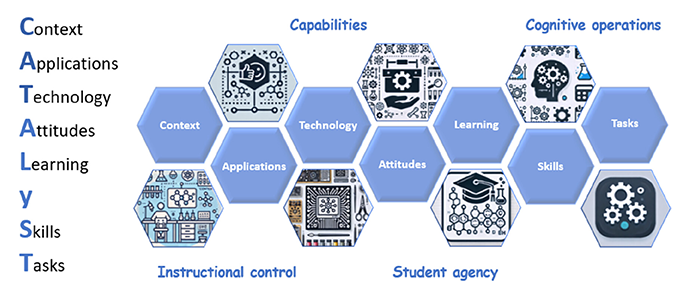
This project aims to investigate the transformative effects of generative AI on pharmaceutical science education. The research will focus on how AI-driven tools enhance learning outcomes, critical thinking, and problem-solving skills among students in pharmaceutical science.
Key objectives include:
- Evaluating the impact of generative AI on students' study strategies
- Evaluating the effectiveness of generative AI in teaching complex pharmaceutical concepts.
- Evaluating the effectiveness of generative AI on students' learning and problem solving, including prompt engineering strategies.
- Assessing student perceptions and attitudes towards the integration of AI in their learning processes.
- Analysing the potential of generative AI to personalize learning and provide tailored educational experiences.
- Identifying challenges and barriers to the adoption of AI technologies in pharmaceutical education.
The project will employ a mixed-methods approach, combining quantitative surveys, qualitative interviews, and case studies. Outcomes will provide valuable insights into optimizing educational strategies and integrating advanced AI technologies to better prepare future pharmaceutical scientists.
Research Placement
Undertake a placement of a defined period in an external institution, either domestic or international, gaining experience in a different research environment that will augment your PhD.
Contact
Leave this here so that Accordion nested does not detect this CT as not existing. -
Education is more about growth in skills than about teaching content. Content changes and moves in directions we can’t even predict today. While students are expected to become content experts, above all they must develop skills that will make them able to function professionally in the faster than ever changing world. They must be able to solve problems and think critically and creatively, communicate effectively in a variety of modes and to a range of audiences, work cooperatively and collaboratively with others, and learn independently.
Supporting students in developing such skills is the central goal of educators.
We have been designing and implementing instructional resources and practices to provide such support. For example:
Yuriev et al., “Scaffolding the development of problem-solving skills in chemistry: guiding novice students out of dead ends and false starts”, Chemistry Education Research and Practice 2017, 18, 486-504. DOI: 10.1039/C7RP00009J
K. Vo, M. Sarkar, P. J. White, and E. Yuriev, “Problem solving in chemistry supported by metacognitive scaffolding: Teaching associates’ perspectives and practices”, Chemistry Education Research and Practice 2022, 23, 436-451. DOI: 10.1039/D1RP00242B
The objective of our educational research is to evaluate the usefulness of these approaches for (i) deeper, more meaningful learning and (ii) improvement in students motivation and engagement. Two specific areas are currently actively pursued:
1. Modifying assessment to motivate learning (the use of open notes during examinations)
2. Goldilocks strategy for scaffolding problem-solving skillsResearch Placement
Undertake a placement of a defined period in an external institution, either domestic or international, gaining experience in a different research environment that will augment your PhD.
Contact
Leave this here so that Accordion nested does not detect this CT as not existing.