
Pharmacy and Pharmaceutical Science Education
We conduct ground-breaking research that underpins our approach and informs our cutting-edge innovations in pharmacy and pharmaceutical science education.
.
-
Empathy, along with other skills such as communication and teamwork are essential healthcare professional skills. Pharmacists as healthcare practitioners are increasingly expected to be competent in empathetic communication and to provide person-centred care. As future pharmacists in training, pharmacy students receive training in, and assessment of, professional skills including empathy and cultural sensitivity, communication, problem solving and critical thinking, integrity and team work. This study will examine the interplay between these various core skills and undergraduate assessment performance, as well as determine factors that influence the attainment and retention of these skills by pharmacy students.
Contact
Leave this here so that Accordion nested does not detect this CT as not existing. -
While diversity, equity and inclusion (DEI) as well as cultural awareness are core values of most tertiary education institutions, this is often not reflected in the teaching curriculum. Therefore, in this project we will explore the international landscape for DEI initiatives within the tertiary education sector. Furthermore, we will analyse the course curricula at MIPS with the aim to highlight opportunities to implement DEI and cultural awareness aspects related to pharmacy and drug discovery. Lastly, this project will facilitate the development of novel methods to teach important DEI and cultural aspects of pharmacy and drug discovery, which are inadequately addressed with the current curriculum at MIPS and more generally in pharmacy and pharmaceutical science education.
Ultimately, this research will ensure that future pharmacists and drug discovery scientists will have a broader perspective and increased awareness of the different medical needs and/or access to medical services as well as drugs that may affect people differently.
Contact
Leave this here so that Accordion nested does not detect this CT as not existing. -
While diversity, equity and inclusion (DEI) as well as cultural awareness are core values of most tertiary education institutions, this is often not reflected in the teaching curriculum. Therefore, in this project we will explore the international landscape for DEI initiatives within the tertiary education sector. Furthermore, we will analyse the course curricula at MIPS with the aim to highlight opportunities to implement DEI and cultural awareness aspects related to pharmacy and drug discovery. Lastly, this project will facilitate the development of novel methods to teach important DEI and cultural aspects of pharmacy and drug discovery, which are inadequately addressed with the current curriculum at MIPS and more generally in pharmacy and pharmaceutical science education.
Ultimately, this research will ensure that future pharmacists and drug discovery scientists will have a broader perspective and increased awareness of the different medical needs and/or access to medical services as well as drugs that may affect people differently.
Contact
Leave this here so that Accordion nested does not detect this CT as not existing. -
This project is part of a Learning and Teaching project through the Australian Council of Deans of Science.
Teamwork skills are teachable qualities that students need to succeed in a 21st century workplace. However, teamwork does not automatically occur as a consequence of putting people together. Teamwork is a dynamic skill that requires instruction, guidance and mentorship. Although the importance of upskilling graduates in effective teamwork skills is widely recognised, students participating in teamwork at the undergraduate or postgraduate level may face several cognitive, motivational, and emotional obstacles within their groups.Our research question is: What are design principles for an embedded teamwork skill curriculum in a multi-year university degree program?
As there are currently no proposed design principles for an embedded teamwork curriculum, our team would be pioneering this work.
This project will follow a design-based research (DBR) approach. We will utilise mixed methods to study the iterative and systematic design of a theoretically guided educational intervention (i.e., teamwork curriculum) during implementations in two degree programs - pharmacy and pharmaceutical sciences. Analysis will include descriptive analysis and interaction analysis.Contact
Leave this here so that Accordion nested does not detect this CT as not existing. -
We offer projects that focus on improving the employability of our PharmSci graduates. Project details will be discussed with potential students identifying their areas of interest.
Contact
Leave this here so that Accordion nested does not detect this CT as not existing. -
During their professional practice, pharmacists are exposed to multiple stressors often simultaneously. Therefore, they must be able to prioritise and switch focus, as well as manage their mindfulness in order to identify and direct their attention to critical activities. High-fidelity simulation provides a controlled learning environment that closely represents reality and can be used to teach and assess pharmacy students’ skills. The modality also provides students an evolving understanding of learning and competency in a simulated environment resembling their future pharmacy practice. This project aims to investigate the impact of interruptions and distractions on task prioritisation and dispensing errors on pharmacy students whilst undertaking assessments incorporating high fidelity simulation. Task prioritisation, number of errors and heart rate will be measured. Students will also complete a self-evaluation pre and post assessment modelled on an evidence-based mindfulness scale. These outcomes will be compared to student assessment results.
Contact
Leave this here so that Accordion nested does not detect this CT as not existing. -
Are you interested in the combination of pharmaceutical science, teaching and learning?
This project is part of an international program led by the Faculty of Pharmacy and Pharmaceutical Sciences and endorsed by the International Union of Pharmacologists. The project aims to identify the core concepts of pharmacology and other pharmaceutical science disciplines that all students should attain before they graduate.
The explosion of knowledge in pharmaceutical sciences has made the task of choosing what to learn almost impossible for students and for educators. An international team with leaders from Australia, the USA, United Kingdom, Africa and South America are working to identify those big ideas that are challenging and critical for students to understand and apply 3-5 years after they graduate.
Key research questions are: What are the core concepts? How can we tell for sure if someone knows these concepts? Do current graduates understand and apply them correctly? How can educators help student to attain these concepts? The project for a PhD or Honours student would be to work with hundreds of international educators and students to produce questions that test some of the core concepts our international group has identified - tests that can be used by students and teachers all over the world.
The project would involve surveys, data mining, qualitative data analysis and development of multiple choice questions. The project would provide a student with the skills and experience to move into a career as an education focused academic or educational designer.
Contact
Leave this here so that Accordion nested does not detect this CT as not existing. -
Student engagement during class is a major determinant of student learning and student outcomes. During classes, students vary in the level to which they think about an activity, how they feel about the activity and how meaningfully they participate in the activity. As Pharmacy and Pharmaceutical Sciences educators increasingly move to active classrooms, where students are asked to engage with a range of activities, we have preliminary evidence that variable student engagement occurs. This variability appears to depend upon the design and implementation of the teaching activity, and on the interpersonal relationships between the students and the teacher.
This project will involve a controlled investigation of these factors that determine student engagement during classes, using 3 methods used in parallel to measure engagement. Student will self-report their level of engagement using a survey designed within the faculty, heart rate will be determined using heart rate monitors worn in class, and external observation will measure behavioural engagement. Individual interventions to be evaluated include the use of games, different types of clicker question, and reflective tasks, and instructor approach.
Contact
Leave this here so that Accordion nested does not detect this CT as not existing. -
Pharmacy and Pharmaceutical Sciences Education
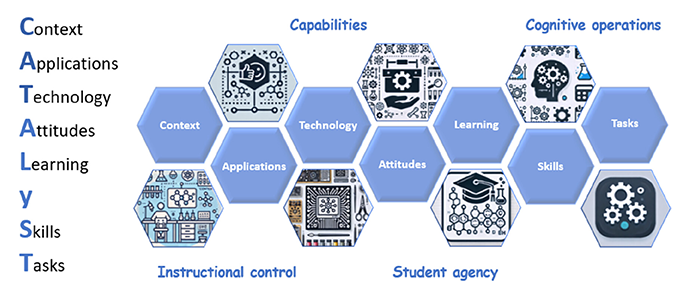
This project aims to investigate the transformative effects of generative AI on pharmaceutical science education. The research will focus on how AI-driven tools enhance learning outcomes, critical thinking, and problem-solving skills among students in pharmaceutical science.
Key objectives include:
- Evaluating the impact of generative AI on students' study strategies
- Evaluating the effectiveness of generative AI in teaching complex pharmaceutical concepts.
- Evaluating the effectiveness of generative AI on students' learning and problem solving, including prompt engineering strategies.
- Assessing student perceptions and attitudes towards the integration of AI in their learning processes.
- Analysing the potential of generative AI to personalize learning and provide tailored educational experiences.
- Identifying challenges and barriers to the adoption of AI technologies in pharmaceutical education.
The project will employ a mixed-methods approach, combining quantitative surveys, qualitative interviews, and case studies. Outcomes will provide valuable insights into optimizing educational strategies and integrating advanced AI technologies to better prepare future pharmaceutical scientists.
Contact
Leave this here so that Accordion nested does not detect this CT as not existing. -
Education is more about growth in skills than about teaching content, as the latter changes and moves in directions we can’t even predict today. While students are expected to become content experts, above all they must develop skills that will make them able to function professionally in the faster than ever changing world. They must be able to solve problems and think critically and creatively, communicate effectively in a variety of modes and to a range of audiences, work cooperatively and collaboratively with others, and learn independently.
Supporting students in developing such skills is the central goal of educators.
We have been designing and implementing instructional resources and practices to provide such support. For example:
Yuriev et al., “Scaffolding the development of problem-solving skills in chemistry: guiding novice students out of dead ends and false starts”, Chemistry Education Research and Practice 2017, 18, 486-504. DOI: 10.1039/C7RP00009J
K. Vo, M. Sarkar, P. J. White, and E. Yuriev, “Problem solving in chemistry supported by metacognitive scaffolding: Teaching associates’ perspectives and practices”, Chemistry Education Research and Practice 2022, 23, 436-451. DOI: 10.1039/D1RP00242B
The objective of our educational research is to evaluate the usefulness of these approaches for (i) deeper, more meaningful learning and (ii) improvement in students motivation and engagement. Two specific areas are currently actively pursued:
1. Modifying assessment to motivate learning (the use of open notes during examinations)
2. Goldilocks strategy for scaffolding problem-solving skillsContact
Leave this here so that Accordion nested does not detect this CT as not existing.