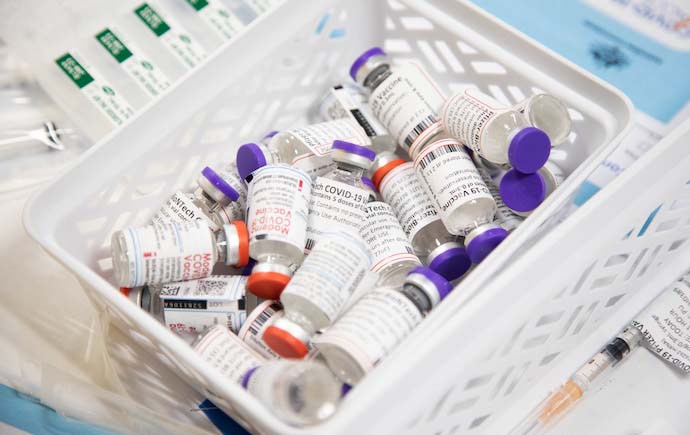
Making waves in mRNA
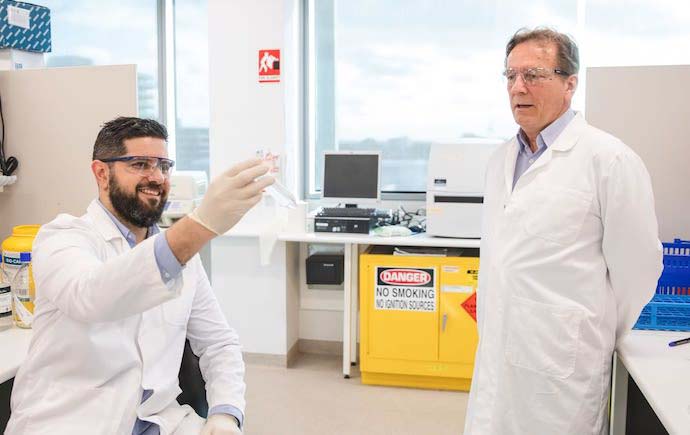
Dr Harry Al-Wassiti (left) and Professor Colin Pouton
Monash made a name for itself in the global race to find a vaccine against COVID-19, with researchers from MIPS developing three mRNA vaccine candidates in 2020. The University remains at the forefront of mRNA research in Australia with several key partnerships and developments over 2022.
2022 has been a defining year for mRNA research and manufacturing in Australia, with much of this activity driven by the Monash Institute of Pharmaceutical Sciences (MIPS), which sits within the Faculty of Pharmacy and Pharmaceutical Sciences at Monash University.
We take a look at the COVID-19 vaccine that has emerged from MIPS research and is currently in Phase 1 Clinical Trials, the future of Monash as an “RNA ecosystem”, as well as the news that US biotech company, Moderna Inc., will open its first production facility at the Monash Technology Precinct in Clayton.
Australia’s first locally developed mRNA COVID-19 vaccine
While the general public may not have known much about mRNA before COVID-19, Monash researchers have been at the forefront of using mRNA in vaccines and other therapeutic innovations for some time.
After the pandemic hit in 2020, a team of researchers from MIPS, led by Colin Pouton, Professor in Pharmaceutical Biology, were the first in Australia to use mRNA science to produce three new vaccine candidates for COVID-19.
Like other leading commercial programs, Professor Pouton’s small team at MIPS, which included Dr Harry Al-Wassiti, assisted by Dr Estelle Suys and two PhD students, Asuka Takanashi and Tom Payne, worked with messenger RNA (mRNA).
In developing an mRNA vaccine, the goal was to produce antibodies that bind to the virus and prevent infection. The mRNA contains the genetic code that allows people’s cells to make part of the coronavirus spike protein. Immune cells can then recognise the protein as foreign, leading to the production of antibodies.
MIPS Professor Pouton named in the “Who Mattered in 2021” list Professor Colin Pouton featured on The Age Good Weekend’s list of “Who Mattered in 2021”. Professor Pouton was listed alongside other influential experts in an informal coalition of scientists from the Australian RNA Production Consortium (ARPC). First formed in August 2020, the list observed that the APRC had “won hearts, minds and dollars in a climate of confusion, suspicion and misinformation.” The ARPC has been responsible for lobbying for local RNA research and manufacturing capabilities. It has also been working with the Australian Academy of Science to organise a National roundtable that will set future priorities for RNA science and research. |
|---|
Collaboration for a common goal
By September 2020, the vaccine research team at MIPS had teamed up with the Peter Doherty Institute for Infection and Immunity (Doherty Institute). Spurred on by the urgent need to respond to the COVID-19 pandemic, the two institutes each brought different and complementary skills.
Unlike MIPS, Doherty scientists could work with live viruses, which allowed them to test the vaccine effectively. The two teams also shared an interest in producing vaccines that focused on the tip of the spike protein, also known as the receptor binding domain (RBD). This collaboration resulted in two vaccine candidates:
- The Doherty Institute’s RBD protein – represents the tip of the spike in an isolated molecular form to focus the immune response on this critical region of the virus targeted by antibodies that neutralise viral infectivity.
- The MIPS RBD mRNA – represents the virus genetic sequence that codes for the tip of the spike, which will lead to production of the RBD protein.
In September 2020, The Commonwealth Government’s Medical Research Future Fund (MRFF) announced a $3 million investment to commence the clinical trial process for these two vaccine candidates.
RBD: A different type of mRNA vaccine The two vaccine candidates developed by MIPS and the Doherty Institute differ from existing mRNA vaccines because they focus the immune response on the tip of the SARS-CoV-2 spike protein, known as the receptor binding domain (RBD). The RBD enables the virus to enter and infect cells in the body and elicits over 90 per cent of neutralising antibodies (antibodies that can block the virus) following SARS-CoV-2 infection. Professor Pouton was quoted as saying that one of the notable things about the RBD mRNA vaccine was its ability to rapidly adjust its composition in response to emerging and future virus mutations. |
|---|
Investing in local production and Melbourne as an mRNA centre
Relatively early in the pandemic, the Victorian government began to invest in mRNA, seeing it as an industry with future potential. In 2021, it made a $50 million commitment to work towards establishing mRNA vaccine and therapeutic manufacturing in Melbourne through the formation of mRNA Victoria. The immediate focus was on COVID-19 vaccines, however, it realised that mRNA technology also offered the potential for new therapeutic solutions for cancer, heart disease, HIV and a variety of other rare disorders.
Scientists and other stakeholders who had lobbied hard for local mRNA manufacturing saw this as a win. It helped overcome the effects of ongoing supply chain issues and increase vaccine capability, while allowing for mRNA production connected to research and development and late-stage clinical trials.
In June 2021, Monash University received $5 million from mRNA Victoria. The grant enabled the MIPS team to work with Melbourne-based manufacturing company IDT, and the Doherty Institute, to prepare their vaccine candidates for Phase 1 clinical trials .
By October 2021, Monash had announced a manufacturing agreement with IDT, to produce the mRNA COVID vaccine in a current Good Manufacturing Process (cGMP) facility for clinical trials. This represented a real milestone as it was Australia’s first locally-developed COVID-19 mRNA vaccine candidate to progress to clinical trials.
In a statement at the time, MIPS Director Professor Chris Porter highlighted the collaboration as an example of world-class research with the potential for commercialisation. This positioned MIPS and the Doherty Institute at the cutting edge of mRNA therapeutics development.
“Monash is highly committed to the exploration of mRNA therapeutics, and this provides a first example of what we hope will be a template for Australian industry and academia to work together to progress this enormously promising new field of medicine,” Professor Porter said.
Building an RNA ecosystem at Monash Monash University is home to Australia's largest network of RNA and mRNA researchers. Established in 2021, Monash RNA is an initiative that spans five faculties, bringing together more than 65 researchers to build an RNA ecosystem to develop life-saving vaccines and therapeutic treatments, including for other infectious diseases and cancers. The lead team includes Professor Colin Pouton and Professor Michelle McIntosh from MIPS, alongside researchers from fields as diverse as Biomedicine, Biochemistry and Molecular Biology, Engineering, and Software Engineering. |
|---|
Groundbreaking Phase 1 clinical trials
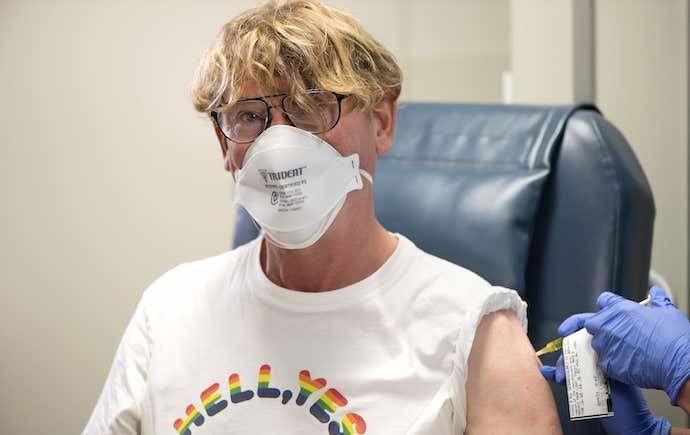
First patient in the clinical trial of two Melbourne-made COVID-19 vaccines. Image supplied by Royal Melbourne Hospital.
Recruitment for Phase 1 clinical trials began in early 2022, with the first volunteers receiving their first dose of the Melbourne-made vaccine in May 2022.
Professor Chris Porter, Director of MIPS, highlighted the uniqueness of the trial, saying:
“It’s the first time a side-by-side comparison will be undertaken of two new COVID-19 platforms. That this is possible within a single trial is a testament to the collaborative ethos of the research teams at MIPS and the Doherty Institute and the broad support of the Australian and Victorian governments and our industry partners.”
Support for the development of the vaccines over time was also received from University of Melbourne, The Royal Melbourne Hospital, CSIRO, Seqirus, Jack Ma Foundation, IFM Investors, Australian Research Council and National Health and Medical Research Council.
Using mRNA to help a broad range of medical applications and diseases The pandemic and the first commercial vaccines from Pfizer and Moderna shone a spotlight on the many possibilities of mRNA technology. With this increased attention has come much-anticipated new funding to further the research that many at Monash have been quietly undertaking for years. Professor Colin Pouton describes 2022 as an exciting time for mRNA technology, thanks to its potential to transcend a broad range of medical applications. The COVID-19 vaccine is not the only mRNA innovation he’s been working on. In June 2022, he received $360,000 in funding through the mRNA Victoria Research Acceleration Fund. These came in the form of two grants for two separate mRNA projects. Professor Pouton received one grant for his collaboration with Professor Christina Mitchell and Dr Meagan McGrath from Monash Faculty of Medicine, Nursing and Health Sciences (MNHS), in partnership with Alfred Health. This project involves developing a lipopeptide-based nanoparticle RNA delivery system for treating muscular dystrophy or acquired musculoskeletal conditions. The second grant was for research he is conducting with the Children’s Medical Research Institute (CMRI). This involves combining mRNA delivery with viral gene delivery to treat metabolic liver disease in infants and children using in vivo gene editing. The MIPS team also includes other mRNA researchers, Dr Harry Al-Wassiti, Dr Joan Ho and Dr Stewart Fabb. In November 2022, two further grants were announced. The Victorian Government’s mRNA Victoria Activation Program awarded over $3 million to accelerate the development of next generation mRNA vaccines, through a collaboration led by Burnet Institute’s Burnet Vaccine Initiative (BVI) with Professor Pouton’s team at MIPS, to develop the next generation of world-class novel mRNA vaccines in Victoria. These will include multi-antigen vaccines that will have the potential to produce more potent and long-lasting immune responses and greater protection, for viruses like COVID-19, malaria and hepatitis C. Dr Harry Al-Wassiti from MIPS was also awarded $427,000 through the mRNA Victoria Activation Program to scale-up a unique ‘RaRtech’ platform designed to produce and manufacture high-quality mRNA vaccines and therapeutics locally. |
|---|
Professor Porter from MIPS to lead Victorian mRNA Innovation Hub
In August 2022, The Victorian mRNA Innovation Hub was established after receiving $5.4 million in funding from the state government’s mRNA Victoria Activation Program. The Hub aims to develop new technologies that will underpin mRNA therapeutics and develop vaccines that are more effective, cheaper and faster to produce. The Hub will also train a cohort of cross-disciplinary mRNA scientists to drive next-generation mRNA innovation and production in Victoria.
Headquartered at MIPS and Monash RNA and chaired by Director of MIPS, Professor Chris Porter, the Hub is made up of four “nodes” and brings together mRNA experts from the Monash Institute of Pharmaceutical Sciences (MIPS), the Peter Doherty Institute for Infection and Immunity, the Monash Biomedicine Discovery Institute (BDI) and the University of Melbourne’s Faculty of Engineering and Information Technology.
Node 3 will be led by Professor Colin Pouton from MIPS with the aim of developing new delivery technologies to promote the utility of next generation mRNA therapeutics. It brings together broad experience in parenteral and mucosal drug delivery, targeting to immune cells within the lymph and immune system, pharmacokinetics and drug disposition, and expertise in vaccine and drug development.
“We are lucky to have a pool of exceptional talent in mRNA research right here in Victoria, however until now, there has been no central hub bringing together the cross-disciplinary skills in molecular biology, mRNA biology, drug delivery and pharmaceutical sciences to drive this expansion,” Professor Porter said at the time of the announcement.
Moderna to build manufacturing facility at Monash

Over the course of the pandemic, US biotechnology company Moderna Inc., which specialises in mRNA technology, quickly became a household name. In early 2022, the Australian Government, Victorian Government and Moderna signed a 10-year agreement to allow Moderna to develop and commission a vaccine production facility in Melbourne at a yet-to-be determined location.
In August 2022, the Victorian Government and Federal Government together announced that Moderna would establish an mRNA vaccine manufacturing facility in the Monash Technology Precinct. Based in Clayton, the Monash Technology Precinct is the largest hub for employment and innovation in Victoria outside the Melbourne Central Business District. It is set to host 95,000 jobs and should inject $9.4 billion into the Victorian economy each year.
Moderna joins other world-leading research and technology companies, including CSIRO, Australian Synchrotron, Victorian Heart Hospital, and Melbourne Centre for Nanofabrication. The precinct will also be home to other industry partners, as well as a thriving start-up hub.
Moderna’s mRNA production facility will be its first in the Southern Hemisphere. It will also be the world's first mRNA production facility located on a university campus. It is expected to produce up to 100 million vaccine doses each year in Australia for diseases including COVID-19, influenza and respiratory syncytial virus (RSV).
Moderna’s facility may open as soon as late-2024 and will secure the production of mRNA vaccines on Australian shores, ensuring Australians have quick and easy access to vaccines. It will also boost the country’s medical research and development, clinical trials and global supply chain access.
Creating the Monash Centre for Advanced mRNA Medicines Manufacturing and Workforce Training
Monash University is partnering with the Victorian government to establish the Monash Centre for Advanced mRNA Medicines Manufacturing and Workforce Training, to be located within the Monash Technology Precinct.
Monash University President and Vice-Chancellor Professor Margaret Gardner AC, said the facility would complement Monash’s own RNA ecosystem. In particular, its ground-breaking work should lead to the rapid development of life-saving vaccines and therapeutic treatments.
“The combination of the manufacturing site, Monash research and training centre bring together all of the elements of an mRNA innovation ecosystem that will deliver long-term health and economic benefits for the community,” Professor Gardner said.