Course Directors' updates

Changes in pharmacy mean the Faculty has had to keep a firm eye on the future and prepare students for a wider scope of practice.
Associate Professor Dan Malone, Course Director of the Bachelor of Pharmacy (Hons) / Master of Pharmacy, Dr Ian Larson, Course Director of the Bachelor of Pharmaceutical Science, and Dr Tony Hughes, Course Director of the Master of Pharmaceutical Science, discuss some of the highlights and challenges within their courses and reflect on teaching during 2023.
BPharm: The increasing role of pharmacists
Associate Professor Dan Malone is Course Director for the Bachelor of Pharmacy (Hons) / Master of Pharmacy degree.
“We’ve had increasing demand for this course, resulting in record enrolments in the Bachelor of Pharmacy in 2023 of over 300 first year students,” Dan explains. “The flip side is that space on campus is finite, so we’ve needed to leverage Monash teaching spaces at 750 Collins Street for workshops. This has turned out to be a positive experience that students have enjoyed.”
Dan says changes in pharmacy mean the Faculty has had to keep a firm eye on the future and prepare students for a wider scope of practice.
“Pharmacists are being allowed to do more in many jurisdictions, from vaccinations to prescribing some medicines, and the Government is also looking into the role of pharmacists in aged care,” he explains. “The pandemic meant the general public became more aware that pharmacists can do more and are the most accessible health care practitioners.”
“Changes in the profession are exciting because they mean students have more options,” he explains. “The role of pharmacists is only going to keep on growing.”
“For example, we’re looking at how we prepare our students for prescribing medicines rather than just dispensing them,” he explains. “We have to train students in the skills needed to diagnose correctly, follow processes in a safe environment, and differentiate between when they should treat and when they should refer to another healthcare professional.”
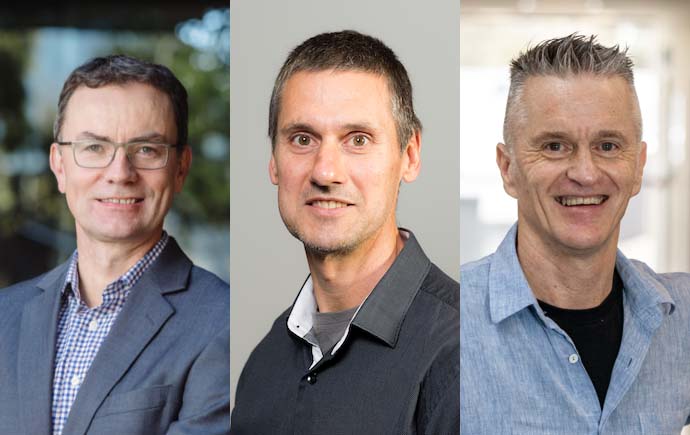
L-R: Associate Professor Dan Malone, Dr Ian Larson, Dr Tony Hughes.
Dan also highlights the continuing focus on improving the communication and professional skills of students. He says research led by fellow Lecturer and Course Simulation Lead Dr Angelina Lim has looked at student assessment and how it relates to student performance in the workplace, which feeds into updates made to the BPharm.
Dan also says that artificial intelligence (AI) is set to transform pharmacy education and practice. Alongside addressing issues of academic integrity thrown up by generative AI, the Faculty is also looking at how it can be used in assessments to make them more authentic and lifelike for students.
“A pharmacist needs to provide evidence-based information and have the inquiry skills to determine what’s accurate information and what isn’t, and this applies to any pharmacy interaction, including with AI.”
This year, Monash again offered rural and regional placements in light of pharmacy shortages.
“Placements were on a voluntary basis, and some students were hesitant as they didn’t see themselves ending up in a rural or regional area, or they were trying to juggle part-time paid employment in the city,” Dan explains.
“Those who did go, however, often loved it, and they saw firsthand the excellent opportunities in these practices.”
BPharmSci: Providing rich multidisciplinary learning experiences
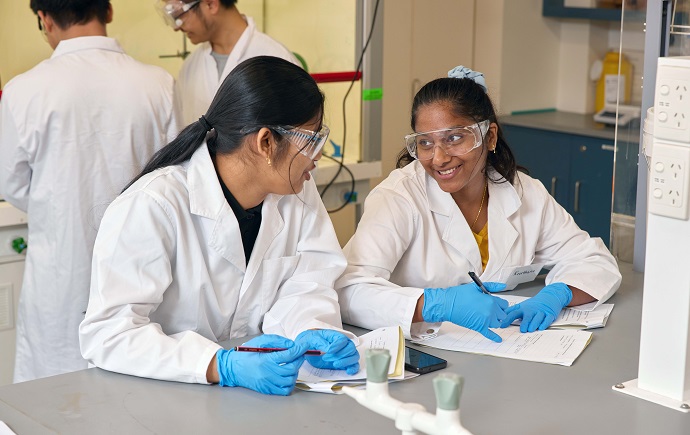
Despite rising student numbers, our grads are still in demand.
Dr Ian Larson was formally appointed Course Director of the Bachelor of Pharmaceutical Science in 2023, having previously held the position on an interim basis.
He says the degree has undergone many refinements.
“We now have upwards of 200 students per intake, and our numbers are continuing to grow,” Ian explains.
Monash offers the degree as either a three-year degree, or four years with honours.
“Despite rising student numbers, our grads are still in demand,” he says. “Our success lies in our graduates, so the fact that they’re getting employed quite quickly is great, and we’re very proud of it.”
“Many of our students find jobs in formulation science rather than pharmaceutical science.”
Ian says that, like many courses, rising student numbers are putting pressure on facilities.
“You can’t build as quickly as you can recruit students,” he says. “But the positive impact this has is teaching innovation”.
“We need to teach a bigger cohort effectively, so our staff have had to think creatively and continue to change the way they teach,” he explains. “Some have become experts in running engaging, interactive online classes.”
Ian says that some students enjoy and benefit from online study, as it decreases travel time and can encourage shy students to ask questions.
“It’s less confronting to ask questions online than in person; it allows them to have their say and encourages interaction,” he says. “But teamwork is a necessary skill, and doing teamwork actively online is the challenge.”
“Online learning will never replace the benefits of face-to-face learning, but there’s a huge demand for it, and it can be complementary.”
One of the changes to the course over 2023 has been introducing two Monash-wide rich interfaculty flagship experiences as electives.
“These are multidisciplinary teamwork mentored projects - students can choose between an industry or research project.”
“It’s mentored by high profile researchers at Monash, across many faculties including Arts, Design, Science, Engineering and others, with the students forming a team to solve a research or industry problem.”
“Monash is putting a lot of effort and energy into these to create standout experiences for students, with real value and impact.”
“It’s opening up a different type of experience for our students and providing insights into the commercial world beyond pharmaceutical sciences companies, including big multinational companies and a variety of industries.”
Ian says it’s good news that enrolments have exceeded expectations for the new BPharmSci launching in 2024 at Monash’s Malaysia campus, which will accompany the BPharm(Hons) that has been run there for several years.
“They’ve seen what the course does and the need for it,” he explains. “That’s another success, and there will be the potential for students to visit each campus.”
Ian also welcomes the appointment of a new Associate Dean for Equity, Diversity and Inclusion (EDI), Dr Betty Exintaris, for the Faculty.
“That’s an innovation and success for the Faculty and is great for us as lecturers,” he says. “The pandemic not only increased the need for student support, but we also have a diverse student cohort, making the position particularly valuable.”
MPharmSci: The first graduates taking advantage of a range of opportunities

The diverse student cohort is an absolute strength of the MPharmSci degree.
Dr Tony Hughes oversees the two-year Master of Pharmaceutical Science program and will celebrate its inaugural cohort's graduation in late 2023.
“It is very exciting,” Tony says. “They started in 2022 and have just finished their research or industry placement.”
Tony says he’s witnessed several interesting outcomes for this cohort.
“Of the students who did research placements at the Monash Institute of Pharmaceutical Sciences, a number have decided to continue into further research and have applied for PhDs,” he explains. “On the industry placement side, a significant number (around a fifth) have already been offered jobs and accepted them, which is terrific.”
“The aim of the degree is to prepare students to work broadly in the pharmaceutical industry. So if we can get them employed as they are completing their degrees, it shows we have been doing things right,” he argues.
Those taking the Masters degree specialise solely in the science behind drug discovery and development, covering medicinal chemistry, pharmacology and formulation science. However, Tony is buoyed by the range of industries in which students undertook placements - from pharmaceutical and biotech companies through to auditing, accounting and consulting firms.
This, he says, demonstrates the broad relevance of the degree and its ability to pair with the interests and backgrounds of students.
“The degree supports individual interests, different backgrounds, starting points and exit points, which gives us the opportunity for diverse outcomes,” Tony says.
Tony says another success has been witnessing presentations from graduating students, who have spoken openly about the importance of teamwork, a skill that is emphasised formally and informally throughout the degree.
A number of changes and tweaks have been made over the past year, including the introduction of a defined lab research task.
“We aim to run these longitudinally so we get a pipeline of drug design and development over a series of years, covering design, synthesis and analysis of compounds, so students contribute to a real project with real-world consequences,” Tony explains.
“We’re also in the process of formalising and scaffolding the sustainable development aspect of the teaching we do in the degree, in a similar way that we’ve done for the EDI aspect,” he says.
Tony describes the diverse student cohort as an absolute strength of the MPharmSci degree, the Faculty and the University. However, he says an associated challenge is identifying students early who need support to develop English language skills, the ability to work in teams, and other transferable skills alongside the science that forms the basis of the course.
“It’s a great opportunity for them,” he explains. “These associated skills are at least as important as the content and are a real value-add from a degree like this.”
In line with the Faculty’s other degrees, Tony says the Master of Pharmaceutical Science is experiencing increased enrolments, more than doubling from an initial cohort of 60 students to around 130 students. He says these students have also benefited from using state-of-the-art Monash teaching facilities at 750 Collins Street.
“Student interest and enrolments are another measure of success,” he explains.
“The interest has outweighed our original expectations, so one challenge is to continue to provide high-quality teaching and learning and individual development for students,” Tony explains.