
MIPS early career researchers awarded nearly $1.5M in ARC funding
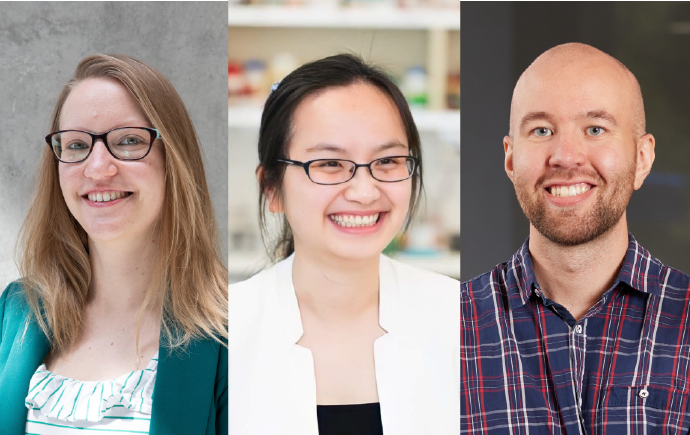
L-R: Dr Sarah Piper, Dr Anh Nguyen and Dr Brian Cary.
27 August 2024
The Monash Institute of Pharmaceutical Sciences (MIPS) is home to three researchers awarded $1,452,953 in funding through the 2025 Australian Research Council (ARC) Discovery Early Career Researcher Award (DECRA) scheme.
The recipients are Dr Anh Nguyen, Dr Sarah Piper and Dr Brian Cary, all from the Drug Discovery Biology Theme at MIPS.
The DECRA scheme provides focused research support for early career researchers (ECRs) in both teaching and research, and research-only positions, with the aim to support excellent basic and applied research.
Director of MIPS, Professor Chris Porter, said that government investment in ECRs is integral to advancing their work and boosting Australia’s research and innovation capabilities.
“It is critical that we support our emerging talent on their journey toward becoming the research leaders of tomorrow. Likewise, investing in both basic and applied research is crucial for breakthrough scientific progress and, in the longer term, the production of new life-saving medicines,” said Professor Porter.
“Many congratulations to Anh, Sarah and Brian for this well-deserved recognition.”
More about the DECRA 2025 MIPS recipient projects:
Dr Anh Nguyen - Understanding G protein-coupled receptor response mechanisms to environmental pollutants, $481,593
This project aims to elucidate how plastic pollutants interact with membrane receptors, specifically two critical cellular sensors: adenosine A1 receptors and G protein-coupled estrogen receptors. It integrates molecular biology, analytical pharmacology, computational modelling, and artificial intelligence. The anticipated outcome is a comprehensive insight into ligand-receptor binding, trafficking, signalling and molecular interactions of these plastic pollutants, which have broad implications for public health and environmental policy. This research could potentially lead to the development of safer and more effective strategies for managing and mitigating the impact of environmental pollutants on human health and ecosystems.
Dr Sarah Piper - Understanding structure, dynamics and function of receptor splice variants, $482,907
This project aims to understand the functional role of a specific class of G protein-coupled receptors by leveraging advanced cryo-electron microscopy, mass spectrometry, and computational approaches. This project will address fundamental knowledge gaps of how different isoforms of the receptor affect its signalling behaviour. Examining the shape and conformational dynamics of receptor isoforms provides a richer understanding of their cellular function. The comprehensive structural and functional data will allow us to produce molecular movies to better communicate the dynamic receptor activation process. This should provide significant benefits to the Australian community by visualising receptor isoforms with altered physiological function.
Dr Brian Cary - Leveraging electron microscopy to study receptor structure and function, $488,453
This project aims to address key knowledge gaps regarding the molecular mechanisms of peptide hormone receptor function, using the parathyroid hormone receptor as a model system. This project expects to use an interdisciplinary approach, focused on cutting-edge microscopy techniques, to generate new insights. Expected outcomes of this project include a three-dimensional, step-by-step view of the receptor’s activation and deactivation process at high resolution, as well as optimised sample preparation methods for microscopy. This should provide significant benefits by greatly enhancing our understanding of this physiologically important receptor and potentially improving numerous future structural studies on similar receptors.
For full details visit the ARC DECRA website.
ENDS