

Teachers across Australia are increasingly looking for ways to address racial equity and build stronger cultural understanding in their classrooms. While the Australian Curriculum outlines strong commitments to diversity and inclusion, these goals are not always reflected in everyday practice.
Monash Education's Dr Nish Belford and Associate Professor Renée Crawford explore how culturally responsive teaching, combined with arts-based approaches, can help teachers build the cultural empathy needed to support racial equity and strengthen social and cultural cohesion in Australian schools.
Migration, racism, and social cohesion in Australia: what teachers need to know
Australia is becoming more culturally diverse, especially with growing migration from Asian and South Asian communities. Recent data shows:
- Over 30% of Australians were born overseas.
- The largest increases have come from India, China, the Philippines, Nepal, Pakistan, and Vietnam.
Even as diversity grows, many immigrant Australians still face stereotypes, racism, and exclusion. For teachers, this means classrooms must be places where all students feel safe, valued, and respected, especially those who may be navigating racism or cultural misunderstanding. Schools play a major role in helping young people build empathy and understanding across cultures.
Why culturally responsive teaching matters
With almost one-third of Australians born overseas, students now bring a wide mix of languages, learning preferences, and cultural identities to school. Many students from immigrant backgrounds also move between multiple cultures – at home, in their communities, and at school.
Culturally Responsive Teaching (CRT) helps teachers support these students more effectively. CRT:
- connects learning to students’ cultural backgrounds
- builds strong relationships
- values diversity as a strength, not a problem
- improves engagement and achievement.
CRT originally came from work in the United States, but it has since expanded globally. In Australia, CRT has been used especially in Indigenous education, but it is increasingly important for supporting migrant and refugee students too.
Many teachers want to create culturally inclusive classrooms but may feel unsure how to start. This is where professional learning, teacher-education programs, and practical classroom strategies become essential.
Turning culturally responsive teaching into practice
Arts-based CRT approaches are particularly powerful. Research shows that creative, authentic practical-based/hands-on activities help teachers and students explore:
- identity
- culture
- language
- belonging
- empathy.
These approaches give both teachers and students safe ways to talk about differences and understand one another’s lived experiences.
The following strategies provide practical ways schools and teachers can strengthen cultural responsiveness and support social cohesion.
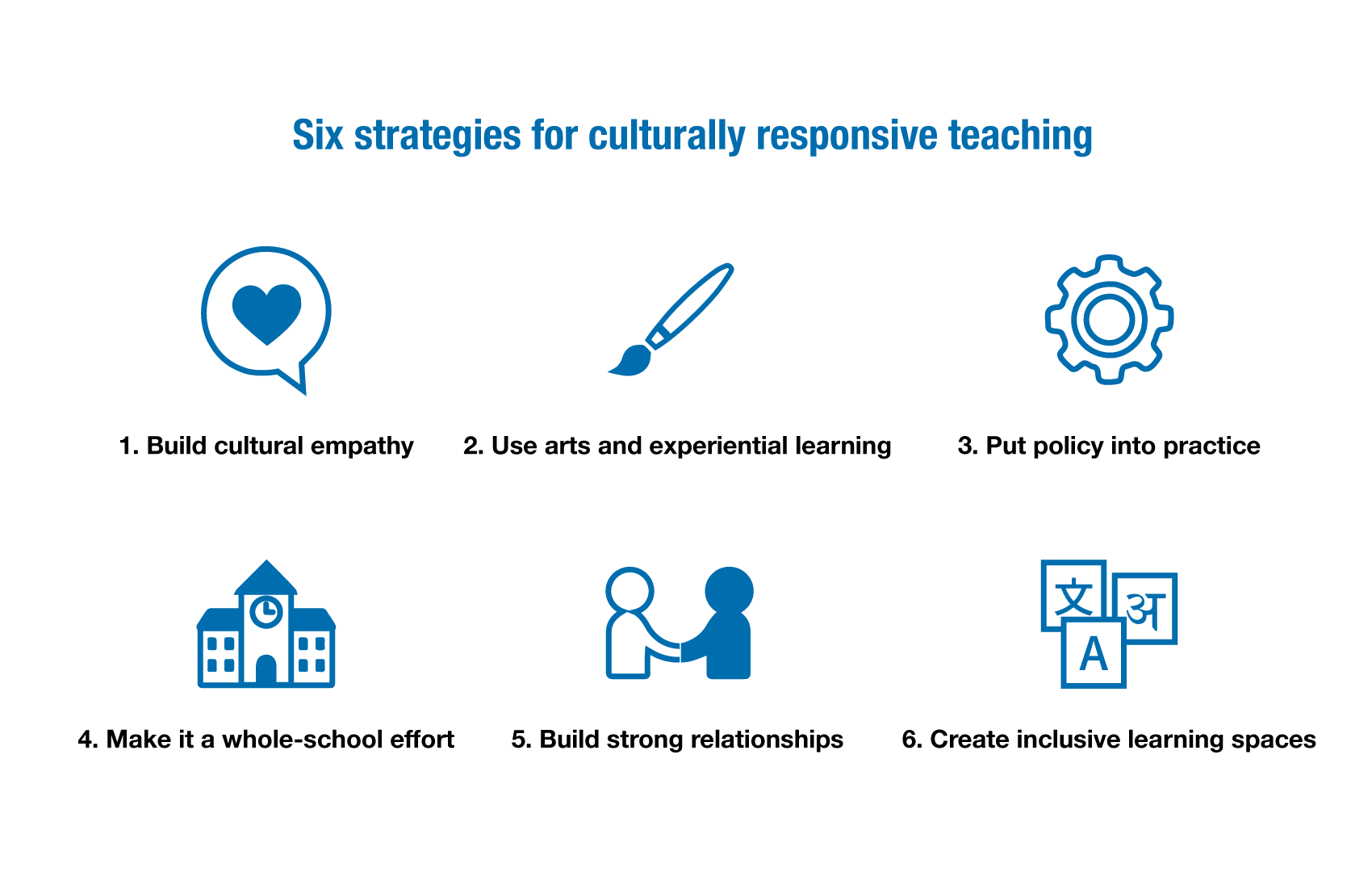
1. Strengthen cultural empathy through teacher training and professional learning
What this looks like
Schools should ensure that both pre-service and in-service teachers develop the skills to understand, value, and respond to cultural differences; practical training that helps teachers reflect on their own cultural assumptions is critical.
Examples
2. Use arts-based and experiential learning to explore identity and culture
What this looks like
Arts-based CRT helps students’ express identity, explore culture, and build empathy through safe, creative pathways.
Examples
3. Turn policy into everyday practice
What this looks like
Commitments to diversity and inclusion should be visible in daily classroom decisions, not only in policy documents.
Examples
4. Build whole-school responsibility for cultural inclusion
What this means
Culturally responsive practice should not be the responsibility of individual teachers alone – it should be embedded into the school’s culture, leadership, and community partnerships.
Examples
5. Support relationship-building between teachers, students, and families
What this means
Culturally responsive teaching starts with strong relationships built on trust, respect, and communication.
Examples
6. Design learning environments that reflect and respect cultural diversity
Examples
Why this matters
CRT helps build classrooms where all students – no matter where they come from – feel respected, safe, and able to succeed. By embracing CRP and arts-based learning, teachers can develop stronger relationships, encourage empathy, and support social cohesion in Australia’s increasingly diverse society.
Resources
Belford, N., & Crawford, R. (2024). Culturally responsive pedagogies and culturally responsive teaching: a reflexive discussion on initial teacher education within arts disciplines. Abstract from European Conference on Arts & Humanities 2024, London, United Kingdom.
Belford, N. (2025). Culturally Responsive Teaching (CRT) with pre-service teachers and the challenges to action Culturally Responsive Pedagogies (CRP) in the Australian Education context. In M. Kumar., S. Pattanayak, & N. Belford (Eds.), Layered Landscape of Higher Education: Capturing Curriculum, Diversity and Cultures of Learning in Australia. Routledge, Australia.
Crawford, R. (2017). Creating unity through celebrating diversity: A case study that explores the impact of music education on refugee background students. International Journal of Music Education, 35(3), 343-356.
Crawford, R. (2020a). Socially inclusive practices in the music classroom: the impact of music education used as a vehicle to engage refugee background students. Research Studies in Music Education, 42(2), 248-269.
Crawford, R. (2020b). Beyond the dots on the page: harnessing transculturation and music education to address intercultural competence and social inclusion. International Journal of Music Education, 38(4), 537-562.