
Meaningful inclusion of Indigenous perspectives in the classroom starts long before the lesson plan.
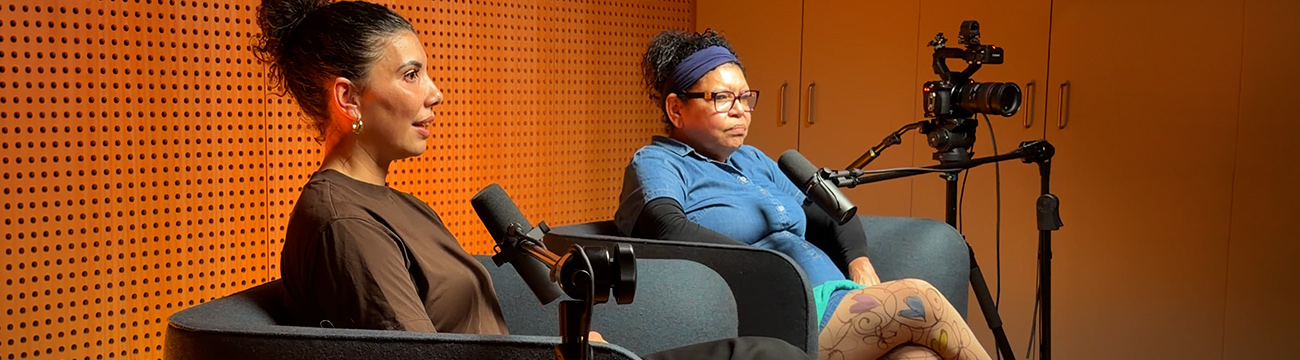
Our latest TeachSpace article unpacks what it really means to embed Indigenous perspectives in schools drawing on insights from Professor Jay Phillips, Deputy Dean of Indigenous Strategy at Monash University, and Jaya Blandthorn, a Monash Nursing and Midwifery graduate and Wamba Wamba woman working on the Parbinata Initiative.
Listen to the full discussion
This article is based on a discussion from the Let’s Talk Teaching podcast.
Start with Country, not content
Embedding Indigenous perspectives is often treated as a curriculum task: adding a text, marking a significant date, or including an Acknowledgement of Country at assembly.
But Professor Jay Phillips says if teachers want to make this worthwhile, they need to begin somewhere deeper.
“To make it meaningful is to actually understand that Country is more than just the land that you're standing on, that it encompasses all the values and cultural obligations, the histories, … and the teachings from our ancestors, and the social and cultural practices of Aboriginal people” she says.
It starts with understanding where we are, whose Country we are on, and how education systems are products of colonisation itself.
“Country is more than just the land that you're standing on. It encompasses all the values and cultural obligations, the histories, and the teachings from our ancestors, and the social and cultural practices of Aboriginal people.”
This is Australian history
Indigenous histories are not separate from Australian history.
Professor Phillips explains that when stories of colonisation, dispossession, exclusion and survival are left out of Australian history, students receive an incomplete version of the country they live in.
“I don’t call it Aboriginal history because it’s Australian history,” she says.
For teachers, this can mean asking different questions when planning:
- Whose knowledge is centred in this lesson?
- What histories are missing?
- How are Aboriginal and Torres Strait Islander peoples represented – only in the past, or as present, diverse and continuing communities?
- Are students learning about deficit, or also strength, survival and Indigenous peoples’ significant contributions to building the Australian nation?
“I don’t call it Aboriginal history because it’s Australian history,”
Move beyond “tick the box” cultural awareness
Jaya Blandthorn reflects on her own schooling experience and says cultural awareness was often absent, superficial or disconnected from students’ lived realities.
“There’s not really much meaningful engagement,” she says.
She describes how Aboriginal students can carry complex responsibilities and experiences that schools may not understand, including family obligations, intergenerational trauma, racism and assumptions about ability.
For Jaya, cultural awareness should help teachers better understand Aboriginal students, not stereotype them. It should support stronger relationships, higher expectations and more responsive teaching.
As she puts it: “How can you teach if you don’t understand?”
Sit with discomfort
Teaching the full truth of Australian history can feel uncomfortable. But both Jay and Jaya argue that discomfort is not a reason to avoid the work. Feeling challenged or uncomfortable is a natural part of the learning process. Jaya says students and teachers may find these histories confronting, but that does not make them less important.
“History is triggering. It should be triggering,” she says.
For teachers, the challenge is to create classrooms where difficult histories and experiences stemming from these histories can be explored with care, honesty and respect. This does not mean expecting Aboriginal and Torres Strait Islander students to explain or carry the emotional weight of the learning.
It means teachers doing their own learning first.
Do the work yourself
Jaya is clear that the responsibility for learning should not always fall on Aboriginal people in a school or organisation.
“The onus 99% of the time is on the Aboriginal person,” she says.
Teachers can begin by seeking out Aboriginal-led sources, reading widely, asking better questions and engaging with professional learning that goes beyond compliance.
Professor Phillips adds that reflection matters. Teachers need to ask not only “What should I teach?” but “What is my role in this system?”
Avoid “shiny object syndrome”
Indigenous-led programs and incursions can be powerful learning experiences. But Professor Phillips warns that schools can fall into “shiny object syndrome” – treating one program, event or excursion as the whole Indigenous perspectives requirement.
This risks turning meaningful work back into a tick-box exercise.
The Parbinata Initiative offers one example of immersive, Indigenous-led learning. Through activities at Monash University’s Clayton campus, students engage with Indigenous knowledge systems, songlines, plants, Country and oral language.
Jaya says students often respond with excitement and surprise when they see the complexity of Indigenous knowledge.
But these experiences need to be connected back into classroom learning before and after the visit. Otherwise, they remain isolated moments rather than part of a deeper shift.
Practical places to begin
Teachers do not need to have all the answers before they begin. But they do need to approach the work with humility, care and commitment.
Some starting points include:
- Learn whose Country your school is on, and what that means beyond naming it
- Reflect on your own assumptions, discomfort and position within the education system
- Review units of work for missing histories, voices and perspectives
- Analyse where the gaps are and possible reasons for these, e.g., when understanding Indigenous knowledges as scientific, there is greater scope to consider embedding in science and maths
- Use Aboriginal and Torres Strait Islander-authored and led resources and resources from non-Indigenous teachers who have ‘done the work’
- Avoid presenting Indigenous peoples only as historical or traditional
- Build relationships with local community in respectful, sustained ways
- Treat embedding Indigenous perspectives as ongoing work, not a single lesson, week or event.
A shared responsibility
For Professor Phillips, teachers need to understand that education has played a role in excluding Aboriginal and Torres Strait Islander peoples – but it can also be part of change.
That begins with recognising the profession’s responsibilities.
Jaya’s advice is equally direct: teachers need to step back, reflect, and understand that these issues are not only in the past.
“It’s today, it’s still happening, it’s future. We've got a lot of work to do” she says.
Embedding Indigenous perspectives well is not about adding more to an already crowded curriculum. It is about changing how we understand knowledge, history, Country and responsibility and the assumptions we may hold about Indigenous knowledges.
It is complex work. It can be uncomfortable work. But it is also essential work – for teachers, students and the future of Australian education.
Browse more episodes: