

The COVID-19 pandemic was one of the most significant and widespread disruptions to schooling in living memory. Teachers moved rapidly to online learning, back to the classroom, and then to short-notice combinations of online and in-person teaching as the pandemic periodically spiked – all while managing ongoing uncertainty about health and safety.
The impact on teachers was significant. In this latest TeachSpace article Monash Education’s Rebecca Collie, in collaboration with her colleagues, shares insights on how this disruption impacted teachers and strategies for schools to manage future disruptions.
Looking back to prepare for what’s ahead
The insights from this period reach well beyond COVID-19 itself. Schools will always encounter times of significant change, and understanding how teachers experience disruption – including how their wellbeing shifts and how long recovery takes – can help schools and systems be better prepared to support teachers through whatever lies ahead. And this disruption is not limited to pandemics. It can also take the form of natural disasters, conflict, or other crises.
The recently published study in Teaching and Teacher Education sheds light on this important topic. They analysed annual snapshots of teachers’ wellbeing across the pandemic, including the dramatic early months and the long tail that followed. This extended view of the pandemic allows them to look back at what was learned and look ahead to what practices should be sustained and what could be done differently in future disruptions.
What did the study examine?
From 2020 to 2025, different groups of Australian teachers completed surveys about their experiences at the same point in each school year. Almost 2,500 teachers took part, providing six snapshots of how teachers were experiencing their work as the pandemic unfolded and then receded.
The years were grouped into two phases:
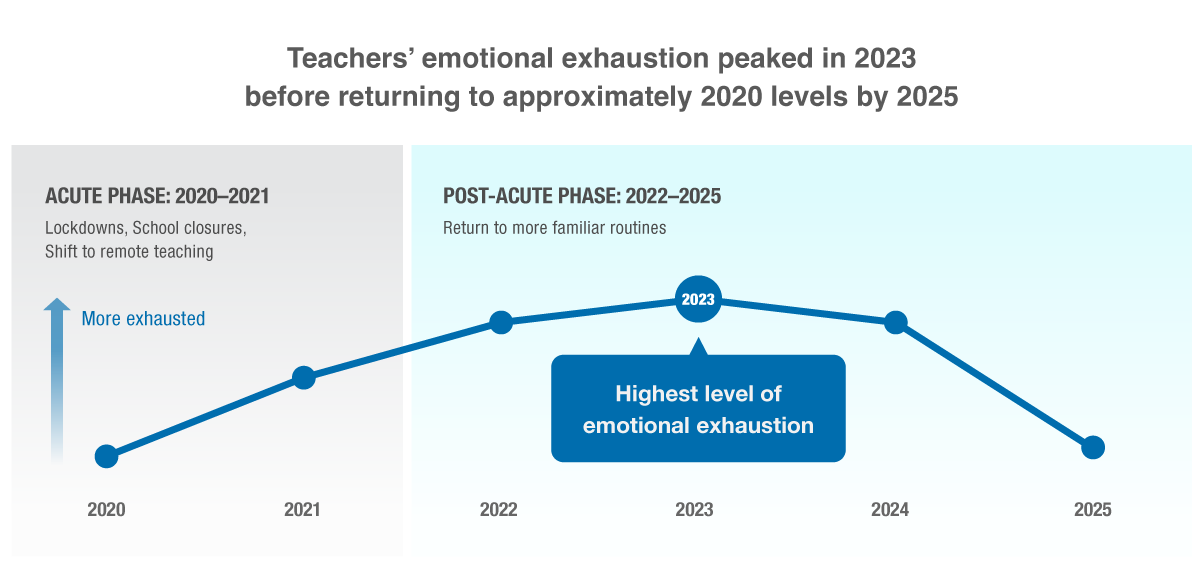
- The acute phase (2020–2021): lockdowns, school closures, and the rapid shift to remote teaching.
- The post-acute phase (2022 onwards): the gradual return to more familiar routines, after widespread vaccinations and the end of large-scale lockdowns.
The study focused on two workplace factors: job resources and job demands.
Job resources are aspects of work that help teachers do their job well and support their wellbeing. Teachers reported on two job resources: their relationships with colleagues and students.
Job demands are aspects of work that require effort and can contribute to stress and exhaustion. The study focused on time pressure – the feeling that there is not enough time to get the work done.
The study investigated how these factors were related to emotional exhaustion – the sense of being emotionally and physically drained that is a key part of burnout.
Teachers exhaustion peaked after the crisis
The most striking finding concerned the timing of teachers’ emotional exhaustion.
Rather than peaking during the acute crisis of 2020 and 2021, exhaustion climbed steadily across the first years of the pandemic and reached its highest point in 2023 – three years after the disruption began. It then started to ease, returning to 2020 levels by 2025.
In other words, the most difficult period for teachers’ emotional depletion was not the emergency itself, but the time that followed. This pattern is consistent with longitudinal research from Germany that followed teachers across the pandemic.
One possible explanation is that teachers drew heavily on their reserves of energy and support networks to get through the immediate crisis. They then faced pressure to return to business as usual before they had fully recovered. The effects of prolonged strain may therefore have emerged later.
What was linked with emotional exhaustion?
Strong teacher and student relationships were associated with lower emotional exhaustion
Results showed that teachers’ positive relationships with their colleagues and their students were linked with lower emotional exhaustion. In fact, relationships with colleagues seemed to matter more in the early years after the start of the pandemic, and relationships with students became more protective later on.
This shift likely reflects how teaching itself changed over these years. In the early, most disrupted period, teachers leaned heavily on one another to navigate remote teaching and constant uncertainty, making colleagues an especially important source of support. As teachers returned to their classrooms full-time, the everyday connection with students came back to the heart of the job and became a steadier source of support.
Time pressure was related to increases in emotional exhaustion that continued past the pandemic
Time pressure told a different story. It was associated with greater emotional exhaustion in every year of the study, making it the most consistent driver of exhaustion.
This finding aligns with other research on time pressure: when teachers feel they do not have enough time to get everything done, they work harder to keep up, which gradually drains their energy.
In combination, our results show that the strain of a major disruption does not necessarily end when the crisis does. Teachers appear to need a prolonged period to recover, and it was time pressure that weighed on them most heavily. In contrast, strong relationships were key for supporting teachers during this time.
What do the findings mean for practice?
The findings point to an important lesson: recovery does not necessarily happen when the crisis ends.
For school leaders, this means thinking beyond the immediate response to the disruption and considering what teachers will need in the months and years afterwards. Here are a few practical priorities for schools and school leaders:
- Protect time for relationships
Relationships with colleagues and students were a resource that helped teachers experience lower exhaustion. During and after a disruption, leaders can deliberately protect time for staff to connect and support one another, and can help sustain the relationships teachers build with students – for example, by leaning on any social-emotional learning programs the school already runs.
- Reduce time pressure
Time pressure was associated with greater emotional exhaustion. Reducing unnecessary demands should ideally be a priority. Practical steps include streamlining administrative tasks, reducing the number of meetings, and cutting down on the interruptions that fragment teachers' core pedagogical work.
- Delay the return of administrative work after a disruption
During the acute phase, many administrative tasks were paused so teachers could focus on the immediate challenges in front of them. These were then reinstated at the start of the post-acute phase exactly when our data show emotional exhaustion climbing towards its peak. Given this, it may be worth postponing the full return of administrative demands a little longer after a disruption, giving teachers more breathing room to recover before the usual workload resumes.
Teaching through a crisis is demanding, but the study findings suggest the period afterwards deserves just as much attention. By protecting relationships, easing time pressure, and pacing the return of administrative work, schools can help teachers to recover.
You can hear more from Professor Collie about the study in her Teacher Magazine podcast interview.