
The Program for International Student Assessment (PISA) 2025 results, released this month, have given Australian schools information about more than just how students perform academically. They provide a broader picture of how students are experiencing education and approaching their learning.
In this TeachSpace article, Monash University’s Professor Kelly-Ann Allen offers insights into what the latest PISA results reveal about students' sense of belonging,and the concern that many Australian students feel like outsiders at school – and what schools can do to create a stronger sense of belonging.
Looking beyond academic performance
PISA is an international study conducted by the OECD every three years that assesses what 15-year-old students know and can do in reading, writing and maths.
The study shows how students experience school. PISA reports on things such as school belonging, feeling safe at school, exposure to bullying, perseverance and enjoyment of science. And it may be a mistake to focus only on academic performance as looking at one without the other does not provide the full story. A new report, The Science of Belonging , developed at Monash University in collaboration with the International Baccalaureate (IB) and drawing on PISA 2025, focuses on school belonging.
What the PISA results reveal about belonging
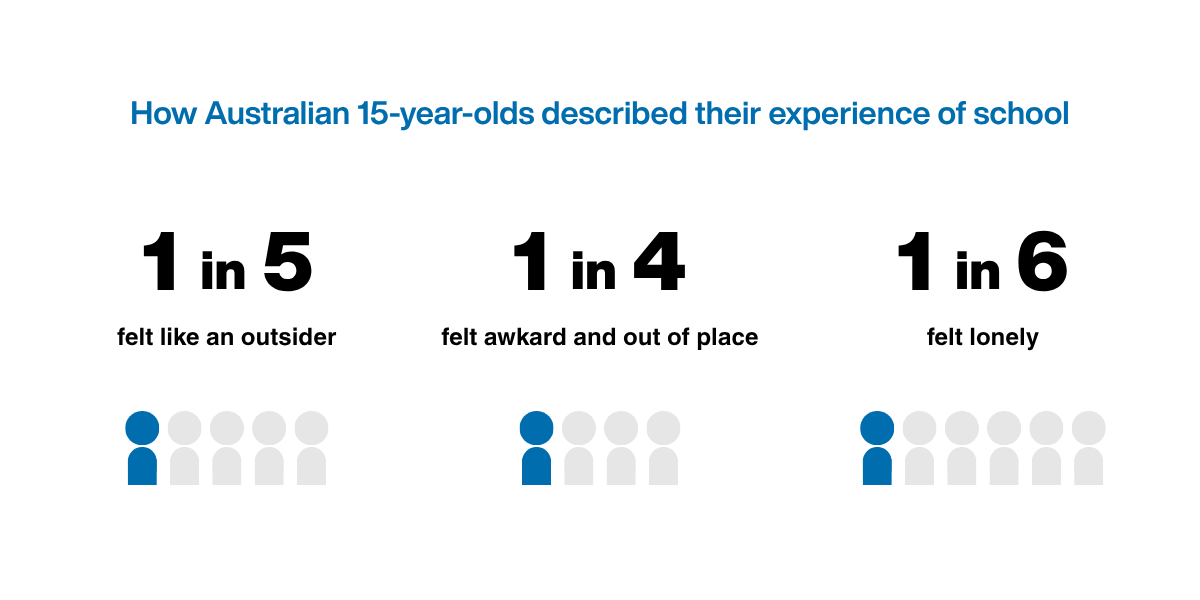
In Australia, school belonging improved between 2022 and 2025 after a long-term decline spanning nearly two decades, but it remained below the OECD average. In PISA, belonging looks at how accepted, respected and included students feel at school. Concerningly, one in five Australian 15-year-olds felt like an outsider. One in four felt awkward and out of place, and around one in six felt lonely.
According to the PISA results, school belonging is closely associated with how students approach learning and how motivated they are at school. Australian students with stronger belonging were more likely to put in extra effort when work became difficult.
The report also linked stronger belonging with greater curiosity and enjoyment of learning new things across participating countries and economies. Alarmingly, across many PISA education systems, weaker belonging was also associated with truancy. These findings do not establish that belonging caused those outcomes, but they do give us reason to ask what might be happening when a student withdraws from their learning or disengages at school.
Belonging is experienced differently by every student
The International Baccalaureate (IB), which provides education programmes for around two million students in more than 6,200 schools, launched the new report, The Science of Belonging, this week. The PISA report emphasises the importance of understanding how school practices and wider social and cultural contexts shape belonging, including the barriers some students face through discrimination or limited opportunities to participate. Belonging is experienced by the student, which means that the same classroom can be experienced quite differently by different students.
The review also found that schools had limited interventions available to them to sustain belonging over time. Yet a student’s belonging should not depend on whether their school can afford a particular programme. Many of the things within an educator’s control are human and relational, including how they respond to students and whether they notice and challenge social norms that leave some feeling they do not belong. Teachers can begin making these changes in everyday interactions.
Small moments can make a big difference
Regular check-ins and remembering what students have shared, no matter how seemingly trivial, may gradually give them evidence that their teacher notices them and that their perceptions and experiences, likes, and preferences matter. That they matter.
A teacher’s response after an absence can also be powerful. After a long absence, asking what would make returning easier can create an opportunity to understand what made attending difficult and to work with the student on it. Or even after a short absence, noticing that they have been away shows instantly that they are seen, and maybe missed.
Creating belonging in the classroom
Group work offers another opportunity to feel a sense of belonging. A student can be placed in a group and still have their ideas dismissed, so assigning roles may make contributing easier, but students also need support to listen and respond respectfully to each other. Tasks should be adapted to different learning and language needs so that students have a way to contribute. How we respond when learning becomes difficult is also important for belonging. Clear feedback about progress and an achievable next step can communicate that a student is regarded as capable and will be supported. But students’ perceptions of the support provided to classmates who need it may also shape their own sense of belonging. These perceptions may reflect classroom norms and culture, including whether students see their class as inclusive.
Responding when students experience bullying
In the review, bullying was consistently associated with weaker belonging. This is no surprise, but the response is important for families and students. A student who reports bullying needs to know what will happen next and whether adults will follow through. Schools can be concerned about protecting the privacy of all parties involved, but they need to balance this with clear, proactive communication so students feel supported and heard.
Listening to students' experiences
Students can also help teachers authentically value their experiences in everyday school life. Students can review learning materials, even school policies, with educators to consider whose cultures, languages, and histories are represented, including whose experiences have been overlooked. Their involvement may reveal assumptions that are difficult to recognise from an adult’s position. Educators also need to be willing to change a familiar practice when students explain how it contributes to their experience of exclusion.
A whole-school commitment
The review calls for sustained professional learning and leadership that supports consistent practice across the school. Asking teachers to build relationships will also require protecting the time those relationships take to build. Teachers also need to feel that they belong, with supportive leadership, trusted colleagues and recognition of their work.
Governing bodies and organisations that measure belonging and ask students about their perceptions of belonging to school should be ethically obligated to act on the findings. Solutions and strategies should not be left for schools to shoulder in isolation. Many of the barriers to belonging in schools reflect wider social issues, some current, some historical. Creating schools where every student feels they belong therefore requires action at multiple levels – from everyday interactions in classrooms to school leadership, policy and the wider systems in which schools operate.
Resources
De Bortoli, L., & Underwood, C. (2026). PISA 2025: A first look at student and school characteristics for Australia. Australian Council for Educational Research.
OECD. (2026). PISA 2025 results (Volume I): Future-ready students. OECD Publishing.
Allen, K.-A., & Dong, S. (2026). The science of belonging: Exploring the concept, drivers, barriers, and evidence-based solutions to cultivate belonging in K–12 education. Monash University, Faculty of Education, in collaboration with the International Baccalaureate.