
The Neuromedicines Discovery Centre: Providing hope for patients with mental health conditions

The NDC's vision is underpinned by a desire to create breakthroughs in treatment options for mental health conditions.
Neuromedicines are next-generation drugs that include antidepressants, antipsychotics, psychedelics such as psilocybin, ketamine and MDMA, and other targeted therapeutics in development. Monash is at the forefront of research through the Neuromedicines Discovery Centre (NDC) at the Monash Institute of Pharmaceutical Sciences (MIPS), which aims to create innovations in medicines for a range of mental health conditions.
A genuine need for innovation
Director of the NDC, Professor Chris Langmead, says there is a “huge innovation gap” when it comes to developing new medicines for mental health.
”As a society, we’ve done a good job of destigmatising mental health conditions and providing better access gateways for mental health,” he explains. “However, we have not seen any big progress in the development of new medicines in this space.”
While almost half of Australians experience a mental health condition during their lifetime, there simply hasn’t been the same level of investment in mental health treatments as there has been in other areas, Chris argues.
“Conditions like heart disease, cancer, or diabetes have seen great leaps made in recent decades, so we now need to do the same in mental health,” he says.
Discovering new mental health treatment options
The NDC’s vision is to translate research into clinical care in order to positively impact the lives of people with mental health conditions, their families and carers. It is underpinned by a desire to create breakthroughs in treatment options for mental health conditions with an initial focus on depression, post-traumatic stress disorder (PTSD), eating disorders, substance use disorders and schizophrenia.
“Depression, anxiety and substance use disorders are the most common mental health conditions in Australia,” says Suzie Bratuskins, General Manager of Strategic Partnerships and Operations for the NDC.
Chris says we’re in desperate need of new medicines for mental health conditions.
“The NDC is about providing solutions,” he says. “Our remit is broad but the problem needs a comprehensive approach that brings together experts across the spectrum to develop better medicines for mental health conditions.”
 Emerging new therapies
View
Emerging new therapies
View

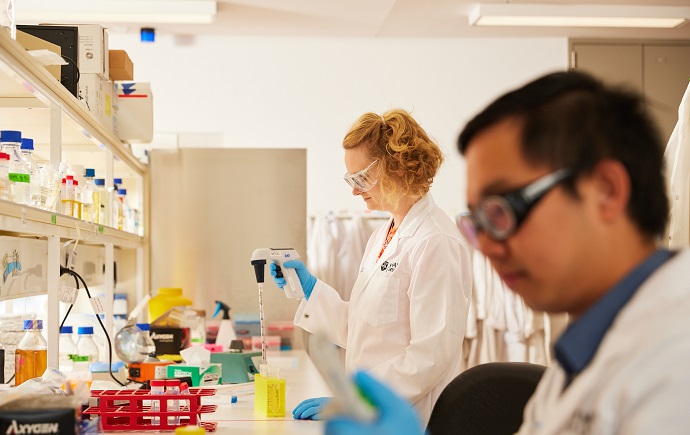
Establishing the NDC
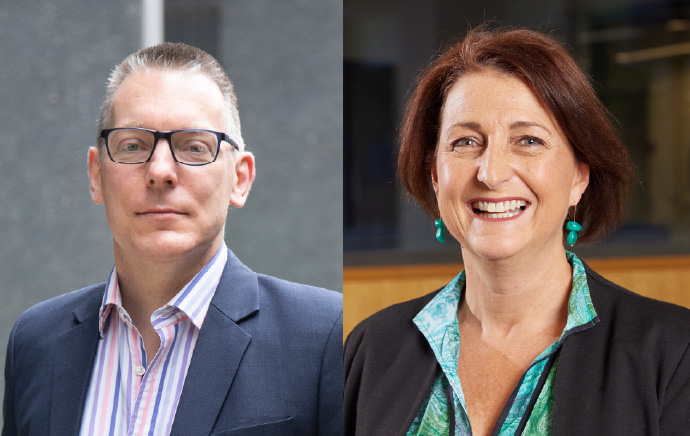
L-R: Professor Chris Langmead and Suzie Bratuskins.
Established by MIPS in 2021, the NDC is a collaboration with The University of Melbourne and The Florey Institute of Neuroscience and Mental Health.
This diverse expertise facilitates a holistic, end-to-end approach that Chris says sets the NDC apart.
“We draw on MIPS' expertise in pharmacy and pharmaceutical sciences for drug discovery, as well as expert knowledge of the neuroscience of these conditions from our partners,” he explains.
“We leverage the experience of psychiatrists and psychologists for clinical trials, alongside input from mental health economists who estimate the cost-effectiveness of a treatment,” Chris says. “Plus, the inclusion of people with lived experience is fundamental to this initiative”.
The NDC focuses on developing scientifically-led, evidence-based, early interventions for the treatment of mental health conditions.
“If you were designing a new medicine from scratch for someone with depression, you’d want something that acted fast, was effective for a lot of people, that you only need to take for a short period of time, and that was relatively devoid of side effects,” Chris says. “That’s the exact opposite of any existing medicines in our armoury right now.”
The NDC also ties into the wider push to create a better quality of life for people with mental health conditions, as a result of the recent Royal Commission into Victoria's Mental Health System. It also capitalises on the TGA’s rescheduling of psilocybin and MDMA, which paved the way for authorised psychiatrists to prescribe psilocybin for treatment-resistant depression and MDMA for PTSD from July 2023.
What does the NDC do?
The work of the NDC is focused on three integrated strategic pillars:
- Better Medicines: Establishing a pipeline of new breakthroughs in mental health from understanding disease mechanisms to discovery of next-generation neuromedicines.
- Better Minds: Conducting translational studies, clinical trials, and workforce training to deliver globally recognised better-practice models for patient care.
- Better Futures: Building a better, more efficient, and more equitable access gateway for next-generation therapies to address the mental health crisis through social policy and mental health advocacy.
“My role is to oversee the strategic division and the delivery of our vision against these three pillars,” explains Chris.
With a background as a pharmacologist, Chris has worked in neuroscience drug discovery for 25 years within pharmaceutical companies, biotechs and universities, before becoming the NDC’s Director in 2022.
“Monash establishing the NDC really plays beautifully into what I consider to be my two passions: developing new medicines and improving mental health,” Chris says.
A strategic collaboration
Suzie is a Monash Pharmacy alum who took on the role of General Manager, Strategic Partnerships and Operations in mid-2023. She’s spent her 25-year career working in retail pharmacy, the pharmaceutical industry, as well as not-for-profit health organisations.
Suzie’s role is to build key partnerships across and within the three organisations (Monash University, The Florey, and the University of Melbourne).
“Collaboration is key and strengthens what the NDC can achieve,” she explains. “We are tapping into these diverse networks to work together which is very exciting.”
“Funding of drug development and discovery is costly and takes time,” Suzie adds. “And historically funding for mental health research has been low in Australia, at less than half of what would be expected, relative to the disability and mortality of mental health.”
“To date, the research work of the NDC has been funded by each of the institutions. We are now formalising the governance and structures of the NDC with the development of a strategic plan to build strong foundations to then seek funding”.
“We are aiming to leverage funds from a range of sources: government, philanthropic, and commercial ventures,” Suzie says.
Chris agrees that there is a role for each funding stream.
“You can’t just have a market-led solution for mental health conditions because, while they are every bit as disabling as each other, some are more widespread, like depression, for example.”
“We also need effective treatment options for alcohol use disorders and eating disorders,” he explains.
Chris also says the NDC faces challenging practicalities in its work.
“Neuroscience is the hardest therapeutic area you can work in,” Chris says. “Working with psychedelic medicines comes with legal, regulatory and reputational concerns.”
For this reason, a key feature of the NDC is the input of Lived Experience Ambassadors.
A focus on lived experience
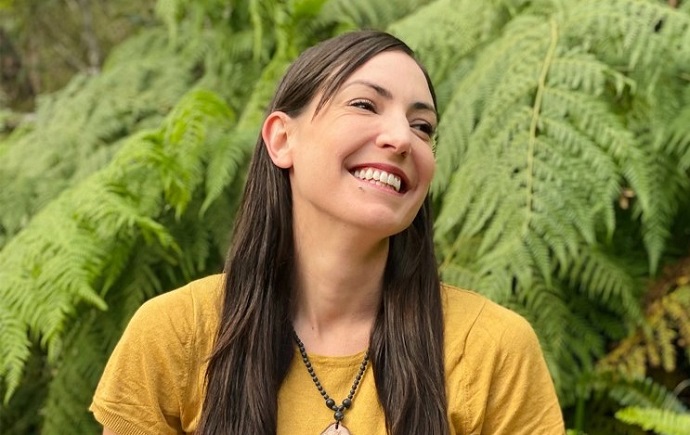
Holly Paterson is a Lived Experience Ambassador for the NDC.
Holly Paterson met Chris after they both appeared on an episode of the ABC’s 7:30 Report in November 2022 that looked at psychedelic-assisted therapies being used to treat PTSD.
“Chris contacted me, and we developed a great relationship around our common interests,” Holly explains. “I am a passionate psychedelic therapy advocate, so when Chris and Suzie invited me to sign on as ‘Lived Experience Ambassador’ for the NDC, I was honoured and excited.”
Holly is the co-founder and Chief Operating Officer of the Heroic Hearts Project Australia, which works with leading medical researchers to improve veterans’ access to psychedelic programs.
With a background in intelligence and national security, Holly experienced bouts of depression, suicidal ideation, and complex post-traumatic stress disorder. This led her to embark on a life-altering journey to South America, where she pursued alternative treatment at a traditional shamanic plant medicine retreat in Peru. Her experience proved to be transformative.
She says several things led to her becoming a Lived Experience Ambassador for the NDC.
“I’ve personally found comfort in hearing people share their stories, and that’s how I ended up in Peru,” she explains. “My healing there through traditional methods literally saved my life.”
She is also keen to continue to work towards reducing the stigma around - and understanding of - the use of psychedelics in Australia.
“Even in the medical space, there is stigma around the use of psychedelics, so continuing to work on this is very important to me,” Holly says. “It’s such powerful medicine, and the research coming out, particularly around MDMA for PTSD is mind-blowing, so I’m keen to further my advocacy.”
“The NDC is making a big effort to understand multiple angles and involve a wide range of people.”
Holly is also keen for these therapies to become more accessible.
“The more awareness we have around these medicines and the more acceptable they become, the more accessible the prices will hopefully become. People go overseas because cost is a huge barrier at $20,000 to $25,000 to access these psychedelic-assisted treatments in Australia,” she explains. “Finding a psychiatrist approved to work with these therapies is also currently hard.”
“The NDC is building a real community around psychedelic medicines that I’m excited to be part of,” Holly says.
 A feeling of ‘cautious optimism’ pervades
View
A feeling of ‘cautious optimism’ pervades
View

Power, passion and purpose
As both Suzie and Chris highlight, everyone has been touched by mental health conditions, whether it's personally, or someone close to them.
“Mental health conditions can be very debilitating, but the NDC provides hope,” Suzie says. “Everyone should have equitable access to treatment.”
“The collaboration and the calibre of the people involved with the NDC is incredible, they are world experts with such passion,” says Suzie.
Chris is similarly optimistic.
“The NDC has the opportunity to do something different and really make a difference,” Chris says. “We are privileged to undertake this impactful work”.
“It is exciting that the Faculty of Pharmacy and Pharmaceutical Science at Monash University is leading this initiative to tackle a fundamental societal problem through the development of new medicines for mental health conditions,” Chris says.


