Our research translated: Discoveries with real-world impact
Monash’s commitment to being a world-leading education provider in pharmacy and pharmaceutical sciences extends well beyond the classroom or even the research laboratory.
The Faculty of Pharmacy and Pharmaceutical Sciences is making a real difference when it comes to translating and commercialising discoveries so that they have real-world impact.
Making a difference
“Traditionally, in the health sciences, a gap has existed between academic research and real-world application,” says Dean of the Faculty of Pharmacy and Pharmaceutical Sciences, Professor Arthur Christopoulos FAA FAHMS.
“One factor that separates Monash is our commitment to overcoming this gap by actively engaging in the translation of our academic discoveries into practical solutions that make a tangible difference in society.”
“But we can’t do that alone, which is why partnership and collaboration are at the heart of our approach,” he says. “We also need to structure ourselves in a way that provides the right environment and resources to allow our research to take the path to practical application.”
MIPS' commitment to translation
L-R: Professor Chris Porter and Professor Arthur Christopoulos, FAA FAHMS.
The main vehicle through which the Faculty of Pharmacy and Pharmaceutical Sciences translates its research discoveries into real-world impact is the Monash Institute of Pharmaceutical Sciences (MIPS). Established in 2008, MIPS employs more than 280 scientists who are actively involved in researching drug discovery, design, delivery and use.
MIPS Director, Professor Chris Porter, says that the institute was established in part to provide better drivers of “non-traditional endpoints” for academic research.
“Too often in the past, great ideas and great research stayed in academia,” he explains. “However, there is an increasing understanding that the powerful discoveries our researchers make can, and where possible should, be translated into practical, useful endpoints that not only deliver better health outcomes but also generate jobs and new companies and help grow the Australian economy.”
Chris says that this shifting understanding of the role that academia should play has been driven by both government policy and societal expectations.
“There is a growing expectation - and I agree completely - that universities should contribute not only to knowledge generation but also to the economy and the public good,” he explains.
MIPS has made major contributions to collaborative programs that have progressed more than 35 novel drug candidates into clinical development, including three key recent clinical trials:
L-R: Professor Erica Sloan and Dr Aeson Chang.
In a pivotal study led by MIPS, researchers uncovered a new approach to combating one of the most challenging forms of cancer. MIPS researchers found that beta-blockers significantly boosted the efficacy of anthracycline chemotherapy in treating triple-negative breast cancer (TNBC).
Anthracyclines, key chemotherapy drugs, face limitations due to their unintended promotion of nerve growth in tumours, which can lead to cancer relapse. This study, published in Science Translational Medicine, demonstrated that adding beta-blockers to the treatment can inhibit this nerve activity and reduce the likelihood that cancer will recur.
The study’s lead author was Dr Aeson Chang, who noted the finding that beta-blockers can halt stress neuron activation caused by chemotherapy. This offers a deeper understanding of cancer treatment failure.
Meanwhile, Professor Erica Sloan, the study’s senior author, noted that the finding that beta-blockers can improve chemotherapy responses presents a novel treatment strategy for TNBC.
This research, supported by the National Breast Cancer Foundation Australia and the National Health and Medical Research Council, involved collaboration with the Cancer Registry of Norway.
It marks a substantial advancement in TNBC treatment, potentially transforming current therapeutic practices.
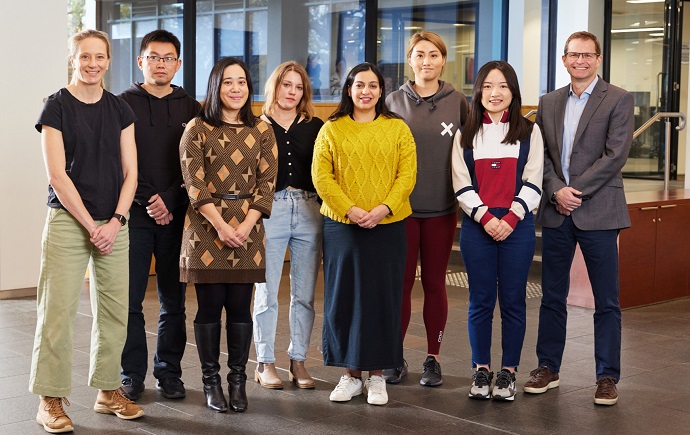
The team behind the Glyph™ platform. L-R: Associate Professor Natalie Trevaskis, Dr Dan Zheng, Dr Nathania Leong, Vilena Ferreira, Dr Garima Sharma, Dr Enyuan Cao, Xiaotong Zhou and Professor Christopher Porter. Not shown: Dr Sifei Han and Dr Mitchell McInerney.
In collaboration with PureTech Health plc, MIPS has made a breakthrough towards novel neurological and neuropsychiatric treatments with LYT-300. This innovative oral form of the neurosteroid, allopregnanolone, developed through the Glyph™ platform, represents a significant step forward towards better treating anxiety disorders, and other neurological conditions.
Allopregnanolone traditionally requires a 60-hour intravenous infusion due to limited oral bioavailability. The Glyph platform, invented by Professor Chris Porter and his team, overcomes this challenge. This novel technology enhances the drug's oral bioavailability by linking it to a dietary fat molecule, redirecting its absorption from the gut into the lymphatic system and avoiding ‘first pass’ liver metabolism.
A multipart Phase 1 trial in 2022 revealed encouraging outcomes for LYT-300. The trial confirmed its oral bioavailability and tolerability, with no significant adverse events reported. It also showed that LYT-300 achieves blood levels of allopregnanolone linked with therapeutic benefits. The study also highlighted LYT-300's targeting of GABAA receptors, which are crucial in mood regulation and neurological disorders.
LYT-300 has recently completed a Phase 2a clinical trial exploring utility in a model of anxiety in healthy volunteers. The trial demonstrated a statistically significant reduction in stress hormone response, compared to placebo, and helps validate the potential for LYT-300 to become a simple oral capsule for people living with anxiety.
This development also promises a more practical treatment approach for a range of neurological conditions. The Glyph technology has current applications extending to LYT-310 (oral cannabidiol), and several further (as yet undisclosed) targets, potentially revolutionising the treatment landscape for a range of diverse conditions.
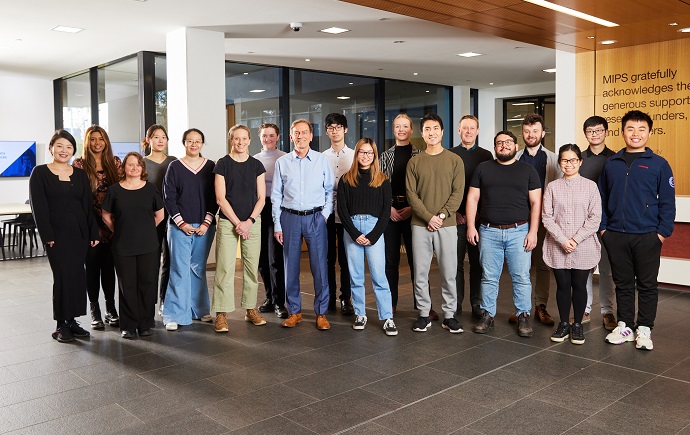
Led by Professor Colin Pouton (eighth from the left), the mRNA team at MIPS has achieved a significant breakthrough in COVID-19 vaccination.
Led by Professor Colin Pouton, MIPS has achieved a significant breakthrough in COVID-19 vaccination with Australia’s first homegrown mRNA vaccine candidate, which addresses the critical issue of 'immune imprinting'.
Immune imprinting refers to the phenomenon where initial exposure to a virus strain limits the immune system's response to new variants. This presents a challenge in effectively combating evolving COVID-19 strains.
Monash’s vaccine, which targets the receptor binding domain (RBD) of the COVID spike protein, has shown promise in preclinical studies to overcome this limitation. Focusing on the RBD rather than the entire spike protein, the vaccine elicited a stronger immune response, particularly against the Omicron BA.1 and BA.5 variants.
The vaccine demonstrated higher efficacy at lower doses and fewer side effects compared to existing vaccines. Boosting with Omicron-specific variations of the RBD mRNA vaccine also indicated enhanced protection against newer variants.
Monash's vaccine underwent a clinical trial as a fourth-dose booster against the Beta variant in collaboration with the Doherty Institute. The promising interim data from this trial positions the vaccine as a key component in next-generation COVID-19 vaccination strategies. It holds the potential for addressing the ongoing challenge of immune imprinting as the virus continues to evolve.
Increased investment and focus
L-R: Gaby Bright and Dr Katie Leach.
Faculty of Pharmacy and Pharmaceutical Sciences Manager, Research and Graduate Research, Gaby Bright, notes that - in line with this - there is a growing pool of capital available globally for drug discovery.
"Increasingly, there is funding for the translation of research to take it beyond fundamental scientific discoveries into real-world applications,” she says.
“In some ways, it’s hard to know whether this is being driven by the growth in the number of discoveries or the increase in translation funding. However, the broader societal view is that research needs to be more than just research in and of itself."
“Knowledge generation will always remain a part of a successful university's DNA, but the translation of that knowledge into tangible impact should also be part of the research agenda,” Gaby explains.
“That said, Australia is newer to the field of academic drug discovery and translation than many other countries, such as the United States and the United Kingdom, where this way of thinking has been entrenched for some time,” she says.
Another real driver of commercialisation has been the COVID-19 pandemic, which rammed home the importance of drug discovery and brought it into the mainstream public consciousness in an unprecedented way.
“The pandemic showed how we could really accelerate things if we collaborated,” Gaby says. “It also showcased how committed the medical research community across the world is to solving problems.”
“It revealed that governments and institutions can respond when we need solutions quickly.”
Meanwhile, Arthur says that, post-COVID, it became clear to many that Australia needed to take sovereign medicine development and related manufacturing processes seriously.
“This period has underscored the importance of having an end-to-end local ecosystem that can link up different precincts and resources for developing medicines and medical technologies to drive clinical trials and attract more venture capital," he explains.
How to translate a discovery
Despite a growing willingness to invest in drug discovery, the main challenge is that it requires exceptionally deep pockets.
In fact, one study estimated the global median capitalised research and development investment to bring a new drug to market was US$985.3 million (A$1,514.2 million). Meanwhile, the mean investment was estimated at US$1,335.9 million (A$2,050 million).
“Clearly, you can’t afford to do this alone, and not many local companies have the kinds of resources needed to invest to the end of the drug discovery pipeline,” says Dr Katie Leach, Senior Business Development Associate.
“That means you need to be able to attract global investment, not just local investment. So you need to be doing research and translation work that stands out internationally to investors.”
“Collaboration is key in our journey of drug discovery and development," Chris says.
"It's simplistic to assume that any university can embark on this complex journey alone. Partnerships are vital at every stage, especially during the discovery phase, where a blend of expertise from biologists, chemists, and pharmaceutical scientists is crucial.”
“Although we have significant in-house capabilities, our most impactful projects usually involve working with external groups."
The pathways to commercialisation
Chris notes that there are two broad ways MIPS can translate discoveries in a commercial sense.
“The first is to ‘spin out’ a company and build it here in Australia,” he says. “The second would be to take the idea and licence it to an external organisation, be that in Australia or overseas.”
He believes that choosing which pathway to take is also key to the commercial viability of any discovery program and that getting it right requires experience and knowledge. That’s why MIPS has gone about systematically building a framework to support scientists in making the right decisions about their research.
This includes having a Business Development Unit (BDU) that focuses on pre-commercial drug development and building interactions with commercial groups. The BDU is also complemented by a commercialisation panel, which provides advice to MIPS scientists on how to go about translating their discoveries.
“Many people that sit on that panel are external, with deep experience on how to develop drugs and take them to market,” Chris explains. “They advise our academics who are trying to get new discoveries off the ground. This is an invaluable source of information.”
“After all, before you have any hope of attracting investment, you need to get your discovery a certain way down the development pipeline. Usually, this means de-risking it to the point where a venture capital (VC) firm will think it's worth funding or a company thinks it’s worth licensing.”
The Commonwealth Government’s Medical Research Future Fund (MRFF) is a $20 billion long-term investment fund aimed at supporting Australian health and medical research.
The MRFF aims to transform health and medical research and innovation to improve lives, build the economy and contribute to health system sustainability.
Recently, the MRFF has invested in three key MIPS initiatives:
MedChem Australia aims to bridge the gap in drug discovery, translating fundamental biology into valuable drug candidates.
The MRFF invested $9.75 million in MedChem Australia, a national medicinal chemistry initiative.
Led by Professor Paul Stupple and Professor Susan Charman at MIPS, Professor Guillaume Lessene (WEHI), Professor Michael Kassiou (University of Sydney), and Dr Stuart Newman (TIA), the initiative aims to bridge the gap in drug discovery, translating fundamental biology into valuable drug candidates.
MedChem Australia is headquartered at MIPS and will unite three leading medical chemistry groups from MIPS, WEHI, and the University of Sydney, as well as Therapeutic Innovation Australia (TIA).
With a total funding of around $15 million over five years, MedChem Australia is set to boost Australia's capabilities in drug candidate translation, fostering the development of high-quality medicines. The initiative will deliver preclinical candidates, support biomed spin-outs, and attract industry investment for job creation.
Each of the nodes at MIPS, WEHI, and the University of Sydney will have state-of-the-art facilities and skilled medicinal chemists to progress selected projects.
This significant investment aligns with Monash's broader efforts to advance critical research infrastructure to promote health and medical research.
The DTIP aims to efficiently identify drug targets and biomarkers for various diseases within Australia's drug discovery pipeline.
Australia's inaugural Drug Target Identification Platform (DTIP) received a $3 million investment from MRFF.
Led by Monash University, this initiative addresses the pressing need for target identification services in the country's drug discovery community.
MIPS’s Associate Professor Darren Creek, who leads the project, aims to establish a dedicated DTIP using a brand new state-of-the-art instrument - the Thermo Fisher Scientific™ Orbitrap™ Astral™ Mass Spectrometer.
The collaborative effort also includes Monash's Faculty of Medicine, Nursing and Health Sciences, Griffith University, Australian National University, WEHI, the Centre for Cancer Biology (University of South Australia), BioCurate, Canthera, BioIVT, and the Children's Cancer Institute (University of New South Wales).
The DTIP aims to efficiently identify drug targets and biomarkers for various diseases within Australia's drug discovery pipeline. By integrating expertise with recent technological advancements, the platform will bridge critical gaps and enhance the understanding of drug mechanisms.
The MRFF funding not only advances the DTIP's development but also contributes to Australia's health security by improving outcomes for homegrown biomedical discoveries.
mRNA Core will enable researchers to accelerate the development of mature mRNA candidate products ready for clinical testing.
The MRFF has also allocated $5 million to support a new Monash laboratory dedicated to developing mRNA vaccines and therapeutics for future clinical trials.
The initiative is being conducted in collaboration with Monash's Biomedicine Discovery Institute and aims to identify and select promising therapeutic candidates for proof-of-concept studies.
Led by MIPS’s Professor Colin Pouton, the initiative involves a team of experienced researchers, including Professor John Carroll, Associate Professor Traude Beilharz, Associate Professor Chen Davidovich, Associate Professor Natalie Trevaskis, Associate Professor Angus Johnston and Dr Harry Al-Wassit.
The laboratory, located at MIPS, will enable researchers to accelerate the development of mature mRNA candidate products ready for clinical testing. These efforts strengthen Australia's resilience to various diseases and future health emergencies, with a focus on infectious diseases, liver diseases, metabolic diseases, muscular diseases, rare genetic diseases, and cancer.
Monash's expertise in mRNA technology, including designing and developing Australia's first mRNA clinical candidate for COVID-19, positions the University at the forefront of mRNA research. The funding will support local mRNA manufacturing and enhance Australia's sovereign capabilities in this field.
A culture of entrepreneurship
Chris believes that even the most well-thought-out plans are only effective if the organisational culture also supports them. Here, he says the nature and temperament of the staff within the Institute matter more than anything.
“There is this fallacy that people are either basic scientists or applied or translation-focussed people,” he says. “I’ve found the truth is that the best scientists - the ones making the breakthrough discoveries are also often the best at translation and commercialisation.”
“We’ve also found that once scientists see their colleagues having success down this path, and they can see startups happening and licence deals being done, then they see what’s possible, and it encourages them to go down the same path.”
“This also has the effect of creating a pool of people with experience, that other scientists can speak to about how to get it done.”
“That’s the kind of culture we are trying to promote within MIPS.”
Increasingly, rather than licensing its drug discoveries, MIPS has looked to create its own ‘spin-out’ companies to progress these advances. According to Professor Chris Porter, this can be a particularly attractive approach, as it allows researchers to retain a greater degree of control over their discovery, typically retaining discovery and development activities (and value) within Australia and providing investors with a known pathway for return on their investment.
However, he says, it’s not always the most suitable approach, and decisions to either spin out, licence or partner new technologies are complex and must be thought through on a case-by-case basis.
L-R: Professor Chris Langmead and Dr Gregory Stewart.
Phrenix Therapeutics is a spin-out from the Neuromedicines Discovery Centre, launched within MIPS in late 2021 to drive novel psychiatric drug discovery for treating mental health disorders, particularly schizophrenia.
The Phrenix Therapeutics MIPS team includes Chief Scientific Officer Dr Gregory Stewart, Chief Executive Officer Professor Chris Langmead, Professor Denise Wootten, and Dr David Shackleford, who work in collaboration with The Florey.
Phrenix Therapeutics received support from the MIPS Commercialisation Incubator Scheme, Monash University and Therapeutic Innovation Australia. In 2022 Australia’s national biotech incubator, CUREator, provided significant support after identifying Phrenix as an early-stage biomedical innovation with long-term potential. It highlighted Phrenix’s use of a specialised platform encompassing medicinal chemistry, structural biology, analytical pharmacology and clinically-relevant preclinical testing to identify new approaches to improve cognition.
Phrenix Therapeutic’s work is vital, given there are no effective treatments for impaired cognition in patients living with schizophrenia. It will move towards phase 1 clinical trials in 2024.
L-R: Professor Arthur Christopoulos FAA FAHMS, Professor Patrick Sexton, Professor Denise Wootten.
Another MIPS spin out, Biotech company Septerna Inc. was co-founded by Professor Arthur Christopoulos FAA FAHMS, Dean of the Faculty of Pharmacy and Pharmaceutical Sciences and Professor Patrick Sexton, Director of the ARC Centre for Cryo-electron Microscopy of Membrane Proteins, with Nobel laureate Professor Robert Lefkowitz, from Duke University. Professor Denise Wootten from MIPS is a Scientific Advisor.
Septerna Inc’s remit is to discover and advance novel small molecule medicines targeting G protein-coupled receptors (GPCRs); the largest drug target class. A proprietary technology, the GPCR Native Complex™ Platform, has been developed to overcome challenges involved in reaching the untapped potential of GPCR drug targets for a wide range of diseases.
Read more about Monash’s successful spin-outs here.
Translation only as good as the discoveries behind it
Chris argues, however, that Monash’s growing emphasis on commercialisation and translation is not coming at the expense of fundamental research. In fact, it is sharpening the focus of research and leading to even better work.
“Not for one minute do we stop thinking that traditional discovery research is important,” he explains. “It’s key and underpins everything we do. Without making world-class fundamental discoveries, we simply have nothing to translate,” he says.
Monash is not sitting still when it comes to the future of translation and commercialisation. It has recently spearheaded a new national body aimed specifically at translating drug research into proven treatments.
MedChem Australia, which is headquartered at MIPS and is a collaboration with WEHI and the University of Sydney, will guide early-stage projects through the process of identifying drug candidates with potential commercial value.
Arthur says: “The MedChem Australia initiative is pivotal for pushing the development of early discoveries to a point where they are commercially viable.”
“It represents the prospect of translating Australian innovation into new companies, jobs, and patient benefits."
Another project that is being undertaken is to expand MIPS through the University’s recent acquisition of the former CSIRO building in Parkville. The new acquisition, which is discussed in detail here, will enable MIPS to expand its activities in neuroscience, medicinal chemistry and drug candidate optimisation, and in particular will co-locate research platforms aimed at research translation.
Very often, MIPS collaborates and partners with leading companies, government bodies and other organisations, pooling resources and knowledge to more efficiently bring discoveries to market.
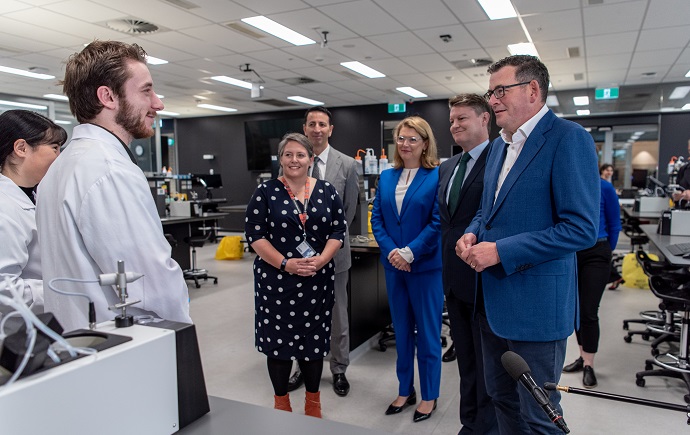
The Hon. Ben Carroll, Minister for Industry and Innovation, visited MIPS for the launch of the Monash-Moderna Quantitative Pharmacology Accelerator in August 2023.
Monash University and biotechnology leader Moderna recently forged a groundbreaking partnership to launch the Monash-Moderna Quantitative Pharmacology Accelerator (MMQPA).
Anchored at MIPS, this dynamic five-year program aims to drive significant advancements in mRNA-based medicines, including innovative therapeutics and vaccines. With Moderna investing $3 million and additional significant funding from both entities, the MMQPA is poised to be a game-changer.
Operating in collaboration with Moderna’s Research Centre for Respiratory Medicines and Tropical Diseases in Melbourne, its core focus is on advancing quantitative pharmacology. This cutting-edge discipline employs mathematical and computer modelling to enhance predictions of drug efficacy within the human body. This collaborative effort is expected to revolutionise the development of new mRNA treatments, leveraging the precision and predictive power of quantitative pharmacology.
The MMQPA not only augments Monash's vibrant RNA and pharmacology landscape but also amplifies Australia's scientific prowess in mRNA technology, offering a strategic bridge to accelerate the country's journey towards groundbreaking drug discovery and innovation.
The partnership harbours high expectations: the creation of a globally unique mRNA quantitative pharmacology hub in Melbourne. Notably this is happening in parallel with the construction of Moderna's first mRNA production facility in the southern hemisphere, located on Monash University's campus.
This marks a significant leap forward for Australia in the global mRNA landscape.
The Victorian Premier, the Hon Daniel Andrews and Minister for Industry and Innovation, the Hon. Ben Carroll, visited the site of the Centre at the launch event in March 2023.
Monash University, collaborating with mRNA Victoria, has launched a pioneering initiative to establish Australia's first dedicated mRNA workforce training centre. The Victorian Government supported the groundbreaking project with a $10 million grant.
The Monash Centre for Advanced mRNA Medicines Manufacturing and Workforce Training significantly enhances Australia's capabilities in manufacturing mRNA vaccines and therapeutics.
The Centre is strategically positioned at the Clayton campus, which is situated inside Victoria's largest employment hub outside the Melbourne CBD. This offers geographical benefits and underscores Monash's commitment to nurturing an ecosystem of innovation, linking top-tier research, companies, and startups.
The Centre's mission is to develop the necessary skills for the burgeoning mRNA manufacturing sector. It aims to serve not just Victoria and Australia but also the Asia-Pacific region.
Leveraging Monash's extensive biotechnology expertise, the Centre will provide comprehensive education and training programs covering the entire spectrum of mRNA medicines. Training will focus on key areas such as mRNA and nucleic acid discovery, bioprocess engineering, and various stages of mRNA-based vaccine and medicine production. This includes lipid nanoparticle encapsulation and fill/finish processes. The programs, shaped in consultation with industry leaders, will align with the latest scientific and regulatory standards.
The Centre's establishment is complemented by Moderna Australia’s manufacturing facility at the University. This symbiosis between academic research and industrial application is crucial for swiftly developing vaccines and treatments for infectious diseases and cancers.
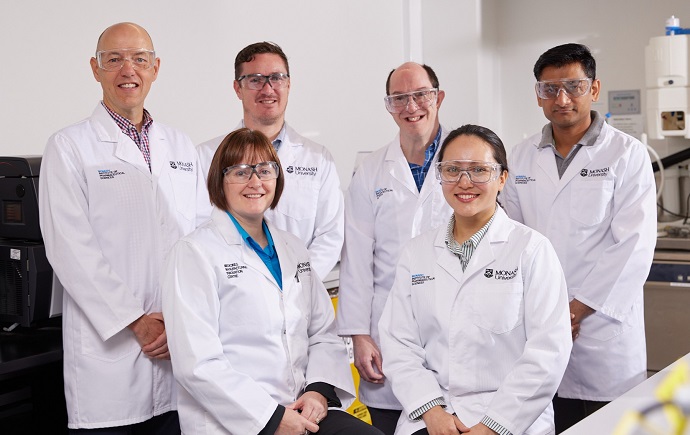
The QoMI team. L-R: (back row) Pete Lambert, Dr David Rudd, Matt Parsons and Bhavesh Patel; (front row) Professor Michelle McIntosh and Pooja Maharjan.
In a significant move to combat the challenge of unsafe and ineffective medicines in low-and middle-income countries (LMICs), MIPS has launched the Monash Quality of Medicines Initiative (QoMI). This initiative, led by Pete Lambert and Professor Michelle McIntosh of MIPS, aims to tackle the grave issue of health inequity caused by the prevalence of substandard and falsified medicines in these regions.
The QoMI, kickstarted with a substantial grant from The Ripple Foundation, focuses on enhancing the quality of medicines. It plans to establish a robust resource that employs Monash's leading pharmaceutical expertise to understand and address the roots of medicine quality issues.
Key future endeavours include conducting post-marketing surveillance studies, building capacity with local health regulators, and fostering scientific research to influence policy changes globally and locally.
A critical focus area for the initiative is maternal and newborn health essential medicines, leveraging existing networks from the Inhaled Oxytocin Project, also co-led by Pete and Michelle. Pete highlighted the dire consequences of poor-quality medicines, citing the loss of over 250,000 children annually due to inadequate antimalarials and antimicrobials.
The Ripple Foundation's investment allows the QoMI to collaborate globally, particularly in sub-Saharan Africa, South Asia, and the Asia-Pacific, with plans to expand further.
The overarching goal is to ensure access to safe and effective medicines – a fundamental human right – in LMICs, echoing the Ripple Foundation's ethos of creating impactful community change.


 Clinical trials
View
Clinical trials
View


 Commercialisation
View
Commercialisation
View


 Spin-outs
View
Spin-outs
View