MedChem Australia: Creating drug candidates with commercial potential

MedChem Australia has been established to address a significant capacity gap in Australia’s drug discovery pipeline that has inhibited locally realised commercial opportunities.
Headquartered at MIPS, MedChem Australia is a partnership between three leading medical chemistry groups that aims to translate drug research into proven treatments with commercial opportunities.
Expert capability in drug research
Monash is spearheading a new national body to translate drug research into proven treatments and grow Australia’s nascent biotechnology sector.
MedChem Australia has been established to address a significant capacity gap in Australia’s drug discovery pipeline that has inhibited locally realised commercial opportunities.
Headquartered at the Monash Institute of Pharmaceutical Sciences (MIPS), the new body will guide early-stage projects through the process of identifying drug candidates with potential commercial value.
Newly appointed MedChem Australia Director, Professor Brendon Monahan, says it brings a unique offering to the research community.
“What sets MedChem Australia apart is the expert capability we’re providing to support researchers,” he says.
“Lots of initiatives give funding support but we’re providing capability – medicinal chemistry expertise and drug metabolism and pharmacokinetics (DMPK) expertise – at a heavily subsidised cost.”
“Another drawcard for researchers is that they retain control of their intellectual property. We will work with the applicants to create new IP by designing the drugs but the applicants never give up their IP.”
“It’s a genuine collaboration,” Brendon says. “Researchers will work side-by-side with experts who know how drug discovery works and how to create new drugs”.
“Our aim is to work with applicants and share in the benefits with them.”
What is MedChem Australia?

L-R: Professor Brendon Monahan, Professor Sue Charman and Professor Paul Stupple.
MedChem Australia is a partnership between three leading medicinal chemistry groups – Monash Institute of Pharmaceutical Sciences (MIPS), Walter and Eliza Institute of Medical Research (WEHI) and the University of Sydney – in collaboration with Therapeutic Innovation Australia (TIA).
It was established in June 2023 with seed funding of around $15 million over 5 years, including a $9.75 million Medical Research Future Fund (MRFF) grant from the Commonwealth Government and a contribution of more than $5 million from the four project partners.
MedChem Australia’s primary goal is to bridge the gap between research and commercialisation.
It will deliver preclinical candidates, increasing opportunities for new biomed spin-outs, and engage actively with industry to drive investment and generate new jobs. Brendon, who joins MedChem Australia from Canthera Discovery, where he was Chief Scientific Officer, has a long record of taking academic research to commercial opportunity.
Two MIPS co-leads – Professor Paul Stupple, Director of the Australian Translational Medicinal Chemistry Facility, and Professor Susan Charman, Director of the Centre for Drug Candidate Optimisation – will bring their medicinal chemistry and DMPK expertise to the initiative.
Filling the commercialisation gap
Paul says there are enormous opportunities to grow Australia’s biotechnology sector, which currently generates around AUD$8 billion in annual revenue.
This is less than one per cent of the US$900 billion global market, which is estimated to reach US$2 trillion in the next five years.
“So much good basic biology research is conducted in Australia,” says Paul. “Many wonderful discoveries are made – and then capitalised on elsewhere around the world.”
“But there’s a shift towards realising more of these opportunities in Australia, to grow the sector, commercialise our work and, more importantly, provide clinical benefit to patients.”
Sue says good discoveries often don’t progress because of a lack of small molecule drug discovery expertise in project teams.
“You need experts who know when a molecule has the right characteristics and when it doesn't, and how to mitigate risks throughout the drug discovery and development pipeline,” she says.
“Having experienced medicinal chemists available who can contribute to these programs at a significantly subsidised rate will really add value and ensure the discoveries that progress have the best chance of succeeding down the track.”
“That’s good for the researchers that bring the program forward, and it’s good for Australia because it builds credibility, momentum and illustrates success”.
“It helps to develop the Australian ecosystem to keep these activities onshore in Australia.”

MedChem Australia’s role will help the academic community move to a commercial mindset.
Brendon says part of MedChem Australia’s role will be helping the academic community move to a commercial mindset.
“The capability and skill sets to turn academic discoveries into new drugs are quite distinct from the skills that made the discovery in the first place,” he says.
A true collaboration
The decision to headquarter MedChem Australia at Monash highlights MIPS’ global leadership in drug discovery and the innovative entrepreneurial research it has delivered over the past 14 years.
Brendon says MedChem Australia now offers the opportunity to grow that capability nationally through advocacy, mentorship and leadership.
He stresses the new body is a collaborative effort – both with researchers and the other partners.
“MedChem Australia’s expertise is medicinal chemistry but we still need the biology expertise from the project provider, so they will be active participants in the process,” he says.
Paul is excited to be working with the medicinal chemistry teams from WEHI and the University of Sydney.
“Working with multidisciplinary project teams is so important in drug discovery,” he says. “That’s where the magic happens.”
“Another of our goals is to train medicinal chemists. Every time we have a new spin-out company you’re going to need someone to lead the chemistry activities within it, so we’re pulling out all stops to ensure we have those leaders of the future.”
Sue’s team will provide input on the properties a drug needs to survive the human body.
“Our role is to understand whether the molecules are suitable from a drug delivery point of view,” she says.
“We work with the chemists to understand the relationship between the structure and how the body processes that molecule.”
“We look at factors such as how the drug will be absorbed, which determines how it can be administered, whether or not it reaches the site of action, what dose is required to achieve effective concentrations, how long the drug stays in the body and therefore how often it needs to be taken.”
Next steps
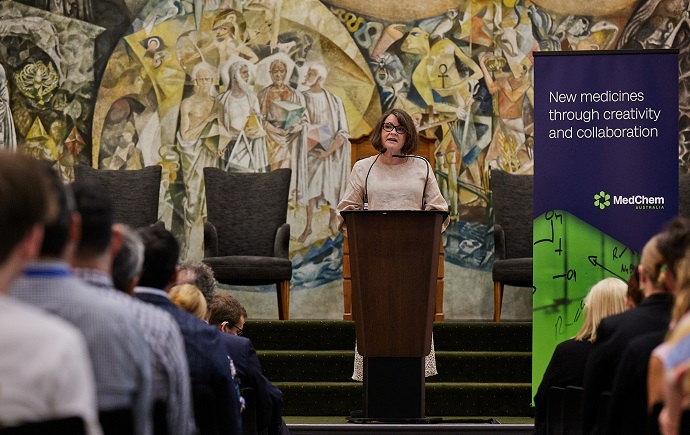
The Hon Ged Kearney MP, Assistant Minister for Health and Aged Care gave an address at the MedChem Australia launch event in November.
Brendon has spent his first months as Director working on the processes governing MedChem Australia’s operations.
A launch event for 200 people was held on 8 November to raise awareness of the new body and provide information on the application process. This was followed by a roadshow in each state.
A website and supporting information will be developed, with a first call for project submissions to follow with a due date in February 2024.
Brendon says an independent selection committee will be formed to assess the applications and approve projects for MedChem Australia support.
“We’re therapeutic area agnostic, so any therapeutic and disease area can apply,” he says.
“We require projects that already have some type of chemistry existing and we’re specifically focused on projects which are creating small molecule therapies.”
Brendon believes MedChem Australia will be able to work on riskier projects that other organisations might avoid.
“Where there’s real proof that a project can help to treat a disease, I feel that MedChem Australia, with the support of the MRFF and TIA, can help de-risk that project and position it for further investment,” he says.
“We can be brave in our projects and go for really innovative biology to identify new medicines.”