The role of pharmacy in international aid
How the Mathew Peck Travelling Scholarship inspired a career and a business
Professor Sharon Pickering, Vice-Chancellor and President of Monash, has a vision of Monash being the university of the Indo-Pacific. Alumni, Michael and Erin Nunan, have both experienced first hand the pivotal role pharmacists can play in the region. Hooked by their experiences volunteering in the Pacific, both built careers in international development, before co-founding Beyond Essential Systems, a company that creates and implements healthcare software. The life and business partners say it is delivering real, positive, sustainable improvements in the lives of people in some of the world’s most challenging, low resource and remote places.
Meeting at Monash; Inspired by the Mathew Peck Travelling Scholarship
Erin Nunan (nee Mitchell) had toyed with the idea of a career in health/law but was inspired to enrol in a pharmacy degree at Monash by a family friend who was also a pharmacist in her hometown of Traralgon. While studying at Parkville in the early 2000s, she met fellow student and future husband and business partner, Michael Nunan.
Michael’s parents, Tony and Genny Nunan, were also both pharmacy alumni, and part of his inspiration in choosing to study at Monash. He was also the first recipient of the Mathew Peck Travelling Scholarship in 2004, when he was just 21.
“Mathew was in our year and, after he sadly passed away a group of us did some fundraising to set up the Mathew Peck Travelling Scholarship,” Michael explains. “I applied for the adventure of it, to see the world and to honour Mat. It ended up being a transformative experience”.
Michael believes the scholarship fundamentally changed the course of his life, with his experience in Vanuatu leading both him, and Erin, to careers in international aid.
“Before the Mathew Peck Scholarship took me to Vanuatu, I’d not even been aware that international health was a career option,” he says.
Doing something different with pharmacy
After Michael and Erin graduated in 2005, they worked in hospital pharmacy in Hervey Bay, Queensland, before registering with Australian Volunteers International to work in the Solomon Islands.
“We wanted to do something a bit different and thought we’d volunteer because we could see that international development was a way of doing interesting things with pharmacy,” Erin explains. “Initially we thought we’d do it for a year or two then start our ‘real life’.”
But, after a few years in the Solomon Islands, Erin took a role in Swaziland, Southern Africa.
“It was amazing and, after living in Swaziland, the idea of retail or hospital pharmacy didn’t feel the same,” she explains.
Michael took short breaks back to Australia to complete research, a Masters, then a PhD, while he and Erin worked together in Swaziland, as well as East Timor, Nigeria, Sierra Leone (during an ebola epidemic), the Ivory Coast, Cambodia and many countries across the Pacific.
The couple finally returned to Australia in 2015.
“We’d been doing contract work for the United Nations Population Fund (UNFPA) and while we both wanted to keep working in international development, it can be tricky to see a path if you can’t travel all the time,” Michael explains. “Erin was pregnant with our first child, I’d just finished my PhD, so I took a corporate job”.
But the pull of international health drew him back.
An unusual way to start a company: The birth of BES
Michael’s inspiration to start his own company stemmed from his personal experience working in international development and seeing the gaps and challenges for staff. He completed his PhD on pharmacy software mSupply, used in 40+ countries.
Michael saw the need for someone to implement that, and other free, open-source software tools, in clinics, hospitals and health systems in developing countries.
His idea became reality when he stumbled upon an unusual way to gain seed funding.
“I actually went on a game show, Million Dollar Minute, and won a couple of hundred thousand dollars,” he explains.
Michael established Beyond Essential Systems (BES) at the end of 2015.
“We focus on digital health implementation and supply chain solutions in low- and middle-income countries,” Michael says. “It was just me for the first 12 months, implementing one software”.
Nine years on, and now as CEO, Michael oversees over 70 staff working in 12 countries. BES now offers four different software programs that allow the company to undertake complex, integrated projects.
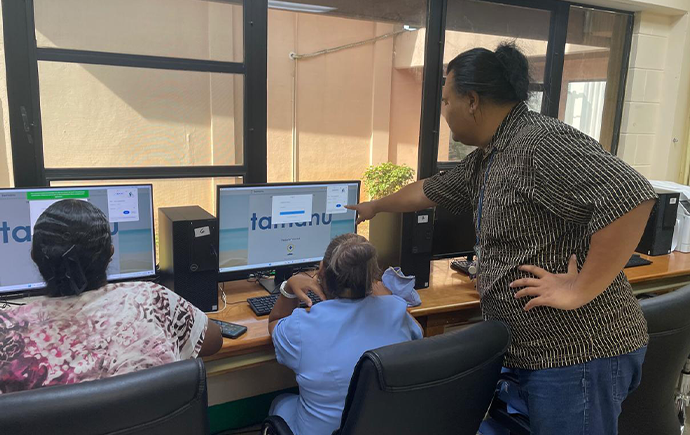
“Two of these are ours: Tamanu, which is electronic medical records and Tupaia, which is data aggregation,” Michael explains.
BES also implements third-party software from mSupply and Senaite, an open-source Laboratory Information Management System.
“The software is necessary, but it's only one piece of the puzzle,” Michael says. “We take a holistic approach and consult on health system strengthening”.
“We are impact-led, not profit-led” Michael says. “By engaging and training local staff to deliver projects, and through cross-collaboration with health departments, our long-term goal is to work towards making ourselves unnecessary in the country or project.”
“We see ourselves as an international development organisation that implements tech and we are really proud of that,” he explains.
Collaborating to build BES
Meanwhile, back in 2015 Erin was working as a Developing Countries Program Manager for Therapeutic Guidelines, while completing the law degree she’d always had an eye on. She says she initially played a role as a sounding board for Michael as he grew BES, but it quickly became apparent they needed to collaborate and work with each other to get the company off the ground.
“BES began with supply chain projects, and I joined formally once we developed Tupaia. It felt like we had something unique to offer,” she says. “I was probably the fourth employee, two years in and I’ve changed my role quite often, through necessity, because it’s our own company”.
As Director and Program Manager, Erin now manages the team that implements Tupaia and Tamanu, as the software grows and undergoes improvements.
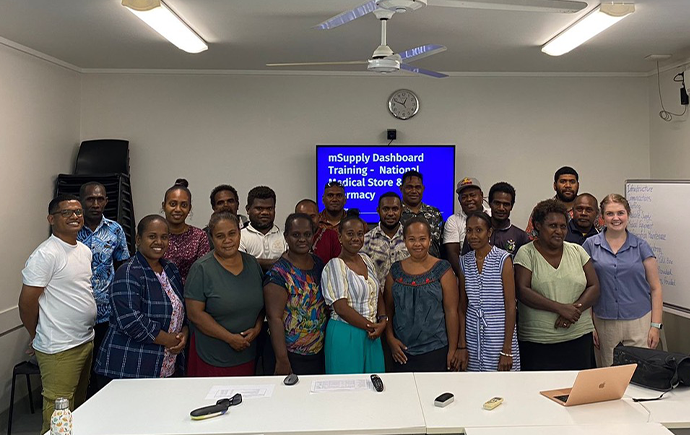
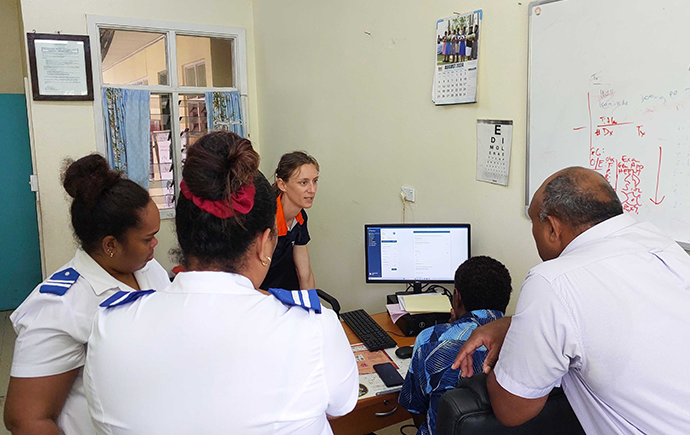
“Our products impact clinical workflows so how can we implement them smoothly?” she asks. “Some of the people being trained have not used a computer before, and they have limited resources so we don’t want to disrupt things too much, just improve efficiency.”
“We take a collaborative approach, we don’t tell them what to do, we work with what they tell us, and adapt.”
Erin credits their success with the flexibility and problem solving that pharmacy teaches.
“It’s interesting to do something so varied in a role,” Erin says. “International development offers a different path and pharmacy has been a transferable skillset.”
Pharmacists play a vital role in international development
Erin highlights the many benefits that seemingly small digital transformation can have.
“If you’re a nurse in a country like Nauru, why shouldn’t you have digitised records? Our products bring these countries into the future, create efficiencies that allow them to focus on clinical care, and are customised for the Pacific”.
“It doesn’t sound like much but if there is less admin and more time for clinical care it can have a bigger impact,” she explains.
Michael highlights an example of a project to implement mSupply in East Timor that reduced the cost of medicines procurement by 40 per cent in its first year.
“That money could be put back into more medicines, or primary health care, both of which have a material impact,” Michael says. “If you can have a little impact on as many people as possible it improves lives and communities”.
Both believe pharmacists have an enormous role to play in international development.
“Pharmacists have broad clinical grounding and can understand clinical workflows,” Michael says. “They are also problem solvers, and we face a range of challenges that are not solely clinical - supply chain, logistics, dealing with a variety of stakeholders, and more”.
“I have loved my career and working in international development,” Michael says.