Beyond COVID: mRNA at MIPS
In 2020, MIPS made headlines as the home of the first Australian-developed COVID vaccine candidate. Five years on, mRNA has become a growth area for the Faculty, encompassing several initiatives including VMIH, CORTx, mRNA Core and MMQPA, which are united by their emphasis on collaboration within and beyond Monash.
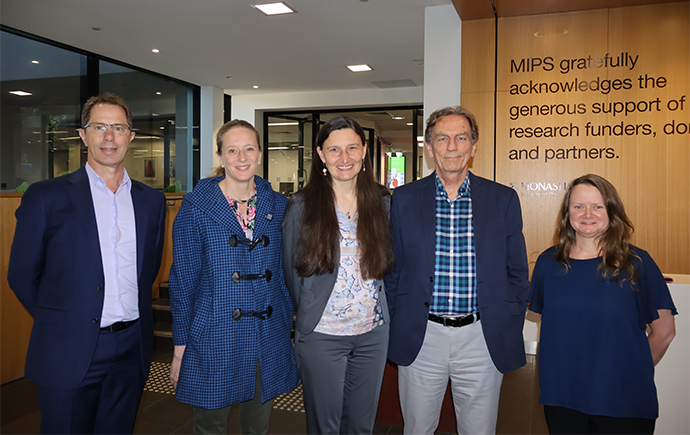
L-R: Professor Carl Kirkpatrick, Associate Professor Natalie Trevaskis, Associate Professor Cornelia (Connie) Landersdorfer, Professor Colin Pouton and Dr Simone Beckham.
The COVID-19 pandemic put mRNA in the spotlight and Monash was perfectly placed to take advantage of the growing scientific interest in this field, says Professor Chris Porter, Director of the Monash Institute of Pharmaceutical Sciences (MIPS).
“There were very, very few good things about the pandemic, but one of them was the visibility it gave to mRNA research,” Chris says. “It's brought a lot of very smart people together to look at what could be a groundbreaking technology.”
“Pre-pandemic, the Faculty had groups working on mRNA, which allowed us to move very quickly when the pandemic arose,” he explains.
In 2020, MIPS researchers, led by Professor Colin Pouton, were the first in Australia to develop three COVID-19 mRNA vaccine candidates. The vaccine has since been manufactured by local Melbourne company IDT Australia and undergone Phase 1 Clinical Trials with the Doherty Institute.
Almost five years on, Chris says the Faculty is now in a new era of mRNA development, which has extended from vaccines into new types of therapeutics. He says MIPS is excited to be involved in understanding what mRNA can - and cannot - do, and that the research so far has been exceptionally promising.
“It’s not a universal panacea, but it is a new field and modality that requires significant, deep research to understand its potential,” he explains.
“For instance, we’re exploring whether it could be a better and more effective way of delivering biologics or used as an alternative to viral gene therapy.”
He also says the research into mRNA vaccines and therapeutics is rapidly growing, and that collaboration will be key to helping unleash its potential.
“We believe that we're currently at the starting point of the transformation in mRNA medicines and what we may be able to do with them,” he explains.
“It requires a rigorous approach to understanding what's possible and what's not, and it requires us to do that in partnership with other research institutes and industry”.
VMIH: Building the foundation of next generation mRNA
Chris also chairs the management committee of the Victorian mRNA Innovation Hub (VMIH), which is at the forefront of groundbreaking advancements in RNA therapeutics.
Established in June 2022 after an agreement for funding was signed with the Victorian Government through mRNA Victoria, VMIH is a collaborative partnership of four leading research “Nodes”: MIPS, the Monash Biomedicine Discovery Institute (BDI), the Peter Doherty Institute for Infection and Immunity, and the University of Melbourne's Department of Chemical Engineering.
Headquartered at MIPS, VMIH is managed by Dr Simone Beckham. She says the Hub has already achieved several significant milestones, including initiation of large cross-node collaborative programs, collaborations with industry and initial discussions around commercialisation of new technologies.
“It’s also really exciting to see the importance of our research being recognised by Australian funding bodies,” Simone says. “There have been a number of very interesting conversations around commercialisation of the targeted nanoparticle delivery technologies that have been developed by VMIH researchers.”
“mRNA therapeutics is a hugely competitive field and it's fantastic to see that we are leading some of the competition.”
“We’ve done a phenomenal amount of great work,” Simone says. “The publications we’ve produced have had a real impact on the development of next generation RNA therapeutics and nanoparticle delivery systems, and this has the potential to shape the global RNA therapeutics ecosystem and future research in this space.”
Simone explains that at its core, VMIH operates on two complementary themes.
“We work to develop next-generation RNA therapeutics and next-generation nanoparticle delivery systems for mRNA therapeutics,” she says. “These systems complement each other, and with our expertise and resources we are uniquely placed to further expand upon existing technologies and platforms, and develop new ones that will hopefully give rise to ground-breaking RNA therapeutics for a range of diseases.”
“VMIH researchers examine the intricacies of RNA elements that impact RNA stability and other features of RNA that could potentially improve current RNA therapeutics and deliver new therapeutics”.
“In parallel, we develop nanoparticles that are targeted to be delivered to a particular organ or specific cells which really has the potential to revolutionise the way that we treat or prevent diseases.”
Simone echoes Chris when she argues that cross-institution collaboration, such as VMIH's, is vital to the future of mRNA.
“The Hub’s success is actually built on forming really strong research relationships and collaborations,” she explains. “It’s not just about what we currently do, but also launching it into the future and creating a sustainable environment for the RNA ecosystem.”
“MIPS programs in RNA therapeutics are a powerhouse, largely because of the synergy of working together. Having collaborations across all our programs is critical to success, but also the way we enjoy working - as such we work very closely with related programs such as CORTx, mRNA Core and MMQPA.”
CORTx

L-R: Associate Professor Natalie Trevaskis and Associate Professor Angus Johnston.
In 2024, MIPS established CORTx, the National Centre for Biopharmaceutical Optimisation of mRNA Therapeutics. Supported by a $4 million grant from the Australian Government’s Medical Research Future Fund, this national program operates in collaboration with biotech giants Moderna and iCamuno, alongside the University of Melbourne, the Walter and Eliza Hall Research Institute, Australian National University, and the University of New South Wales.
Associate Professors Angus Johnston and Natalie Trevaskis are Co-Directors of CORTx, and describe it as a unique platform providing services for academics and biotech companies to evaluate the biopharmaceutical properties of mRNA delivery systems.
“mRNA has quickly become a potentially amazing tool in medicine,” Natalie explains. “Not just for vaccines, but for developing therapeutics that use proteins, and potentially for gene editing.”
Both directors bring extensive expertise to CORTx. Natalie, whose background is in drug delivery research, entered the burgeoning mRNA field three years ago.
“When I studied pharmacy 20 years ago it was inconceivable that mRNA would ever be a medicine,” she says.
Meanwhile, Angus, who established his group at MIPS a decade ago, initially focused on polymer nanoparticles until the pandemic pivoted the focus of his work to lipid nanoparticles (LNPs) to support mRNA delivery.
“The ability to rapidly change mRNA sequences makes it easier than I would have expected to develop pre-clinical candidates,” Angus says. “Our goal is to advance mRNA therapeutics beyond vaccines and into next-generation therapeutics.”
“At CORTx, our first step is to take existing LNP that people around the world have been developing to try to understand the distribution of those - which cells do they go to? And what is the effect?” Angus explains.
“If these off the shelf LNPs can’t deliver the mRNA to the place in the body where it is therapeutically active, then we modify the LNP with targeting agents, antibodies and nanobodies that we connect to the surface of the cell.”
This is done using proprietary technology developed at MIPS.
“We’ve developed a method where we can control the orientation of the antibodies, so it's more effective and targeted,” says Angus.
Natalie explains that using mRNA for therapeutics requires overcoming unique challenges, including its instability (mRNA breaks down quickly) and poor cell uptake.
“It's about improving delivery, specificity, and efficacy,” Natalie says. “If you can increase the amount that goes to the site where it's needed it could be more effective.”
Angus and Natalie say the potential for mRNA is well beyond what one research institute can cover, but the challenges are the same, so collaboration is critical.
“We identified eight partners for collaboration,” Natalie says. “They know what they want to treat - cancer, fatty liver disease, inflammatory bowel disease, and diabetes are some of the diseases - but the delivery of mRNA may not be optimal, so we help them improve the design of the LNPs.”
“For almost any disease you can think of, mRNA could be a potential therapeutic,” Angus adds. “It won’t work for them all but we are in a good position to test the therapeutic effect.”
“It's great being in an area where there are so many potential directions,” Angus concludes. “The hardest thing is prioritising which one to focus on - but that is a good problem to have!”
mRNA Core

mRNA Core team.
With a career in academia and drug delivery research that spans four decades, Professor Colin Pouton has been at the forefront of delivering large molecules, proteins, DNA and gene therapy for a long time.
Around 2010, when interest and funding for RNA technology began to grow, Colin says he saw the potential of this transformative field.
“By 2016, we realised we should also get into RNA,” he explains. “It was starting to become easier to do, the materials were available for making RNA, so we started. It was just me and a few PhD students.”
Then, in 2020, COVID-19 hit, changing everything. Colin became well-known for leading the team that produced the first Australian mRNA clinical product.
“We knew straight away mRNA would be a great technology to work on to produce a COVID vaccine,” he says.
“COVID stimulated a huge amount of funding into the mRNA space, so there has been a consequent increase in the numbers of groups working in the field,” he reflects.
Colin’s group’s expertise in RNA research and their COVID vaccine success laid the foundation for the mRNA Core initiative, where he now serves as Director. mRNA Core was established to advance the next generation of mRNA through collaboration and support for researchers.
“People approached us wanting to use mRNA for their projects, but needed training or help to do so,” Colin says. “It was more time and cost effective to make the mRNA for them”.
Since 2021, mRNA Core has provided RNA materials to more than 20 research groups across Australia, advised on project design and helped researchers choose the best delivery systems for their proof of concept clinical studies. This collaboration is at the heart of mRNA core, and requires active research involvement from project partners.
“We tell them if it doesn’t feel like their idea is feasible, or we work with them to try a simple product and optimise it,” he says. It was this need for a more detailed process of optimisation that also led to the genesis of CORTx.
Unlike traditional drug discovery, in which it can take a decade to produce a clinical drug, mRNA research moves at a much faster pace.
“Making a COVID vaccine is probably one of the easiest things you can do with mRNA,” Colin explains. “There are potentially many uses for mRNA but even vaccines for other viral infections are harder and the therapeutic uses are much more complex.”
The potential uses of mRNA are vast, ranging from treating heart disease (e.g. could mRNA be used to deliver a therapeutic protein to treat atherosclerosis?) to addressing obesity and diabetes with effects similar to Ozempic. Other possibilities include vaccines for Alzheimer's and therapeutic applications for over 10,000 rare diseases, such as cystic fibrosis and muscular dystrophy.
Supported by a $5 million Medical Research Future Fund (MRFF) mRNA Clinical Trials Enabling Grant and NCRIS, mRNA Core is one of the four national nodes of the RNA Products division of Therapeutic Innovation Australia (TIA).
Today mRNA Core operates a manufacturing unit with a team of eight people making materials for around 30 active collaborations. Colin says scientists and post-doctoral researchers at MIPS are heavily involved in these efforts.
“We try to do the things that are more difficult,” he explains. “This is the sort of thing that can change the landscape, help us understand delivery at a deeper level and improve delivery systems”.
MMQPA

Dr Jess Tait and Associate Professor Cornelia (Connie) Landersdorfer.
As part of a five-year collaboration between Monash University and Moderna that commenced in 2023, the Monash Moderna Quantitative Pharmacology Accelerator (MMQPA) headquartered at MIPS aims to accelerate Australia’s development of new safe and effective mRNA medicines for a broad range of diseases.
The MMQPA is the inaugural R&D Accelerator initiative from Moderna’s Regional Research Centre in Respiratory Medicine and Tropical Diseases (RRC) based in Melbourne and is funded by a $3 million investment by Moderna and substantial in-kind contributions from Monash.
Quantitative pharmacology (QP) uses mathematical computer models to help describe and predict how medicines will work in the human body and, as such, is hugely impactful across the entire drug discovery pipeline - from the early stages right through to regulatory submission and even analysis of the real-world performance of medicines.
This makes the work of MMQPA critical to other mRNA research initiatives within MIPS, particularly CORTx and mRNA Core where QP models are able to provide invaluable insight into identifying promising mRNA therapeutic candidates.
“QP models being developed by MMQPA have become central to informing the design of experimental studies being conducted by the other MIPS mRNA initiatives such as CORTx,” said Academic Director at MMQPA, Professor Carl Kirkpatrick.
“In turn, novel physiological and pharmacological information generated through CORTx helps to inform MMQPA’s computational models.”
Carl says a huge advantage to QP models is the ability to identify dosing strategies to optimise efficacy and safety of medicines, thereby reducing the need for large, costly clinical trials across mRNA development programs.
“Much like mRNA technology, QP is a transformative science which has significantly improved the speed, efficiency and safety of the drug development process,” Carl said.
“Because of this, it is able to fast-track the time in which much-needed drugs get to patients, while still going through a rigorous process to ensure optimal efficacy and safety.”
Associate Professor Cornelia (Connie) Landersdorfer, the Scientific Director at MMQPA, explains that QP is being used at MIPS to describe interactions between a medicine and a disease, therefore facilitating the decision-making process across the drug discovery and development pipeline.
“In drug discovery programs working toward clinical trials, the ability to predict a therapeutic dose for the first in human study is a critical step,” Connie said.
“QP provides a unique opportunity to help determine this information, and we’re now applying these exact same principles to mRNA vaccines and therapeutics.”
“Furthermore, MMQPA is addressing a major gap in Australia’s current mRNA development environment. By bringing together the expertise of internationally leading experts in QP and mRNA technology, from Monash and Moderna, QP continues to place Australia at the forefront of drug discovery, development and innovation in new medicines for a broad range of diseases.”