Supercomputers, neural networks and quantum chemistry: How AI and quantum are transforming education and research
This year, MIPS welcomed Professor Giuseppe Barca, whose unique expertise in high-performance computing, artificial intelligence (AI) and quantum chemistry will help MIPS to continue pushing the boundaries of drug discovery and accelerate our scientific efforts in effective, efficient and innovative ways. 2025 has also seen big advancements in technology for the Faculty, including Monash’s announcement of an investment in an advanced supercomputer called MAVERIC as well as AI being applied in novel and useful ways across research and teaching settings.
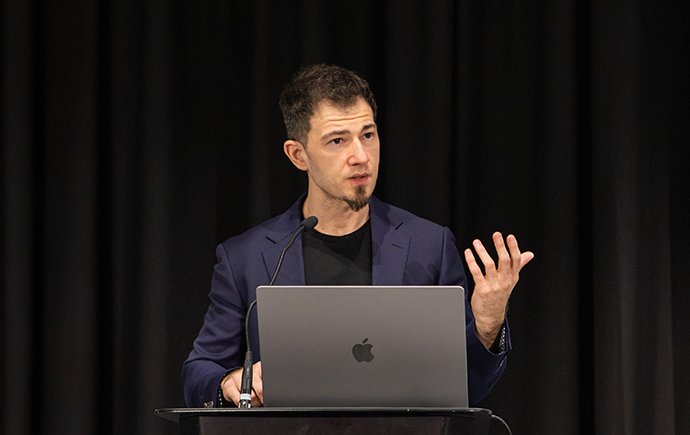 Welcoming Professor Giuseppe Barca
Just over a decade ago, Professor Giuseppe Barca was studying for his Masters in Chemical Engineering in his home country of Italy, when he became intrigued by chemical simulations as a path toward answering much bigger questions.
“I was interested in creating technology that allows us to simulate what happens in the human body,” he explains. “In hindsight it sounds naive: can we simulate life? That question became a serious motivation.”
Giuseppe soon realised that, if he wanted to achieve his goal, engineering could only take him so far. If you want predictive models of biology at the molecular level, you ultimately run into quantum mechanics—the language that governs chemical bonding, electronic structure, and reactivity. So he reached out to leading quantum chemists across the world, including Professor Peter Gill at Australian National University (ANU) in Canberra, before moving to Australia in 2014 to undertake a PhD on the development and implementation of novel scalable algorithms in computational quantum chemistry. It was work that took him closer to computer science, and he found that while much of the theory for solving simulations existed, translating them into computer programs that solved them fast was the challenge. In practice, this meant moving beyond algorithm design and into high-performance computing (HPC).
This transition from quantum chemistry to HPC became central to his career. Building on his PhD work, Giuseppe shifted his focus toward enabling quantum chemistry and molecular simulations on next-generation supercomputers, including exascale systems. Giuseppe’s subsequent research has enabled a new scale in quantum chemistry simulations that can be applied to biosystems.
The implications for drug discovery are significant. High-fidelity simulations can reduce reliance on slow, expensive trial-and-error by allowing researchers to test hypotheses in silico before committing to synthesis and experiments.
“We can run simulations for drug discovery and predict outcomes without waiting months for results in the lab,” he explains.
Increasingly, Giuseppe’s work sits at the intersection of physics-based simulations and artificial intelligence. AI can accelerate parts of the simulation workflow, but its most transformative role is often upstream: helping generate and prioritise new therapeutic candidates in the first place. Generative AI models can propose novel molecules, explore chemical space more efficiently, and suggest candidates tailored to specific biological targets or constraints—candidates that can then be screened using quantum chemistry and large-scale simulation on HPC systems.
“AI has brought enormous potential to the drug discovery field,” Giuseppe says. “It doesn’t just help us compute faster—it helps us ask better questions by proposing what to test next, so simulation and experiment can focus on the most promising options.”
Together, supercomputing, quantum chemistry, and AI form a tighter loop: generate candidates, test them in silico at scale, learn from the results, and iterate—compressing timelines, reducing cost, and expanding what is scientifically feasible.
Award-winning capability
In 2023, Giuseppe co-founded QDX, a deep-tech company combining quantum chemistry, HPC, and AI to advance drug discovery, with operations in Singapore, Melbourne, and Canberra.
He was named one of Australia’s Top 250 Researchers for 2024 by The Australian. His team was also awarded the Association for Computing Machinery (ACM) Gordon Bell Prize. And, in 2025, he received the Dirac Medal from the World Association of Theoretical and Computational Chemists (WATOC). This is the highest international award in the field for scientists under 40, and represents global recognition of his pioneering contributions to high-performance quantum chemistry.
That said, Giuseppe’s career does not only include research. He has lectured at ANU (where he still holds a position as Associate Professor) and the University of Melbourne, before deciding to join Monash in 2025.
“Monash was interested in pioneering this new approach to designing therapeutics, and I was keen to collaborate with people who are experts and leaders on the experimental side, so we could combine our forces,” Giuseppe says.
“The expertise at MIPS complements the capabilities we have developed over the last few years,” Giuseppe says. “Putting these two things together will be revolutionary in terms of how you design novel therapeutics—that’s what is exciting.”
“I’ve found MIPS to be a very interesting, vibrant environment.”
 Monash invests in a supercomputer called MAVERIC
Giuseppe says Monash University’s recent investment in an advanced AI supercomputer called MAVERIC (Monash AdVanced Environment for Research and Intelligent Computing) will allow simulations to be accelerated, as the graphics processing unit-based system is compatible with his software stack.
“It will be an important component in progressing drug discovery programs—both existing and new,” Giuseppe explains. “We can take advantage of that hardware to run our experiments very fast, so everything will be accelerated with MAVERIC.”
Monash University announced the $60 million investment in mid-2025, as part of a collaboration with partners NVIDIA, Dell Technologies and the CDC Data Centres.
Once built in 2026, it will use first-in-Australia technology to solve complex problems across a range of research and development. It also positions the University as a leader in AI-driven research within the international higher education and research sector.
When revealing the news in June, Monash University Vice-Chancellor and President, Professor Sharon Pickering described the collaboration as bringing together the expertise needed to strengthen sovereign capabilities in technology while solving real problems.
“We want our people—Monash academics, students and our research partners—to be at the forefront of shaping the future of AI; not just in how it's applied, but in unlocking entirely new possibilities and innovations,” Professor Pickering said. “Our focus is on solving real problems and putting AI to work in a meaningful way: from breakthroughs in cancer detection to redefining what’s possible in preserving the health of our planet for future generations.”
What supercomputers can do
MAVERIC will be purpose-built for large-scale AI and data-intensive workloads and will feature the NVIDIA GB200 NVL72 platform architecture, deployed through Dell Technologies.
It will be housed at CDC’s data centre in Brooklyn, Melbourne, and will use cutting-edge liquid cooling technology, which is 300 times more water-efficient than traditional systems and reinforces Monash’s commitment to sustainability.
Ultimately, MAVERIC will enable researchers like Professor Giuseppe Barca and many others at MIPS to perform large computational projects that currently lie beyond their reach. The Faculty will be able to harness its power for use in drug discovery research, with one of the initial goals being to cost-effectively identify new medicines.
For MIPS researchers like Giuseppe Barca, the future is becoming a reality.
“This is important from a societal perspective,” Giuseppe explains. “Translating science that seems out of reality, to create outcomes for better health, is what drives me.”

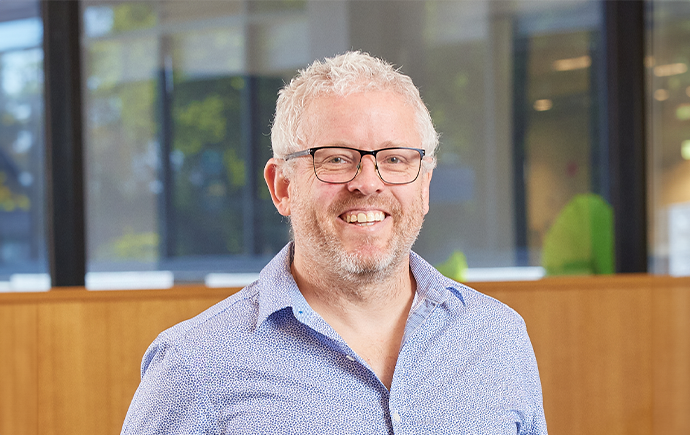 Dr Matthew Belousoff is a Senior Research Fellow in Drug Discovery Biology and MIPS’ AI and Data Science lead. He says neural networks (which he describes as “a really large matrix multiplication machine”) and AI approaches are speeding up research.
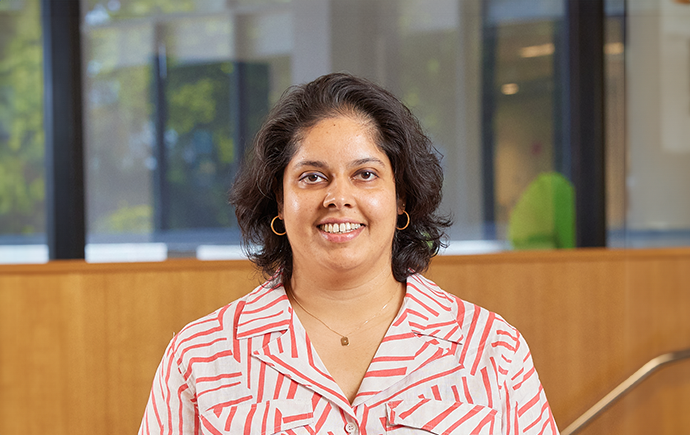 While researchers may be using neural networks and supercomputers, for educators, Large Language Models and GPTs are changing the game.