
East meets west
December 2010
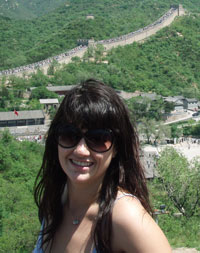
Third year Bachelor of Pharmacy and Bachelor of Commerce student Diana Sandulache recently travelled to China as part of an International Scholar Laureate Program delegation on medicine. Here she describes a life-changing experience that exposed her to a new culture and a very different medical system.
"The delegation was a whirlwind two-week adventure through China, from Beijing to Xi'an and finally Shanghai, with 86 like-minded students. Together we experienced the amazing sights of China and discovered similarities and differences between our healthcare systems.
Our trip started with a visit to Beijing's Peking University, where we met health sciences students. This presented an opportunity to understand how tertiary education operates in China. The cost of university studies there is much lower than it is in Australia. But it's also more competitive, as a lot of value is placed on academic achievement in Chinese society.
We also attended the Beijing Autism Clinic, where we were told about the difficulties children with autism face in China. The country has only recently recognised autism as a valid medical diagnosis and families of patients offered financial assistance. Even so, this assistance is minimal and far from enough. The Autism Clinic does its best to help affected families and, even with its limited resources, it seems to do a better job than we do. Each child has an individual mentor and parents are involved in the program. The most amazing aspect of the clinic is that it receives no government funding and operates solely on donations and the goodwill of volunteers.
One of the main areas we were exposed to during the program was traditional Chinese medicine (TCM). This started with a talk from the director of the Guang An Men Traditional Chinese Medicine Hospital in Beijing. TCM is based on creating a balance between yin and yang, which can be explained as a balance between cold and hot respectively. For example, too much yang causes a fever, while too much yin can cause the flu. At the hospital we were also exposed to reflexology, acupuncture and cupping, all part of TCM.
Pharmacy as a profession is not as important in China, as medical students do a lot of the TCM work. And pharmacologically speaking, TCM practitioners don't know much about the medicines. There's no documented mode of action, no pharmacokinetic information and no consumer medicine information leaflets. At the moment, there are two schools of thought in China about this lack of understanding of how TCM medicines work. At Guang An Men, the medical team is slowly trying to discover the mode of action of different traditional medicines. But most TCM practitioners, as well as the general population, don't want to know about the mode of action. As one TCM student explained to me, "We don't need to know how it works. All we know is that it does. What else matters?"
As a group, the delegation was privileged to visit a traditional herb market in Xi'an and learn about the different ingredients used in TCM. It was quite an experience, navigating lanes of unlabelled powders and mixtures in hemp sacks. The market stocked everything from ground-up flowers and berries to dead preserved reptiles and shark teeth. Most of these are to be boiled in a large pot of water, together with other herbs, and the patient drinks the mixture. We also had our own TCM experience when we sampled some ‘snake wine'.
Although TCM has been around for lifetimes, Western medicine now dominates the medical system in China. However, rural areas are still very reliant on TCM, as we saw when we visited a hospital in Xi'an. This was probably the most confronting of all our visits, as it really highlighted some of the services we take for granted here in Australia. Walking through the hospital we encountered countless rows of patients on IVs in tiny rooms, minor surgeries performed in unhygienic conditions and no air-conditioning or heating. But the staff and villagers were the friendliest community we had the privilege of meeting. They performed traditional Chinese shows for us and invited us to a delicious homecooked meal.
In terms of our sightseeing, we visited Beijing's Tian'anmen Square, Forbidden City and Summer Palace, while learning about the country's great dynasties. The most breathtaking sight of all was the Great Wall of China. We then took an overnight train journey to Xi'an, where we marvelled at the Terracotta Warriors. And finally we reached Shanghai, where we spent a day at the Shanghai World Expo.
The students in the delegation were mostly from the USA, but also from South Africa, Puerto Rico, Canada and, of course, Australia. It was very exciting to connect with people from different countries who had a genuine interest in health sciences and medicine, and we formed lifelong friendships.
The International Scholar Laureate Program experience was made available to me through the Monash Chapter of Golden Key and would not have been possible without generous support from the Faculty of Pharmacy and Pharmaceutical Sciences and the Monash Vice-Chancellor's Office.
It was a wonderful opportunity to learn about how medicine works in other countries, and how it made me really appreciate our own health system while understanding that we can still learn from others. It also made me more certain that I've chosen the right profession!"