
Melbourne researchers paving the way towards new treatment for long COVID
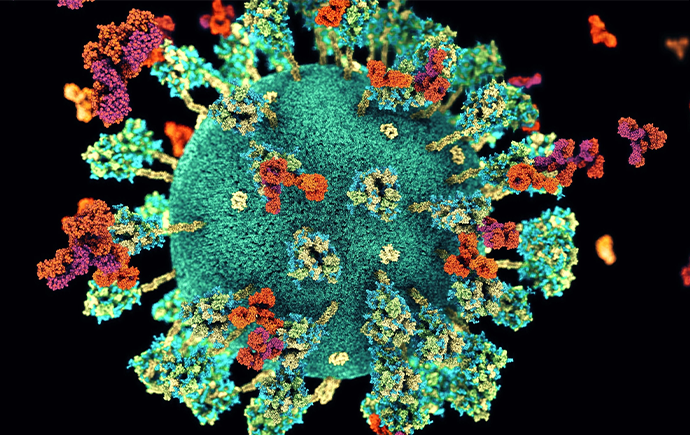
Credit: WEHI. COVID-19 is caused by the SARS-CoV-2 virus. This image shows antibodies (shown in orange and purple) binding to ‘spike proteins’ on the surface of SARS-CoV-2 virus (shown in teal and yellow). Spike proteins are critical for SARS-CoV-2 to enter human cells, and this can be blocked by specific antibodies – breaking the infection cycle.
9 April 2025
Researchers from Monash University’s Centre for Drug Candidate Optimisation (CDCO) have contributed to a WEHI-led study that could lead to a new drug to prevent long COVID symptoms.
The preclinical study, published in Nature Communications, describes how a new drug candidate, developed by WEHI researchers, can prevent long COVID symptoms in mice.
The CDCO team, led by Professor Susan Charman, has been collaborating with WEHI since 2020 to evaluate the biopharmaceutical properties of the antiviral compound. The program was established when WEHI researchers first identified the compound could block a key COVID protein called ‘PLpro’.
The CDCO, which sits within the Monash Institute of Pharmaceutical Sciences, has conducted in vitro and in vivo profiling of the new compound to define its physicochemical, metabolism and pharmacokinetic properties. Identifying compounds with acceptable properties is critical to ensure efficacy, safety and a convenient dosing regimen.
In the world-first study, the team found mice treated with the antiviral compound were protected from long term brain and lung dysfunction – key symptoms of long COVID.
Professor Charman said data presented in the study is encouraging, particularly when it comes to a potential treatment for long COVID which impacts millions of people worldwide but remains poorly understood.
“Long COVID symptoms are known to be quite debilitating, yet the cause remains largely unknown and there is no approved treatment for the disease,” Professor Charman said.
“It’s exciting to see the ongoing potential of the WEHI program, which has been an immense effort from their multidisciplinary team, and we very much look forward to continuing to collaborate as they build on evidence to demonstrate PLpro’s potential as a powerful new drug target for COVID-19 treatments.”
Researchers hope the results could lead to clinical trials and the first treatment for the long COVID in the future.
To read the full story, visit here.
About the research
The research is supported by the Medical Research Future Fund, the Welcome Trust, and generous philanthropic donations for COVID research and translation. Work conducted by the CDCO; MIPS was partially supported by Therapeutic Innovation Australia.
Chief Investigators: Professor Guillaume Lessene, Professor David Komander and Dr Marcel Doerflinger (WEHI), Professor Susan Charman (CDCO, MIPS).
The full study titled, 'A novel PLpro inhibitor improves outcomes in a pre-clinical model of long COVID', can be read here.
About the Centre for Drug Candidate Optimisation (CDCO)
The CDCO is a collaborative research centre that provides expertise and infrastructure in biopharmaceutical lead optimisation to multidisciplinary drug discovery teams for improved compound design, selection and progression. The team is comprised of experienced staff with expertise in physicochemical profiling, drug metabolism, in vitro biopharmaceutics, in vivo pharmacokinetics and bioanalysis using LC-MS/MS. The Centre utilises fully validated scientific platforms to provide decision quality data to academic, commercial and not-for-profit drug discovery programs.